

Think Smarter
Introduction: Thinking is a Skill, Not Magic
Introduction: Thinking is a Skill, Not Magic
Nova: Welcome to the show! We often hear phrases like 'think outside the box' or 'you need to be a genius' to solve big problems. But what if I told you that the ability to think clearly, solve complex issues, and make winning decisions isn't some innate gift, but a trainable skill?
Nova: Exactly. Kallet, who comes from a background in software development before becoming a critical thinking consultant, argues that most of our thinking is automatic, fast, and frankly, lazy. He says true problem-solving requires, purposeful thinking. That’s the core promise of the book: turning thinking from a habit into a deliberate process.
Nova: Precisely. It’s pragmatic. Kallet isn't interested in abstract theory; he’s interested in giving you the tools to apply critical thinking techniques to everyday business issues, whether you’re launching a product or just trying to figure out why your team keeps missing deadlines.
Nova: We start by understanding the structure he lays out. It’s a simple, straightforward process, but deceptively powerful. Let’s dive into the philosophy that underpins this whole system in our first chapter.
Key Insight 1: Thinking as a Deliberate Process
The Manual Mindset: Escaping Automatic Thinking
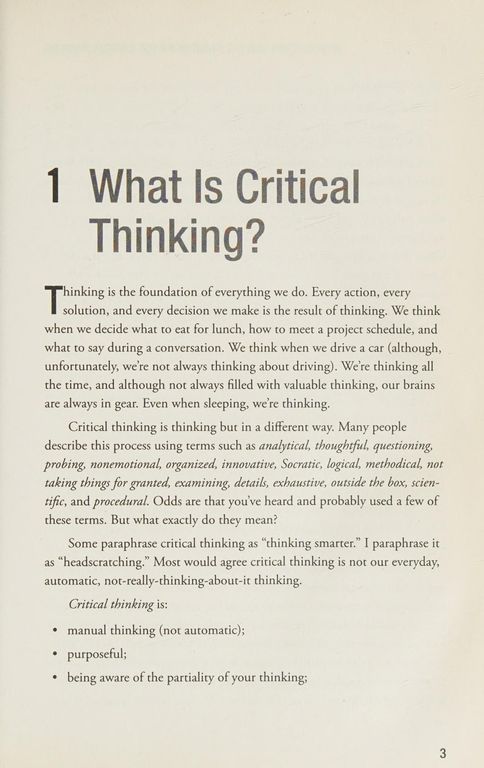
Nova: The first major concept Kallet hammers home is the distinction between automatic thinking and critical thinking. Automatic thinking is what we do 90% of the time—it’s fast, intuitive, and relies on mental shortcuts, or heuristics.
Nova: You nailed it. Kallet describes critical thinking as thinking. It’s purposeful. It’s the act of deliberately engaging your cognitive resources to analyze, evaluate, and construct an argument or solution. It’s not something that just happens; you have to choose to do it.
Nova: Absolutely. And Kallet would say you’ve just outsourced your decision-making to someone else’s confidence. He stresses that intelligence can be found and knowledge acquired, but critical thinking must be through practice.
Nova: Yes, he points to habits like actively seeking out disconfirming evidence—not just looking for proof that you’re right, but actively searching for reasons why you might be wrong. That’s a huge muscle to build.
Nova: It does. And that effort is the 'manual' part. Think about it like driving a stick shift versus an automatic. An automatic is easy, but when you need precise control on a steep hill, you need to manually engage the clutch and shift gears. Kallet is giving us the gears for complex problems.
Nova: That brings us perfectly to the heart of the book: the three-part framework that guides every critical thinking exercise.
Key Insight 2: The Framework for Structured Thought
The Three Pillars: Clarity, Conclusions, and Decisions
Nova: Kallet’s framework is deceptively simple, built around three core components: Clarity, Conclusions, and Decisions. But the order is everything, and the first step is the one most people skip entirely.
Nova: Precisely! He emphasizes that getting clear on the problem—defining the 'headscratcher,' as he sometimes calls it—is the absolute prerequisite. If you spend 80% of your time solving the wrong problem, the remaining 20% spent reaching a conclusion is useless.
Nova: It’s deeper than that. Clarity involves defining terms, understanding assumptions, and framing the question correctly. For example, instead of asking, 'How do we increase sales?' which is vague, Kallet encourages you to define sales,, and. It’s about eliminating ambiguity.
Nova: Yes, Conclusions is where you develop your arguments and evaluate the evidence supporting potential solutions. This is where you apply your critical evaluation skills to the data you’ve gathered, testing assumptions and looking for logical fallacies in your own reasoning.
Nova: Exactly. A weak foundation means the whole structure collapses. Now, the final pillar is Decisions. This isn't just picking the best conclusion; it’s about making a commitment based on the analysis, understanding the risks associated with that decision, and planning the next steps.
Nova: It is. And what makes Kallet’s approach so appealing is that he doesn't just give you this three-part structure; he provides the specific tools and exercises to strengthen each pillar. Let's look at how he translates this into real-world application.
Key Insight 3: Pragmatic Techniques for Skill Building
From Theory to Practice: Tools for Everyday Application
Nova: Kallet’s genius is in making the tools accessible. He focuses on techniques that can be integrated into daily work. One of the key takeaways mentioned in summaries is the focus on '3 Key Habits.' These habits are designed to rewire your automatic responses.
Nova: One powerful habit is related to questioning assumptions. Kallet encourages using techniques like the 'Five Whys'—a method popularized in quality control—but applying it to reasoning. When you form a conclusion, ask 'Why?' five times to drill down to the root assumption supporting that thought.
Nova: That’s the difference between a temporary fix and a true solution! Another practical tool he offers involves structuring arguments. He provides templates for clearly articulating a position, ensuring you explicitly state your evidence and how that evidence connects logically to your conclusion.
Nova: Absolutely. When you present a decision based on Kallet’s framework, you aren't just saying, 'I think we should do X.' You’re saying, 'Based on our clear definition of the problem, the evidence points overwhelmingly to Conclusion Y, which leads us to Decision X, with these identified risks.' It’s bulletproof.
Nova: While it’s applicable everywhere, his background in technology and business consulting means there are many examples related to product development, strategic planning, and resource allocation. The underlying principle is that any situation involving uncertainty and choice benefits from this structured approach.
Conclusion: The Power of Purposeful Thinking
Conclusion: The Power of Purposeful Thinking
Nova: We’ve covered a lot of ground today, moving from the idea that thinking is a muscle we must train, to the specific three-part framework that guides that training: Clarity, Conclusions, and Decisions.
Nova: And remember, this isn't about becoming a robot. Kallet’s goal isn't to eliminate intuition, but to ensure that intuition is informed by rigorous, manual examination when the problem demands it. It’s about having the to engage the higher-level thinking.
Nova: Exactly. Stop accepting automatic answers. Start demanding manual, purposeful thought. Michael Kallet’s 'Think Smarter' gives us the blueprint to build that disciplined, effective mind. It’s about training your brain to do more for you, one deliberate step at a time.