

Unlock Your Mind: The Power of First Principles Thinking for Founders
Golden Hook & Introduction
SECTION
Nova: What if the biggest obstacle to your next breakthrough isn't a lack of resources, but a surplus of assumptions? We're talking about the silent killers of innovation.
Atlas: Whoa, a surplus of assumptions? That's a bold claim, Nova. I think most founders I know are drowning in a of everything else! Time, money, sleep...
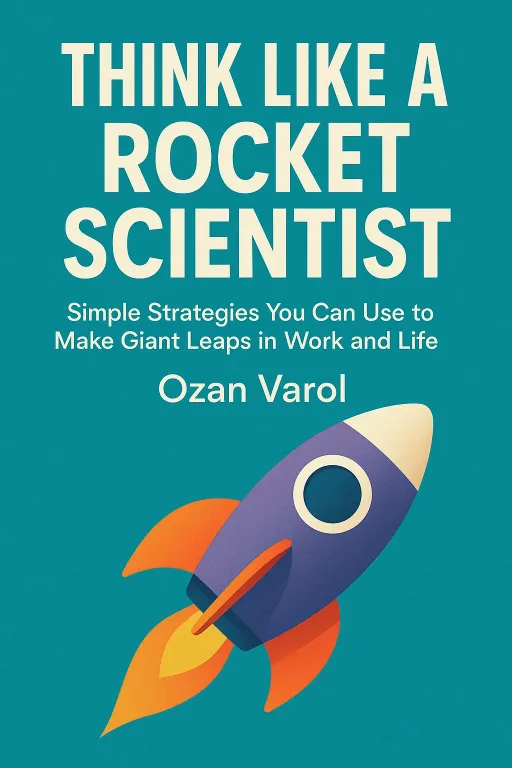
Nova: Precisely, Atlas! And today, we're diving into how to flip that script, how to turn those perceived limitations into launchpads for groundbreaking ideas. We're drawing inspiration from two intellectual heavyweights. First, 'Think Like a Rocket Scientist' by Ozan Varol, a former rocket scientist himself, and then 'Poor Charlie's Almanack' by the legendary Charlie Munger. These aren't just books; they're intellectual toolkits for anyone looking to truly innovate.
Atlas: A rocket scientist, huh? That already sounds like we're about to launch into something intense. So, how do these toolkits help us dismantle those 'silent killers' of innovation you just mentioned? Because for an early-stage founder focused on product growth, the killers feel pretty loud and immediate.
Nova: They do, don't they? And that's exactly where these approaches shine. They show us how to build up knowledge from scratch, like a scientist, and how to look at problems from every conceivable angle. We're going to start with that idea of building from scratch, what's often called First Principles Thinking.
First Principles Thinking: Deconstructing Problems to Their Core
SECTION
Nova: Imagine you're standing in front of a giant, tangled ball of yarn. Most people, when faced with a complex problem, try to untangle it from the outside, following existing threads, maybe cutting a few. First Principles Thinking says, "No, no, no. Stop. Let's melt this whole ball down to its original sheep wool, then re-spin it however we want."
Atlas: Melt it down to sheep wool? That's quite a visual, Nova. So, is this just fancy talk for 'common sense,' or is there a rigorous method to this madness? Because for a founder, 'common sense' often means 'what everyone else is doing,' which isn't always innovative.
Nova: It's definitely not common sense in the traditional way. It's about questioning the fundamental assumptions, the 'cold facts' beneath layers of conventional wisdom. Ozan Varol champions this, urging us to break down problems to their most basic truths, then reconstruct solutions without being limited by existing paradigms. The classic example, and it’s a brilliant one, comes from Elon Musk.
Atlas: Ah, Musk. Always the poster child for thinking differently. Tell me, how did he apply this to something tangible?
Nova: Well, when he was thinking about building electric cars with Tesla, or even rockets with SpaceX, one of the biggest hurdles was the cost of batteries. Everyone 'knew' batteries were incredibly expensive. The prevailing assumption was: "Electric cars will always be pricey because batteries are pricey."
Atlas: Right, that's the kind of 'known truth' that can stop a founder dead in their tracks. It's easy to just accept the industry standard.
Nova: Exactly. But Musk didn't accept it. He employed First Principles Thinking. Instead of asking "How can we make batteries cheaper?", he asked "What are batteries?" He broke them down to their elemental components: cobalt, nickel, aluminum, carbon, and polymers. He then calculated the raw material cost of these elements on the London Metal Exchange.
Atlas: So he literally looked at the ingredients list and their market price, rather than the finished product's price tag.
Nova: Precisely. And what he found was astonishing: the raw materials cost significantly less than the market price of a finished battery pack. This revealed a huge gap. The problem wasn't the inherent cost of the materials, but the of assembling them.
Atlas: That's incredible. So the cause was high battery cost, the process was deconstructing it to raw materials and their market value, and the outcome was realizing the manufacturing process was the actual bottleneck, not the materials themselves.
Nova: Exactly. That insight allowed him to then innovate the manufacturing process, leading to the creation of Gigafactories, and ultimately, far more affordable electric vehicles and even rockets. It's a powerful demonstration of building a solution from those absolute, fundamental truths.
Atlas: That sounds great for a billionaire with an army of engineers and a vision for Mars. But honestly, how does a bootstrapped early-stage startup apply 'thinking like a rocket scientist' to, say, a tricky product feature that users aren't adopting, or a team conflict that's stalling progress? It feels a bit... grandiose.
Nova: You know, that's a fair challenge, and it's where the beauty of First Principles Thinking truly lies: its universality. It’s not about the scale; it's about the mindset. For a product feature, instead of asking, "How can we make this feature more engaging?" ask, "What is the absolute core problem this feature is to solve for the user? And does the user even that problem, fundamentally?"
Atlas: Okay, so it’s stripping away the UI, the animations, the bells and whistles, and asking: what is the fundamental job this feature is hired to do, and is it doing it? Or is the job itself even valid?
Nova: Exactly. Or with a team conflict, instead of "How do we mediate this disagreement?", ask: "What are the fundamental, non-negotiable needs or values each person is trying to protect? What are the absolute truths of their individual motivations?" When you get to those bedrock elements, the solution often becomes much clearer, because you're addressing the root, not just the symptoms. It’s about intellectual honesty.
Multidisciplinary Mental Models: Broadening Your Perspective for Robust Solutions
SECTION
Nova: And speaking of seeing problems differently, that leads us perfectly to our second big idea: Charlie Munger's emphasis on multidisciplinary mental models. If First Principles is about digging deep, Munger is about looking.
Atlas: Looking wide? So, not just focusing on what competitors are doing, or what the latest tech trend is, but like, borrowing ideas from, I don't know, biology or ancient philosophy? That feels like a huge leap for a founder constantly pressed for time.
Nova: It is a leap, but a profoundly rewarding one. Munger's work stresses the importance of having a "latticework of mental models" from various fields. The idea is that by drawing from different disciplines – psychology, economics, physics, biology, history – you gain a broader perspective to analyze problems. This helps you avoid common cognitive biases that narrow your thinking. It's like having a superpower to see around corners.
Atlas: A superpower to see around corners. I like that! But give me an example, Nova. How does something like 'inversion' from mathematics help me build a better team, or 'compounding' apply to product growth beyond just finances? These sound like abstract concepts for concrete business problems.
Nova: Fantastic questions, Atlas, and they get to the heart of why this is so powerful. Let's take 'inversion.' It's a mathematical concept: instead of trying to figure out how to achieve X, you think about what would prevent X, or what would cause the opposite of X. So, for building a great team, instead of "How do I build a great team?", you invert it: "What would absolutely my team? What would make it dysfunctional and toxic?"
Atlas: Oh, I see! So, you list all the ways to fail spectacularly, and then you systematically avoid doing those things. That makes so much sense! It's almost easier to identify what to do than what do, sometimes.
Nova: Exactly. By focusing on avoiding failure, you often inadvertently steer yourself towards success. It's a powerful bias-buster. And for 'compounding,' beyond just financial interest, think about product growth. It's not just about acquiring users. It's about small, consistent improvements in your user onboarding, in your customer support, in your product's daily usability. Each tiny improvement might seem insignificant on its own, but over weeks, months, and years, they compound into massive user retention, loyalty, and organic growth.
Atlas: That's actually brilliant! So it's not about being an expert in everything, but having a toolkit of different lenses to view the same problem. It's like having multiple pairs of glasses, each revealing a different aspect of the landscape.
Nova: Precisely. It allows you to see patterns, make connections, and anticipate consequences that someone stuck in a single discipline might completely miss. It makes your solutions more robust and less susceptible to unforeseen pitfalls. It’s about building intellectual resilience.
Atlas: So, First Principles for digging deep and getting to the core truths, and Multidisciplinary Mental Models for looking wide and approaching problems from every conceivable angle. They really do sound complementary.
Synthesis & Takeaways
SECTION
Nova: They are absolutely complementary, Atlas. First Principles gives you the foundation, stripping away the noise to find the truth. Mental models give you the diverse frameworks to then build upon that truth in novel, resilient ways. Together, they equip you with the intellectual tools to dissect problems fundamentally, leading to novel and robust solutions that others might miss.
Atlas: So, if I'm an early-stage founder, feeling overwhelmed by competition or a stubborn problem in my product or team, how do I even begin to apply this without getting lost in philosophical debates? I mean, where do I start with this 'unlocking my mind' business?
Nova: That's the million-dollar question, and the beauty is, it starts with a tiny step. Pick one challenge in your business today – just one. Instead of thinking about how others solved it, or what the 'best practices' are, list its absolute fundamental truths. What are the undeniable, irreducible elements of this problem? Then, and only then, build a solution from those truths.
Atlas: That's actionable. It's about questioning the default, isn't it? Not just accepting 'this is how it's done' or 'this is how it's always been.' It sounds like it demands a certain level of courage.
Nova: It absolutely does. The courage to challenge your own assumptions, to look beyond the obvious, and to trust in the power of fundamental reasoning. It's about intellectual courage. The courage to truly unlock your mind.
Atlas: Well, Nova, you've definitely unlocked a few new neural pathways for me today. This has been incredibly insightful and surprisingly practical.
Nova: My pleasure, Atlas. And for all our listeners out there, keep questioning, keep building, and keep growing.
Atlas: This is Aibrary. Congratulations on your growth!









