The Art of Problem Solving: Unlocking Complex Challenges
Golden Hook & Introduction
SECTION
Nova: You know, Atlas, I was reading this wild statistic the other day. Apparently, a staggering percentage of people, when faced with a complex problem, will default to the very first solution that pops into their head, even if it's demonstrably terrible.
Atlas: Oh, I believe it. That's not just a statistic, that's practically my Tuesday mornings. My brain's first idea for breakfast is usually "more coffee," which, while delicious, isn't exactly a balanced meal. But come on, for serious problems? People actually do that?
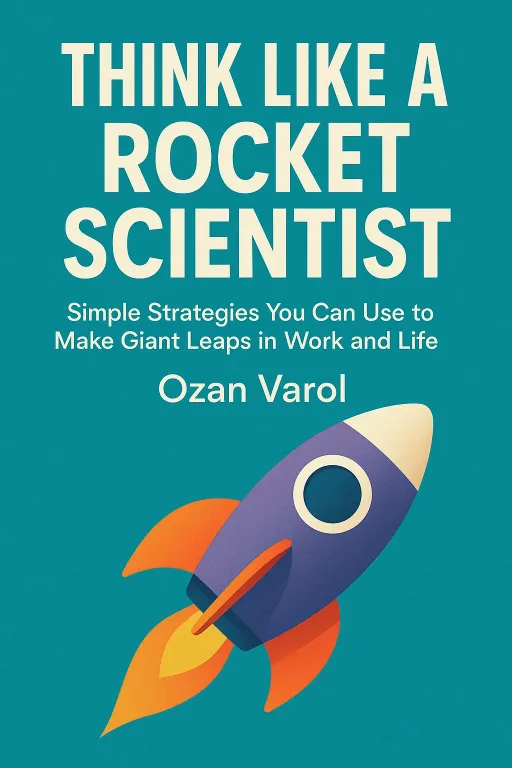
Nova: Absolutely. And it's why today we're diving into the art of truly unlocking complex challenges, drawing insights primarily from two phenomenal books: "Decisive" by the brilliant Chip and Dan Heath, and "Think Like a Rocket Scientist" by the incredibly insightful Ozan Varol. What's fascinating about the Heath brothers is their background in business and journalism, blending academic rigor with a knack for compelling storytelling, making their decision-making frameworks incredibly sticky.
Atlas: That's a great point. It's not just theory, it's practical. I've always admired how they simplify complex human behavior into actionable steps. And Varol, he's a former rocket scientist, right? You can feel that analytical precision in his work.
Nova: Exactly! Varol’s journey from building rockets for NASA to becoming a leading expert on innovation and decision-making gives his work an almost undeniable credibility. He literally applied first-principles thinking to the cosmos.
Atlas: So we're talking about moving beyond gut feelings and into something more structured, more resilient. That makes me wonder, what's the biggest pitfall people fall into when trying to solve a tough problem?
Nova: Well, that's where "Decisive" comes in, Atlas. The Heath brothers argue that our decision-making is plagued by four villains: narrow framing, confirmation bias, short-term emotion, and overconfidence. They call it the WRAP framework, which is a brilliant antidote to these villains.
The WRAP Framework - Widening Your Options
SECTION
Atlas: Okay, so "villains" of decision-making. That immediately piques my interest. It sounds like something out of a superhero movie. Let's start with this "narrow framing" one. What's the Heath brothers' take on that, and how does WRAP help?
Nova: Narrow framing is essentially thinking about a problem with too few options. It's the "either/or" trap, when there are usually dozens of "ands" or completely different paths. The 'W' in WRAP stands for "Widen your options." They tell a great story about a CEO deciding whether to sell his company or keep fighting. It felt like a binary choice, but a wise advisor pushed him to consider a third option: selling part of the company, or even acquiring a competitor.
Atlas: Oh, I love that. It’s like when I’m staring at my closet, convinced I have nothing to wear, when really I just need to combine things differently or, you know, do laundry. But for a CEO, that's a massive decision. How do you widen options when the stakes are so high and time is often limited?
Nova: That’s the beauty of it. They suggest techniques like using the "vanishing options test"—if you couldn't choose any of the current options, what would you do? Or looking for someone who has solved a similar problem. They talk about a medical clinic that was struggling with patient no-shows. Their initial thought was either to penalize patients or overbook appointments. Both felt wrong.
Atlas: Yeah, overbooking just sounds like a recipe for more frustration. And penalizing patients? That feels a bit heavy-handed for a clinic.
Nova: Exactly. But then they looked outside their industry. They found a hair salon that had almost zero no-shows because they required a small deposit that was forfeited if you missed the appointment, but applied to your next visit if you showed up. The clinic adapted this, requiring a small, refundable deposit for appointments, and their no-show rate plummeted. They didn't just solve their problem; they learned from an entirely different context.
Atlas: That’s brilliant! It’s like breaking out of your own industry echo chamber. I imagine a lot of our listeners in strategic planning roles could really benefit from that. It’s easy to get tunnel vision when you’re deep in the weeds of your own operations.
Reality-Testing Assumptions & Attaining Distance
SECTION
Nova: That leads us right into the 'R' in WRAP: "Reality-test your assumptions." We often make decisions based on what we will happen, without actually checking. The Heath brothers highlight how easy it is to fall into confirmation bias, where we only seek out information that validates our existing beliefs.
Atlas: Oh, tell me about it. My social media feed is basically a masterclass in confirmation bias. So how do you effectively reality-test things without getting bogged down in endless research?
Nova: One powerful technique they suggest is "oochems." It’s not an acronym, just a funny word for running small, low-cost experiments to test your assumptions. For example, a restaurant owner might a new menu item will be a hit, but instead of launching it big, they could try it as a special for a week and get feedback. Or, more dramatically, they talk about a CEO who was convinced his company needed to buy expensive new software. Instead of committing fully, he arranged a trial, and it quickly became clear the software was a terrible fit.
Atlas: So, basically, don't bet the farm on an untested hypothesis. Try a tiny step first. That's incredibly practical. And what about the 'A' in WRAP? "Attain distance before deciding." That sounds like a fancy way of saying "sleep on it."
Nova: It’s more profound than just sleeping on it, though that helps! It’s about stepping back from short-term emotion. They suggest asking yourself, "What would I tell my best friend to do?" or "How would I feel about this decision 10 minutes, 10 months, or 10 years from now?" It forces you to detach from the immediate emotional intensity and gain perspective.
Atlas: That’s a powerful reframing. I know I’ve made some decisions in the heat of the moment that I later regretted. It’s like you’re trying to prevent your emotional brain from hijacking your rational one.
Think Like a Rocket Scientist - Questioning Assumptions
SECTION
Nova: And this is where Ozan Varol’s "Think Like a Rocket Scientist" perfectly complements "Decisive." Varol pushes us to question assumptions at a fundamental level, which is exactly what you need to do to reality-test properly and attain distance. He argues that rocket scientists don't just solve problems; they invent solutions to problems that haven't been solved before, by constantly asking "why" and "what if."
Atlas: So, it's not just about solving problem, but solving the problem, and maybe even designing a completely new way to approach it. That sounds incredibly challenging, especially for those of us who aren't, you know, launching things into space.
Nova: But that’s the magic! Varol says we all have a bit of a rocket scientist in us. It’s about first-principles thinking: breaking a problem down to its most basic, fundamental truths, and then building up from there. He talks about how NASA engineers, when faced with a seemingly impossible challenge, don't start with "how can we fix this existing component?" They start with "what is the absolute core function we need to achieve, and what are all the possible ways to achieve it, even if they seem absurd?"
Atlas: That makes me think of Elon Musk’s approach to building rockets, right? He looked at the cost of existing rockets and instead of trying to optimize within that cost structure, he asked, "What are the raw materials and labor costs?" and designed from there.
Nova: Exactly! That’s a classic example of first-principles thinking. Varol emphasizes that this means embracing uncertainty, being comfortable with not knowing the answer, and being willing to fail, or as he puts it, "launching moonshots." He shares stories of how NASA’s early failures were not seen as dead ends, but as crucial data points that informed the next attempt. They "prepared to be wrong," which is the last 'P' in the Heath brothers' WRAP framework.
Atlas: So "Prepare to be wrong" isn't about setting yourself up for failure, it's about building resilience and having a contingency plan. It’s like expecting turbulence on a flight, not because you it, but because you know it's a possibility and you’re ready for it.
Nova: Precisely. It’s about pre-mortems, where you imagine your decision has failed and then work backward to figure out why. Or setting tripwires, which are signals that tell you when it’s time to change course. Both books, in their own ways, are challenging that very human tendency to stick to our initial beliefs, even in the face of contradictory evidence. They're asking us to be more strategic, more resilient, and more innovative in how we approach every challenge.
Synthesis & Takeaways
SECTION
Atlas: This has been incredibly insightful, Nova. It feels like both "Decisive" and "Think Like a Rocket Scientist" are pushing us to move beyond just reacting to problems and instead proactively designing better solutions. It’s about building a strategic mind.
Nova: Absolutely. The core of our podcast today is really an exploration of how systematic thinking, critical questioning, and a willingness to challenge the status quo can transform how we tackle any complex issue. It's not about finding the perfect answer immediately; it's about building a robust process that leads to better outcomes, even if it means iterating through some "failures" along the way.
Atlas: I can see how applying the WRAP framework from "Decisive" could immediately impact strategic planning for our listeners. Just widening options and reality-testing assumptions before a major decision could save so much heartache. And then, taking a "first-principles" approach from "Think Like a Rocket Scientist" to deconstruct a problem to its fundamental truths, that’s going to be transformative.
Nova: It’s about continuous refinement. Perfection is a myth, but progress is incredibly real. We’re inviting our listeners to dedicate just fifteen minutes daily to reflect on what they’ve learned and how they can apply these powerful frameworks.
Atlas: That’s a great call to action. It’s not just about listening and learning, it’s about applying. I’m curious, for our listeners who are facing a truly intractable problem right now, what’s one deep question they should ask themselves after hearing this?
Nova: I think the most important question is this: "Where in your current work or personal life are you making a decision based on the option that came to mind, or an untested assumption, and what would it look like to apply the full WRAP framework, or even a first-principles breakdown, to that very challenge?"
Atlas: Powerful stuff. It shifts the focus from "what's the answer?" to "what's my process?" This is Aibrary. Congratulations on your growth!