

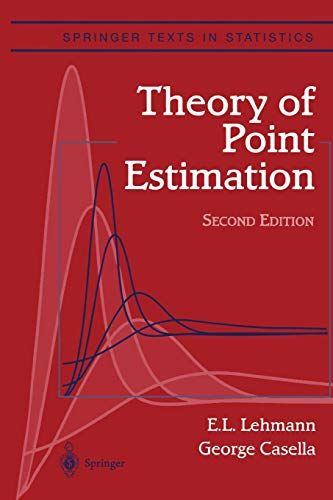
Theory of Point Estimation
Introduction
Nova: Imagine you're a PhD student in statistics. You're sitting in a crowded lecture hall, and the professor walks in carrying a single, well-worn book with a bright yellow cover. She sets it on the podium and says, "This is the book. If you master this, you understand the foundations of statistical inference." That book — published first in 1983 and then expanded in 1998 — is "Theory of Point Estimation" by Erich L. Lehmann and George Casella. Over eleven thousand citations. A standard on PhD qualifying exams for decades. And today, we're going to explore what makes it so extraordinary.
Nova: Fair question. Point estimation is one of the most fundamental tasks in statistics. You have data, and you want to estimate some unknown number — a single value, a "point" — based on that data. Like, what's the average height of all adults in a country based on a random sample of a thousand people? What's the effectiveness of a new drug? The book tackles the deep theory behind how to do that well and what "doing it well" even means.
Nova: Exactly. And this book is special because it synthesizes decades of statistical thinking — from the Neyman-Pearson-Wald school — into a single, unified, rigorous framework. It's the capstone of what we now call classical statistics. And behind it is an remarkable personal story — an author who fled Nazi Germany, arrived in America without an undergraduate degree, and went on to become one of the most influential statisticians of the twentieth century.
Erich L. Lehmann's Remarkable Journey
The Man Behind the Book
Nova: Let's start with Erich Leo Lehmann himself. He was born in 1917 in Strasbourg, which was then part of the German Empire. His family was of Ashkenazi Jewish ancestry, and they lived in Frankfurt — until 1933, when the Nazis came to power. The family fled to Switzerland.
Nova: He went to Trinity College, Cambridge, studied mathematics for two years, and then emigrated to the United States in 1940. Here's the incredible part: he enrolled at UC Berkeley as a graduate student without even having an undergraduate degree. By 1946, he had a PhD under Jerzy Neyman — one of the founding fathers of modern statistics.
Nova: Pretty much. He taught there from 1942 onward, with brief stints at Columbia, Princeton, and Stanford. He got three Guggenheim Fellowships — three — which is extraordinary. He was elected to the American Academy of Arts and Sciences and the National Academy of Sciences. He served as president of the Institute of Mathematical Statistics.
Nova: Yes — that's arguably his most famous contribution. The Lehmann-Scheffé theorem, developed with Henry Scheffé in the 1950s, gives a recipe for finding the best possible unbiased estimator. If you have a complete sufficient statistic and any unbiased estimator, you can condition that estimator on the statistic and get the unique uniformly minimum-variance unbiased estimator — the UMVUE. It's one of the crown jewels of classical estimation theory. He's also the Lehmann in the Hodges-Lehmann estimator, a robust nonparametric method.
Nova: Exactly. The 1983 first edition was his solo work — a synthesis of the Neyman-Pearson-Wald tradition. Then in 1998, Lehmann, then in his eighties, collaborated with George Casella — already a star in his own right — to produce the second edition. That collaboration added about a hundred pages of new material, including Bayesian methods, hierarchical Bayes, empirical Bayes, and the fascinating world of shrinkage estimation.
How the Book Is Structured
The Architecture of Optimal Estimation
Nova: Here's what's brilliant about this book's architecture. Instead of organizing by statistical method — here's maximum likelihood, here's method of moments — Lehmann organized it around optimality criteria. Each chapter asks: under what principle can we declare an estimator "best"?
Nova: The book has six chapters, and the middle four each tackle a different optimality principle. Chapter 2 is unbiasedness — can we find an estimator whose expected value hits the true parameter exactly? Chapter 3 is equivariance — does the estimator behave properly when we transform the data? Chapter 4 covers average risk optimality, which introduces Bayesian thinking. And Chapter 5 tackles minimaxity and admissibility — the deepest and most surprising material in the book.
Nova: We'll get there, but let me just tease it: Chapter 5 is where you encounter Stein's paradox, which stunned the statistics world when it was discovered in 1956. Under certain conditions, the sample mean — which feels like the most natural estimator in the world — is actually inadmissible. You can do better by shrinking your estimates toward zero.
Nova: Not when you're estimating three or more parameters simultaneously. Charles Stein proved this in 1956, and Willard James and Charles Stein then constructed an estimator that dominates the sample mean. It was a genuine shock to the statistical community. The book covers this in beautiful detail in Chapter 5.
Nova: Right. Chapter 6 is about asymptotic optimality — what happens as your sample size grows to infinity. It covers maximum likelihood estimation asymptotics, efficiency, and even the strange world of superefficient estimators. The second edition also added material on the Hájek-Le Cam local asymptotic theory. The first four chapters give you exact small-sample theory. The last two give you large-sample approximations. Together they form a complete picture.
UMVUE, Cramér-Rao, and the Lehmann-Scheffé Theorem
Key Ideas That Changed Statistics
Nova: Let's dig into some of the core ideas the book develops. Early on, in Chapter 1, Lehmann lays the groundwork: measure theory, exponential families, group families, sufficient statistics, convex loss functions. It's the toolbox you need before the real work begins.
Nova: Unbiasedness is intuitive — on average, your estimator should hit the target. But finding an unbiased estimator isn't enough. You want the one with the smallest variance. The book develops the theory of UMVU estimators — uniformly minimum-variance unbiased estimators. And the key tool is the Lehmann-Scheffé theorem.
Nova: Exactly. The theorem says: if you have a statistic that is both sufficient — meaning it captures all the information about the parameter — and complete, then any unbiased estimator that's a function of that statistic is automatically the unique best unbiased estimator. It's an elegant, powerful result that ties together sufficiency, completeness, and optimality.
Nova: The Cramér-Rao information inequality. It gives a lower bound on the variance of any unbiased estimator. If your estimator achieves that bound, you know it's optimal. The second edition expanded this with new developments on the information inequality, including multiparameter extensions. The book gives you the information matrices for common distributions — normal, Poisson, binomial, exponential — so you can compute these bounds in practice.
Nova: Equivariance captures the idea that your estimator should respect the structure of your problem. If you're measuring temperature and someone switches from Celsius to Fahrenheit, your estimation procedure should transform accordingly. The book applies this to location-scale families, normal linear models, and exponential linear models. It's a beautiful framework that exploits symmetry and group structure to derive optimal estimators.
Nova: Right. And what's remarkable is that these different lenses — unbiasedness, equivariance, Bayes, minimaxity — often point to the same estimator in nice problems. The book shows how these optimality criteria converge in exponential families and group families, which cover a vast range of practical statistical models.
How the Second Edition Modernized a Classic
The Bayesian Revolution and Shrinkage
Nova: The biggest change from the first to the second edition in 1998 was the expansion of Bayesian thinking. The first edition had a sparse treatment of Bayesian inference. The second edition added entire new sections on equivariant Bayes, hierarchical Bayes, and empirical Bayes.
Nova: Because Bayesian methods had surged in importance between 1983 and 1998. Computational advances — particularly Markov chain Monte Carlo — made Bayesian analysis practical for complex problems. Lehmann and Casella recognized this and gave Bayesian estimation a proper theoretical treatment within the book's optimality framework.
Nova: Yes! Hierarchical Bayes and empirical Bayes provide a natural framework for understanding why shrinkage works. Take the James-Stein estimator. You're estimating several parameters — say, the batting averages of eighteen baseball players. The naive approach is to use each player's individual average. But the James-Stein estimator shrinks everyone's estimate toward the grand mean. Counterintuitively, this gives you lower total expected squared error.
Nova: Exactly. It's like saying: "I know this player hit.350 this season, but most players regress toward the mean, so I should adjust that downward a bit." The book provides the rigorous theory for this, including risk calculations and extensions beyond the normal case. Chapter 5 also presents a fascinating table — Table 5.5.2 — showing the expected value of the shrinkage factor under different parameter configurations.
Nova: Absolutely. Shrinkage and regularization are central to modern statistics and machine learning. Ridge regression, lasso, random effects models — they all borrow strength from the group in this same spirit. The theoretical foundations laid out in this book underpin much of what practitioners do today with high-dimensional data.
The Book That Defined a Generation of Statisticians
Legacy and Why It Still Matters
Nova: So what's the legacy of this book? Let me quote from a 2013 special issue of CHANCE magazine honoring George Casella. The article states that "for generations of statisticians, Theory of Point Estimation defined the core of statistical theory. Passing a qualifying exam meant mastering this book."
Nova: Right. William Strawderman, a prominent Rutgers statistician, wrote that teaching from Lehmann and Casella was "pretty much my favorite course and my favorite book." The book is demanding — it assumes a strong background in calculus, linear algebra, and mathematical statistics. It's not for beginners. But for those ready for it, it provides a rigorous, unified, and surprisingly readable account of classical estimation theory.
Nova: Casella was already a major figure — his earlier book "Statistical Inference" with Roger Berger had become the standard introductory graduate text. He and Lehmann had a deep mutual respect. The second edition of "Theory of Point Estimation" grew from 500 to about 600 pages, with roughly 25% of the references being post-1983. Casella brought fresh perspective while Lehmann provided the deep architectural vision.
Nova: Yes — "Testing Statistical Hypotheses." Between those two volumes, you have a complete account of classical frequentist statistics. Estimation and testing, two sides of the same coin, each given the same rigorous, criterion-based treatment.
Nova: They should have completed a solid course in theoretical statistics — something like Casella and Berger's "Statistical Inference." They need comfort with measure-theoretic probability, though the book provides a sketch of what's needed. They need patience — the problems are famously challenging. But the reward is a deep understanding of why statistical methods work the way they do, and what it even means for one estimator to be better than another.
Nova: Absolutely. It's not a book you breeze through. It's a book you wrestle with. And in doing so, you join a lineage of statisticians stretching back through Lehmann to Neyman, through Neyman to Pearson and Fisher. You're learning the discipline the way it was built — from first principles.
Conclusion
Nova: So let's pull this together. "Theory of Point Estimation" by Erich L. Lehmann and George Casella is more than a textbook. It's the definitive synthesis of classical point estimation theory, organized around the beautiful question of what makes an estimator optimal. From unbiasedness and UMVU estimation through the Lehmann-Scheffé theorem, through equivariance and Bayesian methods, to the startling world of shrinkage and Stein's paradox — the book takes you on a journey through the intellectual architecture of statistical inference.
Nova: It really is. Lehmann died in 2009 at age 91, and Casella tragically passed in 2012 at only 61. But their book endures — still on PhD syllabi, still cited thousands of times, still the standard by which other theoretical statistics texts are measured. If you want to understand not just how to estimate things, but why estimation theory works the way it does — this is the book.
Nova: Exactly. The James-Stein estimator is waiting to surprise you.
Nova: It really is. And that's what makes great books great — they're not just containers of information. They're the life's work of brilliant people, shaped by the questions that drove them.