

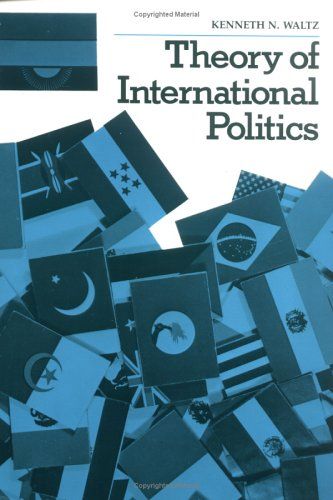
Theory of international politics
Introduction
Nova: Imagine this: it's 1979, and a relatively obscure political science professor publishes a book that doesn't just contribute to his field — it fundamentally rewires how an entire generation of scholars thinks about war, peace, and power. That book is Theory of International Politics by Kenneth Waltz, and here's the wild part: it's still the single most assigned book in International Relations graduate programs across the United States, decades later. John Mearsheimer calls it one of the three most influential realist works of the entire twentieth century.
Nova: Absolutely, and that's exactly what makes his intervention so fascinating. Before Waltz, the dominant realist thinkers — people like Hans Morgenthau — tended to explain international conflict by pointing to human nature. People are selfish, power-hungry, flawed, so states go to war. But Waltz looked at that and essentially said: that's not quite right, or at least it's not enough. Because if human nature is the cause, why do peaceful periods ever happen? Why do states with completely different leaders, cultures, and ideologies — democracies and dictatorships alike — often behave in strikingly similar ways on the world stage?
Nova: Exactly. He argued we need to stop staring so intently at the individual units — the states themselves, their leaders, their regimes — and instead look at the structure they inhabit. The international system itself, he claimed, has a kind of invisible architecture that constrains and shapes what states can do, regardless of who's in charge. It's like a game board that limits the moves available to every player, no matter their personality or intentions. That shift — from unit-level to system-level thinking — is the intellectual earthquake that Theory of International Politics set off, and it's what we're going to unpack today.
Key Insight 1: Levels of Analysis
The Three Images of War
Nova: Great place to start. In fact, Waltz himself laid the groundwork in an earlier book from 1959 called Man, the State, and War. In that book, he identified what he called three "images" — three different levels at which you can try to explain why war happens. The first image locates the cause in human nature and individual leaders — think of explanations that say "this war happened because of Hitler's ambition" or "because humans are innately aggressive." The second image looks inside states — their regime type, their economic system, their internal politics. So a second-image explanation might say "democracies don't fight each other" or "this country went to war to distract from domestic unrest."
Nova: The third image looks at the international system itself — the fact that there is no world government, no higher authority above states. This is what Waltz calls anarchy, and I should clarify right away: he doesn't mean chaos and disorder. He means quite precisely the absence of a central governing authority. In domestic politics, you have hierarchy — the government sits above citizens and can enforce laws. Internationally, no such thing exists. There is no 911 you can call if one state invades another. And Waltz's crucial move in Theory of International Politics was to argue that this third image — the systemic level — provides the most powerful and parsimonious explanations for recurring patterns in world politics.
Nova: It really is. Waltz had a deep commitment to theoretical elegance. He didn't want a theory that needed to add new variables every time something unexpected happened. He wanted a lean, rigorous framework. And his argument was that by focusing on the system's structure — rather than on the endless variety of leaders, cultures, and domestic regimes — you could explain why, across centuries and continents, states keep doing similar things: balancing against powerful rivals, forming alliances, competing for security. As Waltz put it, "if the same effects follow from different causes, then constraints must be operating on the independent variables."
Nova: Exactly. And that's the move from what he called "reductionist" theories — which try to explain everything by looking at the parts — to a truly systemic theory.
Key Insight 2: The Three Elements of Structure
The Architecture of Anarchy
Nova: Waltz identifies three essential elements that define any political structure, domestic or international. First, the ordering principle. In domestic politics, that principle is hierarchy — there's a chain of command, a constitution, a legal framework. But internationally, the ordering principle is anarchy — no central authority above states. Second, the differentiation of units. Domestically, units are highly specialized — legislatures make laws, courts interpret them, the military provides defense. But in international anarchy, states are functionally undifferentiated. Every state has to do the same basic things for itself: provide security, raise revenues, defend its borders. No state can outsource its survival.
Nova: Functionally, yes. And that's one of his most provocative claims. He's not saying France and North Korea are identical in every way — obviously they're not. But he's saying that in the international system, every state faces the same fundamental imperative: survive. And because there's no higher authority to protect them, they all have to perform the same core functions. This is what Waltz means when he says anarchy "entails relations of coordination among a system's units, and that implies their sameness."
Nova: The distribution of capabilities. This is where states do differ. Some states are vastly more powerful than others — they have larger economies, bigger militaries, more advanced technology, more population. And Waltz argues that while capabilities are attributes of individual units, the distribution of capabilities across all units is a systemic property. It's a positional picture — who stands where relative to whom. And changes in that distribution are what transform the international system. Waltz famously said that students of international politics "make distinctions between international-political systems only according to the number of their great powers." That's it. That's the variable.
Nova: Precisely, and that's where we're headed next.
Key Insight 3: Bipolarity, Balancing, and the Stability Puzzle
Why Two Is Better Than Five
Nova: That's the intuitive view, and it's exactly what Waltz challenges. He makes a series of arguments for why bipolar systems — like the Cold War with just the US and the Soviet Union — are actually less war-prone than multipolar systems, like pre-World War I Europe with its five or six great powers. The reasoning is fascinating. In a bipolar system, the two great powers can focus almost entirely on each other. They know who the threat is. They don't have to worry much about alliance partners defecting, so their strategies can be flexible. And crucially, balancing happens internally — each superpower builds up its own capabilities rather than relying on shifting coalitions.
Nova: In multipolarity, balancing happens externally — through alliances. And alliances in a multipolar world are dangerous precisely because they're flexible. Partners can defect. States have to woo each other, adapt to each other, and constantly worry about being abandoned. Waltz points to the alliance between France and Russia in 1894 — these were radically different regimes that had to make themselves appear more similar just to form the partnership. In a crisis, Waltz argues, the weaker partner in an alliance tends to determine policy, because the stronger partner is more afraid of losing them. And all those shifting allegiances create immense uncertainty. The flexibility of alliances, Waltz says, makes for rigidity in strategy — you can't pivot easily when you're constantly managing a coalition.
Nova: Waltz would point to World War I as a catastrophic failure of multipolar management — a system of shifting alliances that produced rigid mobilization plans and a war nobody seemed able to stop. The Cold War, by contrast, despite being terrifying in its own way, never escalated into direct superpower conflict. Now, critics obviously push back hard on this. They note that the Cold War saw plenty of proxy wars — Korea, Vietnam, Afghanistan — that killed millions. But Waltz's point is about great power war specifically. He also made the controversial argument that the slow spread of nuclear weapons could actually enhance stability by making war between nuclear-armed states unthinkably costly.
Key Insight 4: Critiques, Counterarguments, and Enduring Legacy
The Great Debate
Nova: A tremendous amount, and from multiple directions. Let me walk through the biggest lines of attack. First, neoclassical realists like Gideon Rose argued that Waltz stripped away too much. By treating states as "black boxes" and ignoring domestic politics, regime type, leadership, and ideology, you lose a lot of predictive power. The peaceful end of the Cold War is the classic example — neorealism, with its static structural focus, simply didn't see it coming. The Soviet Union didn't collapse because of a shift in the distribution of capabilities; it collapsed largely due to internal factors that Waltz's framework had deemed irrelevant.
Nova: That's exactly the charge. A second major critique came from neoliberals like Robert Keohane, who accepted Waltz's starting assumptions — anarchy, self-interested states — but reached very different conclusions. Keohane argued that international institutions can meaningfully alter state behavior by reducing uncertainty, lowering transaction costs, and making cooperation rational even under anarchy. Waltz had dismissed institutions as largely epiphenomenal — creations of powerful states that don't independently shape outcomes.
Nova: Yes, the constructivist critique is perhaps the most fundamental. Alexander Wendt, in what became a famous phrase, argued that "anarchy is what states make of it." Waltz treats anarchy as a fixed structural condition that always produces the same logic of self-help and security competition. But Wendt says that's wrong — how states interpret anarchy depends on shared ideas, norms, and identities. The US and Britain today are both nuclear-armed states in an anarchic system, but neither fears invasion by the other. The structure didn't change; their shared understanding of their relationship did.
Nova: Here's the thing: despite all the criticism, neorealism remains a foundational reference point — the baseline that almost every other theory defines itself against. And in certain domains, its insights remain remarkably sharp. Look at the US-China rivalry today. As China's capabilities grow relative to America's, we're seeing exactly the kind of security competition, balancing behavior, and alliance tightening that Waltz's framework would predict. The structural logic he identified — that rising powers and established powers will experience friction — is playing out in real time. Even critics have to engage with the core question Waltz posed: how does the structure of the international system constrain what states can do?
Conclusion
Nova: I'd say it's this: you cannot understand international politics by only looking at individual states and their leaders. There is a system out there — defined by anarchy and the distribution of power — that operates according to its own logic, and it socializes states, rewards certain behaviors, punishes others, and produces recurring patterns that span centuries. Waltz gave the field a language for talking about that system with rigor and parsimony. He asked scholars to stop piling up ad hoc explanations for every conflict and instead look for the deeper structural forces at work.
Nova: When you read about China building up its navy or NATO expanding or Iran pursuing nuclear capabilities, you can ask the Waltzian question: is this behavior being driven by the internal characteristics of these states — their leaders, their ideologies, their domestic politics — or is it being driven by the structural pressures of an anarchic system where no one can ultimately guarantee anyone else's security? Waltz would say that even if you changed the regime, the structural pressures would remain. That doesn't mean he's always right — plenty of evidence suggests he underestimated cooperation and domestic factors — but the question itself is indispensable. It forces you to look beyond the personalities and see the deeper chessboard.
Nova: Beautifully put. And that's exactly the enduring provocation of Theory of International Politics — a book that, nearly half a century later, still sets the terms of the debate. This is Aibrary. Congratulations on your growth!