

The Clash of Gods: How Belief Shapes Empires and Conflict.
Golden Hook & Introduction
SECTION
Nova: Imagine you're watching a chess game, right? Two grandmasters, locked in a battle of wits. You see the knights, the rooks, the queens moving, but what if I told you the game isn't happening on the board? What if the players' deepest beliefs, their entire worldview, are dictating every move, every strategy, in ways they might not even consciously realize?
Atlas: Oh, I love that! Like, the board is just the symptom, and the actual conflict is playing out in their very souls. That’s a powerful image, Nova. It makes me think about how often we look at the surface, you know? We see the headlines, the policy debates, the economic shifts, and we think we understand the game. But what if the deepest roots are completely hidden from plain sight?
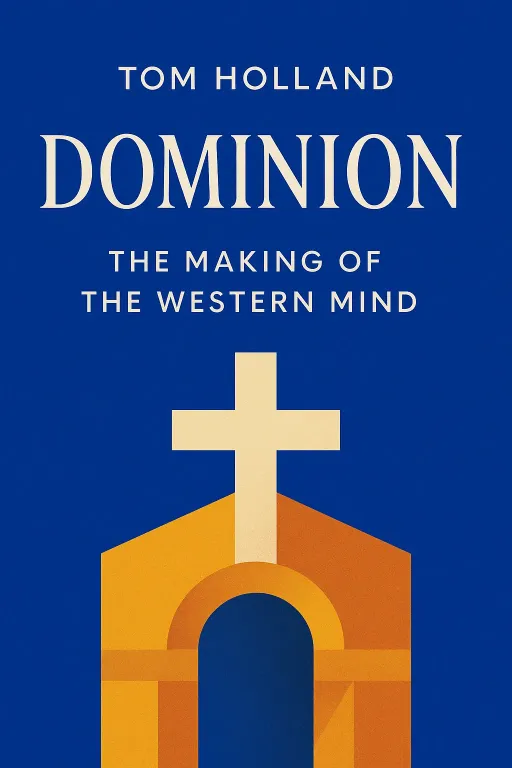
Nova: Exactly! And that's precisely what we're dissecting today. We’re pulling back the curtain on the profound, often unseen influence of belief systems on power, empires, and conflict. Our guide for this journey is a blend of two incredibly insightful works: Tom Holland's "Dominion," which brilliantly traces Christianity's profound impact on Western thought, and Huston Smith's "The World's Religions," a comprehensive and empathetic overview of major global traditions. Holland, a celebrated historian with a knack for making ancient history feel incredibly relevant, brings a unique perspective, often lauded for his ability to connect historical dots that others miss. Smith, on the other hand, was a philosopher and religious scholar who dedicated his life to understanding and presenting world religions with incredible depth and respect, earning widespread acclaim for making complex spiritual ideas accessible.
Atlas: So, we’re not just talking about explicit religious wars, then. This is much deeper. It sounds like we're exploring the very DNA of our political systems, seeing how spiritual and philosophical frameworks are embedded in everything, from our laws to our ideas about justice. It makes me wonder, how much of contemporary geopolitical tension is rooted in historical religious or philosophical differences, rather than purely economic or political ones? Because, honestly, as someone who tries to dissect global affairs, I often default to the economic or strategic explanations.
Nova: That's the deep question, isn't it? And it’s where we begin. We often assume that modern political ideologies exist in a secular bubble, detached from ancient spiritual roots. But what if that's a fundamental misunderstanding?
The Spiritual Architecture of Power
SECTION
Nova: Let’s start with what we're calling 'The Spiritual Architecture of Power.' Tom Holland, in "Dominion," makes a compelling, almost provocative argument: that even our most secular Western ideas—things like human rights, equality, compassion for the weak—are not self-evident truths of reason, but rather direct inheritances from Christianity. He posits that Western secularism isn't an from Christianity, but rather its.
Atlas: Wait, are you saying that even atheists in the West are, in a sense, living by Christian values without realizing it? That sounds like a big claim, Nova. I imagine many would push back on that, especially those who see secularism as a deliberate rejection of religious doctrine.
Nova: It's definitely a bold claim, and it's one that has sparked considerable debate among historians and theologians alike, though many critics acknowledge his meticulous research. Holland argues that the very concepts we use to critique religion, like individual liberty or universal human rights, were forged in the crucible of Christian thought. Think about it: the idea of a universal human dignity, that every individual, regardless of status, possesses inherent worth, finds its most powerful early expression in Christian theology—the idea that every person is made in the image of God. Before that, in the Roman world, for example, the concept of 'rights' was often tied to citizenship and social standing. Slaves had no rights. The weak were often disposable.
Atlas: That's a fascinating point. So, the concept of universal human rights, which we now take for granted as a global ideal, isn't some default setting for humanity? It actually has a very specific, historically contingent origin point? Like, if you look at ancient civilizations, even some of the most advanced ones, the idea of universal human dignity wasn't necessarily a widespread operating principle.
Nova: Exactly. Holland illustrates this with vivid historical narratives. Consider the early Christian martyrs, who chose death over renouncing their faith. Their defiance, their belief in an authority higher than Caesar, introduced a revolutionary idea into a world where the state was supreme. This wasn't just about personal piety; it was a profound political act that chipped away at the absolute power of emperors, laying groundwork for future challenges to state authority. It's like a tiny, almost imperceptible crack that eventually fractures a massive wall.
Atlas: That’s incredible. So, the act of martyrdom wasn't just a religious statement, it was a political blueprint for future resistance and the eventual assertion of individual conscience against state power. I can see how that would resonate with anyone who’s ever questioned authority or fought for a cause they believe in, even in a completely secular context.
Nova: Absolutely. And it extends to things like charity and care for the poor. The Roman world had patronage, where the wealthy supported their clients, but Christian charity introduced the idea of caring for in need, regardless of their social standing or whether they could offer anything in return. Hospitals, orphanages, systematic care for the vulnerable—these institutions, which we now consider fundamental to a civilized society, have deep Christian roots.
Atlas: I’ve been thinking about this a lot lately. It’s like these foundational spiritual ideas have become so ingrained, so much a part of the water we swim in, that we don’t even see them anymore. They're just 'common sense' or 'human nature.' But you're arguing they're actually cultural constructs, deeply shaped by a specific historical belief system.
Nova: Precisely. And this isn't just a historical curiosity. It means that when Western nations engage in geopolitical discussions, or even conflicts, their underlying assumptions about justice, human value, and the purpose of governance are still, often unconsciously, informed by these spiritual architectures. It shapes their foreign policy, their interventionist impulses, their ideas about what constitutes a 'good' or 'bad' regime.
The Enduring Clash of Civilizational Belief Systems
SECTION
Nova: And that naturally leads us to the second key idea we need to talk about: the enduring clash of civilizational belief systems. While Holland focuses on the Western context, Huston Smith's "The World's Religions" offers a comprehensive lens on how different major religious traditions—Hinduism, Buddhism, Islam, Judaism, and others—provide distinct conceptual frameworks for understanding the world, ethics, and communal life.
Atlas: So, if the West has this Christian undercurrent, what about other major civilizations? Are their political and social structures similarly shaped by their dominant spiritual traditions? And how do these different 'spiritual architectures' interact, or clash, on the global stage?
Nova: That's the crux of it. Smith emphasizes that these religions aren't just sets of rituals; they are complete worldviews that answer fundamental questions: What is reality? What is a human being? What is the purpose of life? And critically, what is justice, and how should society be ordered? For example, in Islamic traditions, the concept of 'Ummah,' the global Muslim community, is a powerful force that transcends national borders, creating a different kind of political imagination than, say, the atomized individual focus that emerged in the West.
Atlas: That makes me wonder about the concept of sovereignty. If you have a strong idea of a global spiritual community, how does that interact with the modern, Westphalian idea of nation-state sovereignty? Because that seems like a direct point of tension in many geopolitical hotspots.
Nova: Absolutely. Take the concept of law. In many Islamic societies, Sharia law is not merely a legal code; it's seen as divinely revealed, a comprehensive guide for all aspects of life, including governance. This contrasts sharply with the Western idea of secular law, which is human-made and subject to democratic amendment. When these two systems meet, or clash, in a geopolitical context, it’s not just a disagreement over policy; it’s a fundamental divergence in what constitutes legitimate authority and the source of truth.
Atlas: That’s a perfect example. We often hear about economic sanctions or territorial disputes, but beneath that, there’s this deeper philosophical chasm about the very nature of governance and society. It means that understanding geopolitics isn't just about understanding economics or military power; it’s about understanding theology and philosophy.
Nova: Precisely. Smith, through his empathetic approach, helps us see that each tradition has its own coherent logic. For instance, in some Eastern philosophies, the emphasis is on harmony, balance, and the interconnectedness of all things, often leading to a more hierarchical or communitarian political structure, where individual rights might be subsumed for the greater good of the collective. This contrasts sharply with the Western emphasis on individual liberty and autonomy. These aren't just different preferences; they are fundamentally different ways of seeing the world and humanity’s place within it.
Atlas: So, applying this to contemporary issues, when we see conflicts or misunderstandings between nations or cultures, it’s often not just about resources or power grabs. It could be a clash of these deep-seated, civilization-defining ideas about what a 'good society' even. We're talking about the 'why' behind the 'what.'
Nova: Exactly. When a Western nation advocates for 'democracy' or 'human rights' in a region with a different spiritual architecture, it might genuinely believe it's promoting universal values. But from the perspective of the other civilization, it might be perceived as imposing a foreign, culturally specific spiritual framework that undermines their own divinely ordained or philosophically grounded way of life. It’s a profound disconnect that goes far beyond diplomacy. It's a clash of spiritual operating systems.
Atlas: That's such a crucial insight. It means that peace isn't just about finding common economic ground, but perhaps about finding common or ground, or at least a deep understanding and respect for these fundamental differences. Otherwise, we’re just talking past each other with different definitions of reality.
Synthesis & Takeaways
SECTION
Nova: So, what we've seen today, through the lenses of Holland and Smith, is that the political world we inhabit isn't nearly as secular as we often assume. The ghosts of ancient beliefs, the spiritual architectures of power, still profoundly shape our empires, our conflicts, and our understanding of what it means to be human.
Atlas: It’s a powerful reminder that if we truly want to understand why nations act the way they do, why certain tensions persist, or why some ideas resonate deeply while others are fiercely resisted, we have to look beyond the immediate political or economic factors. We have to dig into the philosophical and spiritual bedrock. It's like trying to understand a building's strength without ever looking at its foundation.
Nova: Precisely. The core takeaway here is that genuine geopolitical analysis requires a philosophical and theological literacy. It means embracing the nuance, recognizing that not all answers are absolute, and understanding that the journey into these foundational truths is incredibly insightful. It's about seeing the world not just as a collection of states, but as a tapestry woven from diverse spiritual and philosophical threads, each contributing to its unique pattern of power and conflict. This is Aibrary. Congratulations on your growth!