

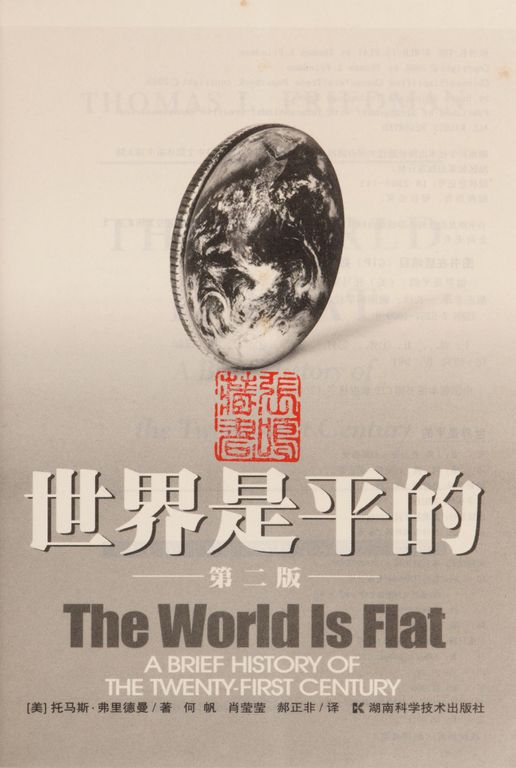
The World Is Flat -A Brief History OF THE TWENTY-FIRST CENTURY
Introduction: The World Shrank Overnight
Introduction: The World Shrank Overnight
Nova: Welcome to Aibrary, the show where we dissect the ideas that shaped our modern world. Today, we are tackling a book that became the defining text of early 21st-century business and geopolitics: Thomas Friedman’s 2005 blockbuster, The World Is Flat.
Nova: : That book was everywhere, Nova. I remember the buzz. It felt like a sudden revelation for so many people—that suddenly, your competition wasn't just the guy down the street, but someone in Bangalore or Beijing, and you couldn't even see them coming.
Nova: Exactly. The core thesis is that technology and workflow advancements had, in Friedman’s words, 'flattened the playing field,' creating a level competitive landscape where individuals and small companies could compete globally. It was a seismic shift from the previous era of Globalization 2.0, which was driven by multinational corporations.
Nova: : But what was the catalyst? Was it just the internet getting faster, or was there a specific moment he pinned this whole transformation on? I recall he mentioned a trip that sparked the idea.
Nova: He did. The concept crystallized for him after a trip to Bangalore, India, in 2004. He saw firsthand how digital connectivity allowed highly skilled workers there to seamlessly collaborate with companies in the West. He realized that the barriers—the 'roundness' of the world—were crumbling due to a convergence of technological and political forces.
Nova: : So, we’re talking about a world where geography matters less than connectivity. Why should our listeners care about a book published nearly two decades ago? Doesn't the world feel more fragmented now, with trade wars and digital borders popping up everywhere?
Nova: That’s the perfect setup for our deep dive. The book’s enduring relevance lies in understanding the of today’s hyper-connected, yet often polarized, reality. We need to know what flattened the world before we can understand why it sometimes feels like it’s buckling under the pressure. Today, we break down the ten flatteners, the critiques, and what Friedman missed in his vision of the 'Flat World.'
Nova: : Let’s dive into the mechanics of this flattening. I’m ready to see the blueprint for the new global economy.
Key Insight 1: The Convergence of Ten Forces
The Ten Flatteners: Blueprint for a Level Playing Field
Nova: Friedman structured his argument around ten specific forces, which he called the 'Ten Flatteners.' These weren't just one thing; they were a convergence that happened around the year 2000, creating what he termed 'Globalization 3.0.'
Nova: : Ten forces sounds like a lot to track. Can you give us the highlights? I assume the internet is high on that list, but what else was happening simultaneously?
Nova: Absolutely. The number one flattener, the foundational event, was the Fall of the Berlin Wall on November 9th, 1989. Friedman called this 'When the walls came down, and the windows came up.' This wasn't a tech event, but a political one that brought billions of people—from former communist states and China—into the global free-market system.
Nova: : That makes sense. You need the political infrastructure for global commerce to thrive. So, what was the first that truly enabled this collaboration?
Nova: That would be Netscape, launched in 1995. The introduction of the user-friendly web browser made the internet accessible to the masses, not just academics or tech specialists. It was the graphical interface that opened the door for everyone else to start sharing and collaborating online.
Nova: : And then, once people were online, how did they start working together across continents? That’s where the real disruption must have happened.
Nova: That’s where Flatteners three, four, and five come in: Workflow Software, Uploading, and Outsourcing. Workflow software allowed different parts of a business process to be digitized and sent anywhere. Uploading meant that digital content—like blueprints, code, or even medical scans—could be sent easily. Outsourcing is the direct result: companies realizing they could send entire business functions, like call centers or back-office accounting, to lower-cost locations.
Nova: : I remember the explosion of call centers in India around that time. It was the first time many Western consumers directly interacted with this new flat world. But how did they manage the logistics of that work being done remotely?
Nova: That’s Flatteners six and seven: Offshoring and Supply Chaining. Offshoring is moving the entire factory or operation overseas, like manufacturing electronics in Vietnam. Supply Chaining, perfected by companies like Walmart and Dell, is the incredibly efficient, digitized management of inventory and logistics across that global network. Dell, for example, could take an order online, route the manufacturing steps across three continents, and deliver the customized PC in days.
Nova: : So, we have the political opening, the accessible internet, the software to manage the work, and the logistics to move the goods. What were the final three? They sound more specialized.
Nova: They are. In-sourcing, where specialized firms like UPS or FedEx handle the entire logistics chain for another company. Informing, which is the ability for anyone to access vast amounts of information instantly—think Google or Wikipedia—which levels the knowledge playing field. And finally, the most controversial one: Steroids. This refers to digital transmission, like wireless technology, VoIP, and instant messaging, which turbo-charged the entire system.
Nova: : It’s a powerful narrative. Ten forces converging at once. It paints a picture of inevitable, smooth progress toward global efficiency. But I have a feeling that smooth picture gets a little rough around the edges when you look closer at the real-world impact, right?
Nova: You are absolutely right. The world might have been flattened for the highly educated knowledge worker, but for many others, the surface remained decidedly bumpy. That brings us to the necessary reality check in our next chapter.
Key Insight 2: The Pushback Against Leveling
The Spiky World: Inequality and the Limits of Flatness
Nova: The book was wildly successful because it offered a compelling, optimistic narrative. But almost immediately, critics pointed out that 'flat' for a software engineer in Bangalore didn't mean 'flat' for a subsistence farmer in rural Africa. The world, they argued, was still very spiky.
Nova: : That's the core critique, isn't it? If the world is flat, why is global wealth inequality still so stark? Critics argued Friedman was viewing the world from the privileged perch of a well-connected American journalist, seeing only the parts that were successfully plugged into the digital economy.
Nova: Precisely. One major counter-argument is that the 'flatteners' primarily benefited those who already had education, infrastructure, and capital. The digital divide didn't vanish; it just shifted. If you couldn't speak English, didn't have reliable electricity, or lacked access to the internet, the world remained very round, or perhaps even more inaccessible.
Nova: : And what about the negative externalities of this hyper-efficiency? I recall the research mentioning that this flattening also enabled destructive forces.
Nova: That’s a crucial point Friedman himself acknowledged later. Flattening the world means flattening the barriers for. This includes terrorist organizations, organized crime, and the spread of misinformation. The same tools that allow a team in Chicago to collaborate with a team in Mumbai allow malicious actors to coordinate globally with unprecedented speed and anonymity. The world became not just efficient, but also fragile.
Nova: : Speaking of fragility, the 'Steroids' flattener—the wireless and digital speed—also seems to have created a new kind of pressure. Did Friedman capture the sheer required to keep up?
Nova: He touched on it, suggesting that in this flat world, you have to 'run faster just to stay in place.' This relentless pace leads to burnout, constant reskilling, and a sense of perpetual anxiety for workers in developed nations who suddenly face competition from highly capable, lower-cost labor pools globally.
Nova: : It sounds like the book described a fantastic new highway system, but failed to mention that everyone was now required to drive 150 miles per hour, and only the cars with the best tires could handle the curves.
Nova: A perfect analogy. Furthermore, the book was published in 2005, right before the 2008 financial crisis, which exposed deep structural flaws in globalized finance and supply chains. Then, of course, we had the rise of massive digital monopolies—Google, Amazon, Facebook—which arguably created new, very steep peaks in the landscape, not a flat field.
Nova: : So, the world didn't just flatten; it became intensely competitive, unequal, and incredibly fast. It seems the optimism of Globalization 3.0 needed a serious dose of reality, which Friedman himself later tried to address in his updates, like 'The World Is Flat 3.0.'
Nova: He did. He had to acknowledge that the playing field wasn't just level; it was also uneven, and that the responsibility shifted heavily onto individuals to constantly upgrade their skills to remain relevant in this new ecosystem.
Key Insight 3: The Evolution of the Global Landscape
Beyond Flat: Fast, Fused, Deep, and Fragile
Nova: If we look at the world today, years after the initial publication, we see that the concept of 'flat' is too simplistic. Friedman himself, in subsequent discussions, expanded the metaphor. The world isn't just flat; it's also fast, fused, deep, and fragile. Let's unpack those additions.
Nova: : 'Fast' is easy to grasp—that’s the acceleration of everything, driven by mobile technology and instant communication that has only intensified since 2005. But what does 'Fused' mean in this context?
Nova: Fused refers to the way these technologies are now intertwined with our physical and social lives. It’s not just about sending an email; it’s about AI algorithms managing your supply chain, social media platforms influencing elections, and the blurring line between work and personal life because you are always reachable. The layers of technology are fused into the fabric of society.
Nova: : And 'Deep'? That sounds almost philosophical. Is that about data?
Nova: It is deeply connected to data. 'Deep' refers to the sheer volume and complexity of the data being generated and analyzed. We moved from simply sharing documents to having massive, interconnected databases that power everything from personalized medicine to predictive policing. The depth of interconnected information is staggering.
Nova: : That depth must contribute directly to the 'Fragile' aspect you mentioned. When everything is so interconnected and optimized for speed, a single failure point can cascade globally, right?
Nova: Exactly. The fragility became painfully obvious during the COVID-19 pandemic. Supply chains optimized for 'just-in-time' delivery, which was a hallmark of the flat world efficiency, snapped instantly when a single port shut down. That fragility is the direct consequence of maximizing efficiency across a flat, interconnected surface.
Nova: : So, the lesson here is that the forces Friedman identified were real, but they were only the first act. The second act involves managing the complexity and risk created by that initial flattening.
Nova: Precisely. The challenge shifted from 'How do I get connected?' to 'How do I build resilience into my hyper-connected system?' The book was a brilliant diagnosis of the of globalization, but the subsequent decade has been about managing the —the inequality, the speed, and the systemic fragility.
Nova: : It forces us to re-evaluate what skills are necessary now. It’s no longer just about being able to use workflow software; it’s about critical thinking, adaptability, and understanding systemic risk.
Nova: Absolutely. The call to action in the book was for individuals and nations to upskill. Today, that call is even louder, but the required skills are less about basic digital literacy and more about complex problem-solving and ethical navigation of fused technologies. The flat world demands constant evolution.
Conclusion: The Enduring Challenge of the Flat World
Conclusion: The Enduring Challenge of the Flat World
Nova: We’ve journeyed through the revolutionary concept of the 'Flat World,' tracing its origins from the fall of the Berlin Wall to the rise of Netscape and workflow software that enabled Globalization 3.0.
Nova: : It’s clear that Friedman nailed the technological and geopolitical shifts that connected us. The idea that a small team anywhere could leverage global talent remains the bedrock of modern digital business. The 10 Flatteners were a powerful framework for understanding that moment in history.
Nova: But as we discussed, the narrative wasn't complete. The world isn't just flat; it’s spiky, favoring those with access and education, and it’s deeply fragile due to the very efficiency it achieved. The fusion of technology into every aspect of life means the stakes are higher than ever.
Nova: : So, what is the ultimate takeaway for us today? If we accept that the world is fundamentally interconnected, what must we do to thrive in this fast, fused, deep, and fragile environment?
Nova: The actionable takeaway is twofold. First, for individuals: Embrace continuous learning. The shelf life of any specific skill is shorter than ever. Second, for societies: We must actively work to smooth out the 'spikes.' This means investing in infrastructure, education, and digital literacy for everyone, ensuring that the benefits of flattening are shared, not hoarded by the connected elite.
Nova: : It’s a reminder that technology is a tool, not a destiny. The shape of the world is determined by the choices we make about how to use these tools—whether we use them to build bridges or to deepen divides.
Nova: A perfect summary. The World Is Flat remains essential reading, not as a perfect prediction, but as a vital historical marker showing us the moment the rules of global competition fundamentally changed. It forces us to ask: Are we running fast enough, and are we building resilience into our interconnected systems?
Nova: : Indeed. The conversation continues, and the world keeps evolving, whether flat, spiky, or something entirely new.
Nova: This has been a fascinating look back at a defining text. Thank you for joining us on Aibrary. Congratulations on your growth!