

Unlocking Collective Wisdom: The Power of Diverse Thinking
Golden Hook & Introduction
SECTION
Nova: Atlas, I’m going to throw out two names: Albert Einstein and a random group of 100 people guessing the weight of an ox at a country fair. Which one are you betting on to get closer to the truth?
Atlas: Oh, that’s a classic setup, Nova. My gut, and probably societal programming, screams Einstein. The lone genius, right? The unparalleled intellect.
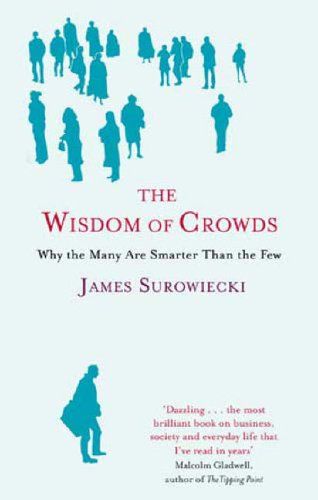
Nova: Exactly! And that’s our collective blind spot. Because if you read James Surowiecki’s groundbreaking work,, you’d know that those 100 random people, under the right conditions, would likely beat Einstein. Not individually, of course, but as a collective.
Atlas: Wait, really? That completely upends the traditional hero narrative of problem-solving. My mind immediately goes to the visionary leader, the strategic builder, the person who's supposed to have all the answers. Are you telling me that a diverse group of non-experts can consistently outperform a singular, brilliant mind in certain situations? That feels… counterintuitive.
Nova: It is, and it’s why Surowiecki’s book, which came out in 2004, was such a revelation. He meticulously compiles research and fascinating anecdotes showing that under specific conditions, a diverse group’s aggregated answer is often closer to the truth than the estimate of even the most knowledgeable individual expert. It challenged the very foundation of how we value expertise, and its ideas have resonated across fields from economics to political science.
Atlas: That’s wild. This isn’t just about getting more opinions; it's about something deeper, isn’t it? It suggests there's a fundamental flaw in how we often approach complex decisions, especially if we're always looking for that one 'right' answer from that one 'right' person.
The Blind Spot of Individual Expertise
SECTION
Nova: Absolutely. And that brings us to our first core idea: the blind spot of individual expertise. We’re wired to seek out the guru, the thought leader, the person with the most impressive resume. We assume that the more complex the problem, the more we need that singular, towering intellect to solve it.
Atlas: I can totally see that. When I'm facing a tough decision, my first instinct is to find someone who's 'been there, done that,' someone who's the 'expert.' I imagine a lot of our listeners, especially those leading teams or building movements, feel that pressure to that expert, or to that expert. It’s almost a comfort in a chaotic world, isn't it? The idea that one person have the definitive answer.
Nova: It is comforting, but it’s often a delusion. Surowiecki gives us examples like the USS Scorpion, a nuclear submarine that vanished in 1968. The Navy convened a group of top experts to pinpoint its location. They used all their advanced mathematical models and deep knowledge. But it was a far less conventional approach that actually got them closest.
Atlas: What was it? Did they bring in a psychic?
Nova: Even better! A naval officer, John Craven, gathered a diverse group of people – not just submarine experts, but also mathematicians, salvage operators, and even a few who had no direct military experience. He asked each person to independently estimate various parameters of the disaster – the speed, the angle of impact, the depth – and then he aggregated their individual guesses. No discussion, just independent estimates.
Atlas: So he literally tapped into the 'wisdom of crowds' without them even interacting. That’s fascinating. What was the outcome?
Nova: The averaged estimate from his diverse, decentralized group was significantly closer to the submarine's actual resting place than the predictions of the elite expert panel. It wasn't about any one person being right; it was about the collective intelligence emerging from their combined, varied perspectives.
Atlas: That’s a powerful illustration. It challenges the assumption that the person with the most credentials automatically holds the best solution. It makes me wonder, how many times have we missed a crucial insight because we were only listening to the loudest, most credentialed voice in the room? It sounds like the very act of seeking out a single expert can create its own kind of tunnel vision.
Conditions for Collective Wisdom to Flourish
SECTION
Nova: Precisely. And that leads us to our second core idea: the specific conditions under which collective wisdom truly flourishes. It’s not just about throwing a bunch of people together. Surowiecki identifies four key conditions: diversity of opinion, independence, decentralization, and aggregation.
Atlas: Diversity of opinion makes sense – different backgrounds, different ways of looking at a problem. But what about independence and decentralization? How do those play out in practice, especially for leaders trying to build high-performing teams?
Nova: Independence is crucial. It means people aren't influenced by each other's opinions. If everyone just parrots the first person who speaks, you lose the benefit of diverse perspectives. Think of it like a brainstorming session where the boss shares their idea first – suddenly, everyone's ideas start to converge around that.
Atlas: Oh, I've seen that happen! Or even just the most confident, charismatic person in the room dominating the conversation. So, independence means actively encouraging individual thought before group consensus?
Nova: Exactly. And decentralization means that people can specialize and draw on local knowledge. They might not know the whole picture, but their specific, localized insight is valuable. And finally, aggregation – there needs to be a mechanism to turn individual judgments into a collective decision, whether it's through averaging, voting, or some other method.
Atlas: So, it's not just about having a lot of smart people; it's about structuring the interaction in a way that truly harnesses their individual insights without groupthink or hierarchy stifling the original thought. For someone trying to build resilience and agility into their organization, this is huge. It’s about creating a system where the best ideas can actually rise to the top, not just the loudest.
Nova: Consider the classic example of predicting election outcomes. Pollsters interview a few thousand people, and based on their diverse, independent responses, they can often predict the behavior of millions. It’s decentralization at work – no single person knows how the entire country will vote, but the aggregate of many independent opinions gets surprisingly close.
Atlas: That’s a great analogy. It highlights that the power isn't in finding the 'average voter' but in understanding the average the voters. This is a fundamental shift from trying to find the perfect individual to designing the perfect system for decision-making.
Holistic Thinking for Complex Problems
SECTION
Nova: Which brings us beautifully to our third core idea, and it’s where Donella H. Meadows, with her seminal work, truly shines. She takes this idea of interconnectedness even further, emphasizing that complex problems require holistic thinking, not just linear solutions. You can have the wisest crowd, but if they're only looking at isolated parts of a system, they'll miss the bigger picture.
Atlas: Oh, that's a common trap. We see a problem, we identify a symptom, and we try to fix without understanding the underlying dynamics. It's like trying to bail water out of a leaky boat without patching the hole. For someone trying to understand customer psychology or build a movement, this is critical. You can't just optimize one touchpoint; you have to understand the entire customer journey, the entire ecosystem.
Nova: Meadows would argue that you can't understand a system by breaking it into pieces and studying those pieces in isolation. The behavior of a system comes from how its parts interact. She illustrates this with the classic example of a bathtub. If the water level is too low, our instinct is often just to turn up the faucet. But what if the drain is also open? Or if there's a leak we can't see?
Atlas: So, you're not just dealing with the input, but also the outflow, the storage, and any hidden variables. It’s about seeing the whole dynamic, the relationships between the elements. This is why a lot of well-intentioned solutions often create new, unforeseen problems elsewhere.
Nova: Exactly! Meadows shows us that leverage points – the places where you can make the most profound and lasting change – aren't always obvious. They're rarely in the components or even the flows, but often in the feedback loops, the goals, or even the paradigms that shape the system. For instance, trying to solve traffic congestion by building more roads often just induces more demand, leading to more traffic. It’s a classic systems trap.
Atlas: That makes perfect sense. It's a shift from 'fixing' to 'understanding.' If you want to inspire and guide a team through uncertainty, you can't just give them a new process; you have to understand the values, the incentives, the communication channels – the entire system that shapes their behavior. This kind of thinking is essential for anyone trying to build something meaningful and enduring, not just a quick fix. It’s about building a movement, not just a product.
Synthesis & Takeaways
SECTION
Nova: So, bringing it all together, we started by challenging the idea that individual genius always holds the answers, revealing our blind spot. Then, we explored how diverse, independent groups, when their opinions are properly aggregated, can unlock collective wisdom. And finally, Meadows reminds us that even the smartest crowd needs to think holistically, understanding the interconnectedness of systems to avoid creating new problems while solving old ones.
Atlas: It’s a powerful progression: from individual brilliance to collective intelligence, and then to systemic wisdom. It’s about moving beyond simply having more people, to having within a of the world. For anyone navigating complex problems, whether it's a startup or a global challenge, the deep question isn't just 'what should we do?', but 'where can we actively seek out more diverse perspectives to improve this current decision, and how does this decision fit into the larger system?'
Nova: That’s the real takeaway. It’s a call to action to radically rethink our approach to problem-solving. Stop looking for the silver bullet from the lone expert. Instead, cultivate diverse voices, ensure their independence, and understand the intricate dance of the systems they operate within. The collective intelligence of a well-structured, holistically thinking group will almost always outperform a single brilliant mind on truly complex issues. It requires a shift in mindset, embracing the messy middle where true innovation thrives, and practicing radical empathy by truly listening more than speaking.
Atlas: It’s a humbling but incredibly empowering insight. It means the best solutions aren't waiting to be discovered by a few; they're waiting to be by many. And that’s a journey worth embarking on.
Nova: Absolutely. This is Aibrary. Congratulations on your growth!