

Unlocking Collective Intelligence: The Power of Diverse Teams
Golden Hook & Introduction
SECTION
Nova: Atlas, I want to play a quick game. I'll give you a scenario, you tell me the first thing that comes to mind. Ready?
Atlas: Oh, I like this. Hit me.
Nova: You're in charge of a massive, complex project, say, designing the next generation of cybersecurity for a global organization. You need a critical decision made. Who do you trust more: the single, brilliant expert with decades of experience, or a diverse group of people, many of whom might not even be experts in this specific field?
Atlas: Hmm, that’s a tough one, Nova. My gut reaction, as someone who values deep expertise, is always the brilliant expert. They've seen it all, right? But then, I'm thinking about our conversation today, and I'm guessing that's not the answer you're looking for.
Nova: Exactly! It’s the counter-intuitive truth that forms the bedrock of what we’re exploring today: the profound power of collective intelligence. We’re diving into how groups can be smarter than individuals, and not just any groups, but they become smarter.
Atlas: Right, like the idea that two heads are better than one, but on steroids, with a PhD.
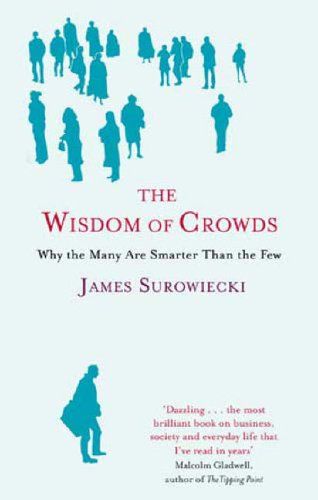
Nova: Precisely. And we’re looking at it through the lens of two seminal books: James Surowiecki’s "The Wisdom of Crowds" and Thomas W. Malone’s "Superminds: The Power of Human-Computer Collaboration." Surowiecki, a journalist by trade, actually popularized this concept through accessible storytelling, turning academic theories into something everyone could grasp. His ability to distill complex ideas into relatable narratives is what made the book a phenomenon.
Atlas: That’s interesting, a journalist bringing this kind of deep insight to the forefront. It speaks to the power of clear communication, doesn't it?
Nova: Absolutely. And Malone, on the other hand, is an MIT professor, a pioneer in organizational studies, who takes that concept and catapults it into the age of AI. His work explores not just how humans collaborate, but how human computer collaboration can create a new form of super-intelligence.
Atlas: So, we’re moving from just people being smart together, to people and machines being smart together. That's a huge leap.
The Wisdom of Crowds: Conditions for Collective Genius
SECTION
Nova: It is. So, let’s start with Surowiecki and "The Wisdom of Crowds," because it lays the essential groundwork. The core idea is simple yet revolutionary: under the right conditions, a diverse group of people is often more intelligent than even the smartest people in that group.
Atlas: That sounds a bit out there, Nova. My mind immediately goes to mob mentality. Aren't crowds often, well, kind of dumb? Panicked, easily swayed?
Nova: That’s a brilliant point, and it’s exactly where Surowiecki draws the line. He identifies four crucial conditions for a crowd to be wise, not foolish. Think of them as the secret sauce. The first is. You need people with different perspectives, different information, different ways of thinking. If everyone thinks alike, you just amplify a single bias.
Atlas: Okay, so not just a bunch of yes-men. Got it.
Nova: Exactly. Second,. People need to form their opinions without being influenced by those around them. If I tell you my answer before you give yours, I’ve just tainted the crowd’s wisdom.
Atlas: That makes sense. No groupthink. So, no shouting out answers in the meeting before everyone's had a chance to think.
Nova: Precisely. The third is. Knowledge isn’t concentrated in one place. Individuals can specialize and draw on local knowledge. This allows for a wider range of solutions and insights to emerge.
Atlas: So, you’re saying not everything has to flow through a single bottleneck. Information can bubble up from different corners of an organization, for example.
Nova: That’s a perfect example. And finally,. There needs to be some mechanism to collect all those individual opinions into a collective judgment. This could be anything from averaging estimates to voting systems.
Atlas: So, it's not just a free-for-all brainstorming session. There has to be a way to actually pull all those disparate ideas together into a coherent outcome.
Nova: Exactly. And when these four conditions are met, the results can be astonishing. Surowiecki shares this fantastic anecdote about a county fair in England in 1906. A statistician named Francis Galton, who was actually a cousin of Charles Darwin, observed a contest where people guessed the weight of an ox. Around 800 contestants, from butchers to farmers to townspeople, submitted their guesses. Galton, a staunch proponent of eugenics, expected the average guess to be wildly off, reflecting the ignorance of the common folk.
Atlas: Oh, I can see where this is going. He was probably proven wrong.
Nova: He was spectacularly wrong! He collected all 800 guesses and calculated the median guess. The ox actually weighed 1,198 pounds. The crowd’s median guess? 1,207 pounds. Only a 9-pound difference. Not a single individual guess was closer than the average of the entire, highly diverse, and largely unexpert crowd.
Atlas: Wow, that’s incredible. So, the collective was almost perfectly accurate, even with all those seemingly random guesses. That’s a powerful example of how diversity and independence can really work.
Nova: It highlights the statistical magic at play. Each individual guess had errors, but because those errors were random and unbiased, they canceled each other out when aggregated. The true signal emerged from the noise.
Atlas: So, for a strategic leader, this means you shouldn't just rely on your internal experts for every critical decision, but actually cultivate an environment where a broader, more diverse range of opinions can be gathered and aggregated.
Nova: Absolutely. It’s about designing processes and communication channels that actively encourage independence and diversity, and then having effective ways to synthesize those insights. It’s a powerful model for decision-making in complex organizations, especially when navigating uncertain futures.
Superminds: Human-AI Collaboration for Enhanced Intelligence
SECTION
Nova: Now, if Surowiecki showed us the surprising power of crowds, Malone takes that concept and launches it into the 21st century with "Superminds." His central argument is that the most intelligent entities on the planet aren't just individual humans or even human groups, but groups of people.
Atlas: Oh, I see. So, it's not just humans anymore; it's like adding a super-powered brain to the collective.
Nova: Exactly. Malone defines a 'supermind' as a group of individuals acting together in ways that seem intelligent. This could be anything from a traditional team to an online community, or even an entire company. But where it gets truly fascinating is when you integrate AI.
Atlas: That makes me wonder, what does that collaboration actually look like? Is it just the AI doing the heavy lifting and humans supervising?
Nova: That’s a great question, and it’s a common misconception. Malone argues for a synergistic relationship, where humans and AI each do what they’re best at. AI excels at processing vast amounts of data, identifying patterns, and performing repetitive tasks with incredible speed and accuracy. Humans, on the other hand, bring creativity, emotional intelligence, ethical reasoning, and the ability to understand context and nuance that AI currently lacks.
Atlas: So, it's not a competition, but a partnership. The AI handles the grunt work, the data crunching, and the humans provide the insight, the direction, the 'why.'
Nova: Precisely. Think about it in terms of security. Imagine an AI sifting through petabytes of network traffic, flagging anomalies in real-time that no human analyst could ever hope to catch. That’s the AI’s strength. But then, a human security expert steps in to interpret those anomalies, understand the intention behind a potential attack, and devise a creative, adaptive defense strategy. That’s the human strength.
Atlas: That’s actually really inspiring. For our listeners who are managing high-stakes environments like cybersecurity, this isn't just theory; it's a blueprint for navigating future challenges. It means we don't have to be afraid of AI taking over; we should be thinking about how to integrate it to make our teams exponentially smarter.
Nova: Absolutely. Malone outlines different types of superminds. There are 'hierarchies,' like traditional command structures, but now augmented by AI decision support. There are 'democracies,' where AI can help aggregate opinions more effectively or even identify biases in voting. And then there are 'markets,' where AI can optimize resource allocation or predict trends with greater accuracy.
Atlas: So, it's about applying AI to enhance the aggregation mechanisms we talked about with Surowiecki, but on a much grander, more sophisticated scale.
Nova: Exactly. And the most interesting one, perhaps, is the 'community' supermind, where large groups of people collaborate online, and AI tools facilitate that collaboration, recommend connections, or synthesize discussions to extract collective wisdom. Think of open-source projects or massive online problem-solving initiatives.
Atlas: That sounds rough, but it also sounds like a future where problems that seem insurmountable today, like global security threats or climate change, could actually be tackled with a level of collective intelligence we haven’t even imagined yet.
Nova: That’s the promise. For our strategic leader, this means moving beyond simply hiring smart people to actively designing systems where humans and AI work hand-in-glove. It's about cultivating a culture that embraces this collaboration, where the AI isn't just a tool, but an integral, intelligent partner in the collective brain.
Synthesis & Takeaways
SECTION
Nova: So, bringing these two powerful ideas together, we see a clear progression. Surowiecki shows us the foundational power of diverse, independent human crowds. Malone then takes that and says, "What if we add AI to the mix?" The result is a profound amplification of our collective intelligence.
Atlas: That’s a great way to put it. It’s like we’re learning to play a completely new game, where the rules of engagement for intelligence are being rewritten. The future of leadership, especially in complex fields like security, isn't just about having the smartest individual, but about building the smartest —a human-AI supermind.
Nova: And it speaks directly to the strategic leader, the human architect, the future seeker. It’s about trusting your vision, but also trusting the collective. It’s about cultivating people, but also cultivating the right tools and processes to amplify their cognitive power. The deep question isn't just how do I get smarter, but how do I design my team and my systems to be smarter than any single individual, human or machine?
Atlas: That’s such a hopeful way to look at it. It shifts the focus from individual burden to collective empowerment. Leaders aren't just managing people; they're orchestrating intelligence. And that’s a powerful insight that can genuinely transform how we approach problem-solving in the modern world.
Nova: It truly is. The future belongs to those who can effectively harness the wisdom of diverse crowds and integrate the power of artificial intelligence to create these 'superminds.' It’s about designing the systems for collective genius, rather than just hoping for individual brilliance.
Atlas: That’s a fantastic thought to leave our listeners with. Design for genius.
Nova: This is Aibrary. Congratulations on your growth!