

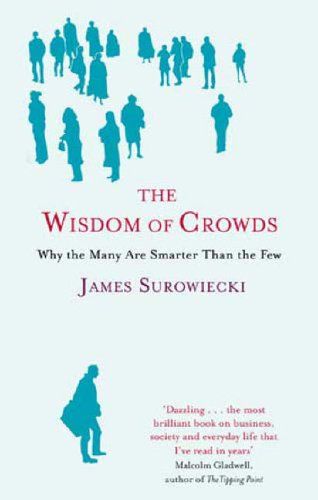
The Wisdom of Crowds: How Diverse Perspectives Drive Better AI Decisions.
Golden Hook & Introduction
SECTION
Nova: What if the smartest person in the room, the undeniable expert, is actually holding everyone back from the best possible outcome?
Atlas: Whoa, that's a bold statement right out of the gate. Are you really saying singular genius can be a liability, not an asset, especially in something as complex as AI?
Nova: Absolutely, Atlas. It's a counter-intuitive truth we often overlook. Today, we're diving into that provocative idea, drawing heavily from two groundbreaking works that illuminate this phenomenon: James Surowiecki's "The Wisdom of Crowds" and Daniel Kahneman's "Thinking, Fast and Slow."
Atlas: Ah, Surowiecki, the financial journalist who beautifully synthesized years of research into why groups can be so remarkably clever. And Kahneman, the Nobel laureate who, with Amos Tversky, basically mapped the hidden biases that trip up even the brightest individual minds. Talk about a dynamic duo for understanding decision-making.
Nova: Exactly. Surowiecki showed us the incredible power of collective intelligence, while Kahneman explained why our individual brains, for all their brilliance, are actually quite prone to error.
Atlas: And this isn't just fascinating academic theory; it has profound, real-world implications for how we build, manage, and strategize with AI, which is inherently complex and often opaque. It makes me wonder, how many AI projects have stumbled because of a brilliant individual's blind spot?
The Blind Spot: Why Individual Genius Falls Short in Complex AI
SECTION
Nova: That's a great question, and it's precisely where Kahneman's work becomes so critical. He didn't just that individual judgment is flawed; he, along with Tversky, scientifically the systematic ways our brains lead us astray. We're talking about cognitive biases—mental shortcuts that, while sometimes efficient, can severely distort our perception of reality and lead to suboptimal decisions.
Atlas: Oh, I know that feeling. It's like when you're convinced your AI model is performing perfectly because you've focused all your testing on the data points that confirm your hypothesis, completely ignoring the edge cases that break it. That’s confirmation bias, right?
Nova: Exactly! Or the availability heuristic, where we overestimate the likelihood of events that are easily recalled, perhaps because they were recent or emotionally vivid. Imagine an AI team leader, after one high-profile security breach, becoming overly focused on a specific type of threat, diverting resources from other, statistically more probable risks, simply because that one incident is so "available" in their memory.
Atlas: So, a single, brilliant architect designing an entire AI system might, without even realizing it, bake their own cognitive biases directly into the system's core logic or its ethical guardrails. That's a scary thought. For someone trying to innovate fast in AI, the allure of the "lone genius" solving everything is strong, but this suggests it's a huge risk.
Nova: It is. Kahneman's research, which earned him a Nobel Prize, wasn't about proving people are stupid; it was about showing that our brains operate on two systems: System 1, which is fast, intuitive, and emotional, and System 2, which is slower, more deliberate, and logical. The problem is, System 1 often jumps to conclusions, and System 2 is sometimes too lazy to correct it. In AI development, where the stakes are high and the problems are novel, relying solely on one or two brilliant minds, no matter how intelligent, means you're almost certainly inheriting their unconscious biases and blind spots.
Atlas: So you're saying that even a founder with a visionary idea for an AI product, if they don't actively seek out dissenting views, could be building a magnificent echo chamber, unknowingly creating an AI that reflects their own limited perspective, or even their own biases, rather than a truly robust and fair system. That's a powerful warning.
The Collective Edge: Harnessing Diverse Perspectives for Superior AI Outcomes
SECTION
Nova: It is a powerful warning, but it also leads us to an incredibly powerful solution, which is where Surowiecki's "The Wisdom of Crowds" comes in. He illustrates how large groups of diverse, independent individuals can collectively make better decisions and solve problems more effectively than even expert individuals. This isn't about average people being smarter than experts; it's about the of the group.
Atlas: Okay, so how does that work? How do you get a better decision from a crowd, especially if some individuals in that crowd might not be experts? Isn't that just "too many cooks in the kitchen" for an AI project?
Nova: It's the opposite, actually, if you have the right conditions. Surowiecki outlined four key requirements: diversity of opinion, independence, decentralization, and a good aggregation mechanism. Think about the classic example: guessing the weight of an ox at a country fair. Hundreds of people, most not butchers or farmers, each made a guess. Not a single person got it exactly right, but when Surowiecki averaged all the guesses, the collective estimate was almost perfectly accurate.
Atlas: That's incredible. So it's not about finding the smartest individual, but about leveraging the collective intelligence that emerges from varied perspectives, as long as they're independent. For an AI developer or an entrepreneur, how do you practically integrate truly diverse perspectives into a tight-knit AI development team or a strategic planning session, especially if those perspectives might challenge the core vision?
Nova: It requires intentional design. It means actively seeking out people with different backgrounds, different cognitive styles, and different lived experiences, especially when building AI. If everyone on your team looks the same, thinks the same, and comes from the same university, you're essentially building a collective blind spot, even if they're all brilliant. For AI, this is crucial. Diverse teams are demonstrably better at identifying biases in data, recognizing ethical pitfalls in algorithms, and foreseeing unintended societal impacts.
Atlas: So, it's about building systems, not just hoping for diverse opinions to emerge. Like, instead of just having one lead data scientist make all the final calls on a new model's architecture, you'd have regular, structured sessions where that architecture is critically reviewed by people from different departments—say, product, ethics, even legal—who each bring a unique lens. And they need to be truly independent in their assessment, not just nodding along.
Nova: Precisely. And the "aggregation mechanism" is key. It's not just about having diverse opinions; it's about having effective ways to collect, synthesize, and act on those opinions. This could be anything from anonymous feedback systems, structured brainstorming sessions with clear rules for dissent, or even specific roles within a team whose job it is to play devil's advocate. It creates an environment where potential flaws in an AI system—whether it's a biased training dataset or an unforeseen ethical concern—are much more likely to be caught before they become major problems. It's about designing for resilience and robustness by leveraging the collective mind.
Synthesis & Takeaways
SECTION
Nova: So, what we're really seeing here is a powerful dynamic: the more aware we are of our individual cognitive blind spots, the more we appreciate the profound, almost magical, power of collective intelligence. For anyone building or leading with AI, this isn't just a philosophical nicety; it's a strategic imperative. If you want to build AI that is truly innovative, fair, and resilient, you cannot rely on a singular vision, no matter how brilliant.
Atlas: That’s a really illuminating way to put it. It sounds like the greatest strength of an AI entrepreneur or leader isn't just their own intelligence, but their ability to strategically assemble and empower a truly diverse group. It’s about creating the conditions for the wisdom of crowds to emerge, even within a focused, fast-moving AI project. It demands humility and a willingness to have your assumptions challenged.
Nova: Absolutely. It means fostering an environment where dissenting opinions are not just tolerated, but actively sought out and celebrated as valuable inputs. It’s about building a system where individual biases are diluted and neutralized by the sheer variety of perspectives.
Atlas: So, for our listeners, especially those grappling with complex AI development or strategic planning, the deep question from our reading today is incredibly relevant: How can you actively seek out and integrate more diverse perspectives into your AI project development and strategic planning, not just as a cultural ideal, but as a core mechanism for superior outcomes? Think about the last big decision you made or the next AI feature you're planning. Who at the table? What perspective are you missing?
Nova: And remember, it's not enough to just have diverse people; you need mechanisms to ensure their independence and to effectively aggregate their insights. That's where the real magic happens.
Atlas: That's a challenge worth taking on.
Nova: This is Aibrary. Congratulations on your growth!