

Beyond the Individual: How Groups Create Collective Intelligence
Golden Hook & Introduction
SECTION
Nova: Alright Atlas, quick question for you: when faced with a really complex problem, who do you instinctively trust more – the single, undisputed expert in the room, or a diverse group of people, many of whom might not even be 'experts' at all?
Atlas: Oh, that's a classic setup, Nova! Instinctively, my gut screams 'expert.' We're conditioned to look for the guru, the rockstar, the one person with all the answers, right? Especially when the stakes are high. It feels safer.
Nova: Exactly! And that "gut scream" is precisely the blind spot we're going to dive into today. Because what if I told you that, more often than not, that diverse group of non-experts could actually be than the smartest individual?
Atlas: Whoa. That's a bold claim. You're saying my brain, which is constantly trying to find the single point of failure or the single point of genius, is actually steering me wrong? That's… counterintuitive.
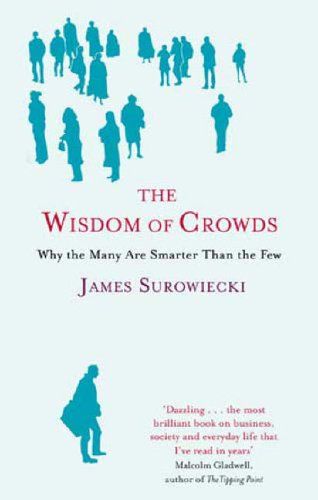
Nova: It absolutely is. And it's the profound insight at the heart of a truly groundbreaking book, by James Surowiecki. Surowiecki, a financial journalist, managed to take this incredibly complex idea and make it accessible, weaving together psychology, economics, and history. It became widely acclaimed, influencing everything from business strategy to how we think about democracy. He showed us that collective intelligence isn't some abstract concept; it's a measurable, powerful force.
Atlas: That makes me wonder, for anyone trying to build a resilient system or make critical decisions in their organization, how do we even begin to tap into something that feels so… amorphous? Where does this 'wisdom' actually come from?
The Counterintuitive Power of Decentralized Crowds
SECTION
Nova: That's the million-dollar question, Atlas. And Surowiecki breaks it down into four core conditions. Think of them as the secret sauce ingredients. First, you need. This means people bringing different information, perspectives, and even interpretations of facts to the table. Not just different backgrounds, but genuinely different ways of seeing the world.
Atlas: So, not just hiring people who look different, but people who different? That's a crucial distinction, especially for leaders trying to foster innovation. We often talk about diversity, but miss the 'diversity of thought' part.
Nova: Precisely. The second ingredient is. Each person's opinion shouldn't be determined by the opinions of those around them. No groupthink. No social pressure. No following the loudest voice.
Atlas: Hold on. How do you even achieve that in a real-world team meeting? People naturally influence each other. That sounds incredibly difficult to engineer.
Nova: It is, but it's vital. And that leads to the third condition:. Knowledge isn't concentrated in one place or one person. Individuals can specialize and draw on local knowledge, making decisions quickly and efficiently without having to report up a long chain of command for every little thing.
Atlas: So it's about distributing both information decision-making power? That feels quite radical for many traditional organizational structures. It requires a lot of trust in the individual contributors.
Nova: Absolutely. And finally, the fourth ingredient is an. You need some way to turn all those individual opinions into a collective decision. This could be a simple average, a vote, a market system, or even a sophisticated algorithm.
Atlas: Okay, so diversity, independence, decentralization, and an aggregation mechanism. That's the recipe. Can you give us an example where these ingredients truly created something magical?
Nova: Of course. One of the most famous examples, and one Surowiecki popularized, goes back to 1906. Sir Francis Galton, a statistician and cousin of Charles Darwin, visited a country fair. There was a contest to guess the weight of an ox. Around 800 people, a mix of butchers, farmers, and even some who knew nothing about cattle, submitted their guesses. Galton expected the average guess to be wildly off, or that the expert butchers would be closest.
Atlas: And I'm guessing that's not what happened.
Nova: Not at all. The ox weighed 1,198 pounds. The average of all 800 guesses was... 1,197 pounds.
Atlas: Wow. That's incredible. One pound off! So the collective wisdom of a random crowd, many of whom had no idea, was almost perfect, outperforming pretty much every individual guess. That's a powerful illustration of those conditions at play. They were diverse, independent, decentralized, and the simple average was the aggregation mechanism.
Nova: Exactly. It wasn't about finding the smartest person; it was about leveraging the collective intelligence that emerged from the right structure. It shows that sometimes, the 'expert' is actually the system itself, not a single individual.
Atlas: That really makes you rethink the "hero leader" narrative. It suggests that a leader's true genius might be in designing the conditions for collective wisdom, rather than always having the answer themselves. For someone building systems, that's a complete shift in focus.
Architecting Collective Intelligence: From Theory to Design
SECTION
Nova: It is indeed a shift. And if we understand why crowds are wise, the next question, as you hinted at earlier, is do we intentionally build them? It's where the theory of collective intelligence meets the practical world of design. This is where books like by Richard Thaler and Cass Sunstein come into play, showing us how understanding collective behavior allows us to design environments that 'nudge' groups towards better outcomes.
Atlas: So it's not just about gathering opinions, it's about setting up the game itself? For an architect or a psychologist, that's fascinating. It's about designing the invisible guardrails that guide people towards better collective decisions without them even realizing it.
Nova: Precisely. Think of it as creating an ecosystem where those four conditions for collective wisdom naturally flourish. For example, to foster diversity of opinion, you might deliberately assemble cross-functional teams, or even bring in external perspectives that challenge internal assumptions. It's not enough to just diverse people; you need to create a space where their diverse opinions can actually be heard and valued.
Atlas: But how do you ensure independence? In many organizations, there's a strong pressure to conform, especially when a senior leader shares their opinion first. That's the opposite of independence.
Nova: You hit on a crucial point there. To combat that, you design processes. For instance, anonymous idea submission before a group discussion, or having everyone write down their individual solution any group brainstorming. This 'nudges' people to form their own independent thoughts first, rather than being swayed by the first, loudest, or most senior voice.
Atlas: That makes sense. It’s like, instead of saying "don't be biased," you design the meeting format so it's harder to biased. It's structural, not just behavioral.
Nova: Exactly. And for aggregation, it's about choosing the right mechanism for the problem. Sometimes a simple majority vote works, but for complex predictions, averaging diverse estimates can be incredibly powerful. Or creating internal prediction markets where people 'bet' on outcomes, leveraging their aggregated dispersed knowledge. The key, as our own Nova's Take suggests, is that harnessing collective intelligence requires, not just gathering many opinions. It's about structuring interaction.
Atlas: So, for someone wanting to leverage the 'wisdom of crowds' within their own organization or projects, how do they start? It sounds like a complete overhaul of how we approach decision-making. What are the first concrete steps or design principles they should consider?
Nova: It doesn't have to be an overhaul, Atlas. Start small. First, when facing a complex problem, pause before asking the 'expert.' Instead, ask: "How can I get diverse, independent opinions on this?" Second, look at your existing processes. Are they accidentally independence or diversity? Do people speak up freely, or do they wait to hear what the boss thinks? Third, experiment with simple aggregation methods – even just averaging a few independent estimates can provide surprising clarity. It's about becoming an architect of information flow and decision environments, rather than just a collector of opinions.
Synthesis & Takeaways
SECTION
Nova: Ultimately, what these insights reveal is that intelligence isn't just about individual brainpower; it's profoundly about the architecture of connection and interaction. The collective mind, when properly designed, holds a vast, often untapped reservoir of wisdom.
Atlas: That's actually really inspiring. For anyone building systems, managing teams, or just trying to make better choices, this isn't just theory; it's a blueprint for creating more resilient, innovative, and frankly, more human organizations. It's about moving from seeking the single right answer to building the right for finding better answers.
Nova: It’s about embracing the idea that the answer might not be in the loudest voice, or even the smartest individual, but in the quiet, independent murmur of many. It urges us to trust the process of collective discovery and to actively design for it.
Atlas: I love that. It puts the power not in finding the guru, but in empowering the collective. So, for our listeners, I’d challenge you to look at your next big decision. Before you turn to that one expert, ask yourself: how can I invite the wisdom of my own crowd?
Nova: A fantastic challenge, Atlas. And a powerful way to put these insights into action.
Atlas: This is Aibrary. Congratulations on your growth!