

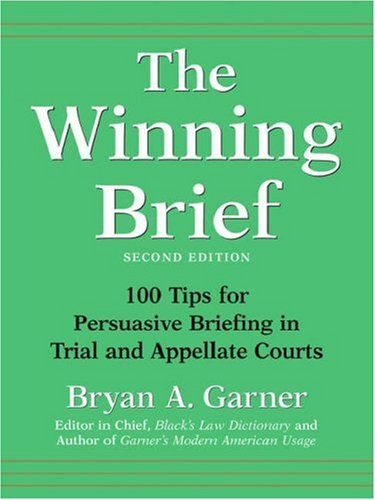
The Winning Brief
100 Tips for Persuasive Briefing in Trial and Appellate Courts
Introduction
Nova: Picture this: you're a lawyer standing before a judge. You've got twenty pages to convince them your client deserves to win. The clock is ticking, the stakes are sky-high, and the judge has a stack of fifty other briefs to read before lunch. What makes yours the one they actually remember? That's the question Bryan A. Garner has spent decades answering, and his book "The Winning Brief" is essentially the bible of persuasive legal writing. I'm Nova, and today we're diving into one of the most influential books ever written about the craft of legal persuasion.
Nova: : And I'm here as the curious listener who's never set foot in a law school classroom. So help me understand: this is a book with a hundred tips about writing legal briefs. Why should anyone outside the legal profession care about this?
Nova: That's a fair question, and here's the surprising answer: Garner's principles apply to almost any kind of persuasive writing. Whether you're drafting a business proposal, writing a grant application, or even composing a carefully argued email to your boss, the same rules of clarity, structure, and persuasion hold true. Garner himself has said that good legal writing is simply good writing about legal subjects. The book has sold over a hundred thousand copies and is now in its third edition, used in law schools and by practicing attorneys across the country.
Nova: : So it's not just for lawyers. But what makes Garner such an authority on this? Who is this guy?
Nova: Bryan A. Garner is the editor-in-chief of Black's Law Dictionary, he's co-authored books with Justice Antonin Scalia, and he's trained thousands of lawyers and judges through his company LawProse. He's essentially the most recognized name in legal writing and advocacy in the English-speaking world. His book distills decades of teaching into a hundred actionable tips, and each one is illustrated with before-and-after examples from real legal briefs. It's like having a master editor sitting on your shoulder.
Nova: : Okay, I'm intrigued. Let's dig into what makes a brief truly winning.
Structure Before Style
The Architecture of Persuasion
Nova: Let's start with what Garner considers the foundation of any winning brief: its architecture. Before you even think about elegant sentences, you need to nail the structure. And Garner's first and most emphatic piece of advice is deceptively simple: put your best foot forward. Lead with your strongest argument.
Nova: : Wait, that sounds obvious. Doesn't everyone do that?
Nova: You'd be shocked how many lawyers don't. There's a persistent myth in legal writing that you should build up to your strongest point, saving it for a dramatic finish. Garner demolishes this idea. He points out that judges are busy, often reading briefs late at night or early in the morning. If your first argument is weak, the judge may already be skeptical before reaching your good stuff. Worse, they might not even get there with full attention. He calls this the primacy effect: what comes first shapes how everything that follows is perceived.
Nova: : So it's like a job interview. You don't save your best qualification for the last minute.
Nova: Exactly. And this principle cascades through every level of the brief. Your strongest argument goes first. Within that argument, your strongest point goes first. Within each paragraph, your strongest sentence leads. Garner calls this the "inverted pyramid" structure, borrowed from journalism. Give the conclusion up front, then support it.
Nova: : But doesn't that make the rest feel anticlimactic?
Nova: Only if you write it poorly. The art is in making each subsequent point feel like it adds depth and reinforcement, not redundancy. Garner's second major structural insight is about point headings. These are the bolded section titles that break up a legal brief. Most lawyers write headings like "The Trial Court Erred in Granting Summary Judgment." Garner says that's a wasted opportunity. He advocates for what he calls "complete-sentence point headings" that tell a story.
Nova: : Give me an example of the difference.
Nova: Sure. A typical heading might say: "The Statute of Limitations Defense." Garner would transform that into something like: "Because the plaintiff filed suit three years after discovering the fraud, the statute of limitations bars this action." See the difference? The second version tells the judge your entire argument in one sentence. If the judge reads nothing but your point headings, they should understand your case. He calls this the "table of contents test."
Nova: : That's brilliant. It's like each heading is a mini-argument. But doesn't that make the table of contents absurdly long?
Nova: Garner addresses that directly. He says the table of contents should read like a compelling executive summary. Some lawyers worry about length, but Garner argues that clarity always wins over brevity for brevity's sake. A judge who reads a clear, story-telling table of contents is already leaning your way before they hit page one. That's worth the extra space.
Framing the Battlefield
The Deep Issue and the Statement of Facts
Nova: Now let's talk about two sections that Garner believes most lawyers completely botch: the issue statement and the statement of facts. These appear right at the beginning of a brief, and they set the entire frame for how the judge will read everything that follows.
Nova: : The issue statement is just the legal question the court needs to answer, right? How complicated can that be?
Nova: That's exactly what most lawyers think, and that's exactly why most issue statements are terrible. The traditional format is something like: "Whether the trial court erred in excluding expert testimony under Daubert." Garner calls this the "whether" format, and he says it's a disaster. It's abstract, it's boring, and it doesn't tell the judge anything meaningful.
Nova: : So what's the alternative?
Nova: Garner invented something called the "deep issue" format. It transforms a dry legal question into a compelling, fact-specific narrative that makes the answer seem obvious. Instead of "Whether the trial court erred," you write something like: "The trial court excluded Dr. Chen's testimony on the grounds that her methodology was unreliable. But Dr. Chen used the same peer-reviewed protocol accepted in fifteen other federal cases. Did the trial court abuse its discretion by excluding this testimony?"
Nova: : Wow, that's night and day. The second version practically answers itself.
Nova: That's the point. Garner says the deep issue should be no more than seventy-five words, should contain enough factual detail to make the dispute concrete, and should end with a question that the judge feels compelled to answer in your favor. He's adamant that the deep issue must be scrupulously fair. You can't twist the facts. But you can frame them in a way that highlights what's truly at stake.
Nova: : What about the statement of facts? I imagine that's where lawyers just dump everything that happened chronologically.
Nova: You've just described the single most common mistake in legal writing. Garner devotes multiple tips to the statement of facts, and his core message is this: the facts section is not a neutral chronology. It's a story. Your story. And it needs to be told with the same care a novelist brings to narrative.
Nova: : But lawyers aren't supposed to be novelists. Isn't there an ethical line here?
Nova: Absolutely, and Garner is crystal clear about this. You cannot misrepresent a single fact. You cannot omit material facts that hurt your case. What you can do is organize the facts thematically rather than chronologically, emphasize the facts that matter, and present them in a way that builds toward your legal argument. He says the best facts sections make the reader think, "Of course this party should win," before they've even read the legal analysis.
Nova: : So it's about emphasis and organization, not fabrication.
Nova: Exactly. One of Garner's most practical tips is to start the facts section with a short, compelling paragraph that captures the essence of the case in a way that favors your client. He calls this the "punch line first" approach. Then you can go into the details. He also advises using concrete details, names, dates, and dollar amounts rather than vague generalities. "The plaintiff waited over two years before filing suit" is far more powerful than "The plaintiff delayed in bringing this action."
Clarity, Brevity, and the Death of Legalese
The War on Words
Nova: Let's get into the part of the book that's most fun and most painful for lawyers: Garner's war on bad writing habits. He's ruthless about cutting words, and his advice here has applications far beyond the courtroom.
Nova: : I've heard lawyers have a reputation for, shall we say, not being the most concise writers.
Nova: That's putting it kindly. Garner has a whole taxonomy of legal writing sins. There's legalese: "heretofore," "aforementioned," "said defendant," "pursuant to." There's throat-clearing: "It should be noted that," "It is important to recognize that." There's redundancy: "null and void," "cease and desist," "free and clear." And there's what he calls "nominalizations" — turning perfectly good verbs into clunky nouns.
Nova: : Nominalizations? Give me an example.
Nova: Instead of "The court decided," lawyers write "The court made a decision." Instead of "The plaintiff argued," they write "The plaintiff made an argument." Instead of "apply," they write "make an application." Each one adds unnecessary words and drains the sentence of energy. Garner says the single fastest way to improve your writing is to hunt down every nominalization and replace it with a strong verb.
Nova: : So it's like the difference between "I took a walk" and "I walked." One is just cleaner.
Nova: Exactly. And Garner has data to back this up. He's conducted readability studies showing that even judges and experienced lawyers comprehend clear, concise writing faster and more accurately than dense, jargon-filled prose. There's a persistent myth in the legal profession that complex ideas require complex language. Garner demolishes this. He quotes Albert Einstein: "If you can't explain it simply, you don't understand it well enough."
Nova: : What about word choice? Does he have specific rules?
Nova: He has strong opinions. Never use a long word when a short one will do. "Use" not "utilize." "Before" not "prior to." "About" not "approximately." "Because" not "due to the fact that." He also insists on the active voice. "The court reversed the judgment," not "The judgment was reversed by the court." The passive voice isn't always wrong, but lawyers overuse it to the point of absurdity, often because they think it sounds more formal and objective.
Nova: : I've definitely seen that in contracts and official documents. It's like they're trying to remove all human agency from the writing.
Nova: That's exactly what it is, and Garner argues it's counterproductive. When you hide the actor, you make the sentence harder to follow and less persuasive. If you want the judge to believe the defendant did something wrong, say "The defendant breached the contract," not "The contract was breached." The active voice assigns responsibility. It's more honest and more powerful.
Nova: : One thing I'm curious about: does Garner address the visual side of briefs? Fonts, spacing, that kind of thing?
Nova: He absolutely does, and this is one of the most underappreciated parts of the book. Garner devotes several tips to typography and document design. He recommends using a readable serif font like Century Schoolbook or Equity for body text. He insists on adequate white space, reasonable line spacing, and margins that don't cram the page. His philosophy is that if a document looks inviting and easy to read, the judge will approach it with a more open mind. If it looks like a wall of impenetrable text, the judge starts off exhausted.
Nova: : That's so practical but I bet most lawyers never think about it.
Nova: They don't, and that's why the ones who do have an immediate advantage. Garner tells a story about a judge who confessed that when he sees a brief in Times New Roman at twelve-point font with narrow margins, he groans internally before reading a single word. First impressions matter, even in the law.
Building the Case and Polishing the Prose
The Art of Argument and the Editing Mindset
Nova: Let's move into the heart of the book: how to actually construct a legal argument that persuades. Garner's approach here is methodical and grounded in cognitive psychology.
Nova: : Before we get into technique, I have to ask: does Garner think you should ever concede anything? In law, isn't admitting weakness dangerous?
Nova: This is one of his most counterintuitive pieces of advice, and it's brilliant. Garner says you should candidly acknowledge and distinguish adverse authority. If there's a case that seems to go against you, don't hide it in a footnote and hope the judge doesn't notice. The other side will certainly bring it up, and if you haven't addressed it, you look either dishonest or unprepared. Instead, bring it up yourself, explain why it's distinguishable, and turn it to your advantage.
Nova: : So it's like inoculation. A small dose of the opposing argument makes you immune to the full attack.
Nova: That's exactly the metaphor Garner uses. He also advises that when you have a genuinely weak point, you should deal with it briefly and move on. Don't try to make a weak argument sound strong by throwing more words at it. Judges see right through that. Acknowledge it, minimize it, and pivot to your strengths.
Nova: : What about the actual logic of argument? How does he suggest structuring the reasoning?
Nova: Garner is a big proponent of what he calls "the scaffold of logic." Every argument should follow a clear logical progression that the judge can follow step by step. He recommends using explicit signposts: "First," "Second," "Third." He says you should state your conclusion, then your rule, then apply the rule to your facts, then restate the conclusion. It sounds mechanical, but when done well, it creates an almost irresistible momentum.
Nova: : It sounds like the IRAC method I've heard about. Issue, Rule, Application, Conclusion.
Nova: Exactly. Garner doesn't invent this from scratch; he refines it. His contribution is showing how to execute it with style and persuasion rather than making it read like a dry checklist. He also emphasizes the importance of analogies and examples. Abstract legal principles are hard to grasp. Concrete comparisons make them stick. He advises lawyers to find the simplest, most relatable analogy for their legal argument and lead with it.
Nova: : Let's talk about the editing process. I've heard Garner is almost fanatical about revision.
Nova: He is, and this might be the most important section of the book for anyone who writes anything. Garner says the difference between mediocre writing and great writing is almost always the number of revisions. He recommends a multi-pass editing process. First pass: fix the structure and argument flow. Second pass: cut unnecessary words and tighten sentences. Third pass: check citations and factual accuracy. Fourth pass: read the entire document aloud.
Nova: : Read it aloud? Why?
Nova: Because your ear catches what your eye misses. Awkward rhythms, overly long sentences, unintentional repetitions — they all become obvious when you hear them. Garner says if you stumble while reading aloud, your reader will stumble while reading silently. He also recommends having someone else read your brief before you file it. Fresh eyes catch things you've become blind to after staring at the same document for weeks.
Nova: : How much time does he think you should spend on editing?
Nova: Garner has a rule of thumb that's both inspiring and terrifying: spend at least as much time editing as you spent drafting. If it took you ten hours to write the first draft, spend at least ten hours revising it. Most lawyers, he says, spend ninety percent of their time on the first draft and ten percent on editing. The great brief writers flip that ratio. They understand that writing is rewriting.
Writing for the Person Who Decides
The Psychology of the Judicial Reader
Nova: One of the things that sets Garner apart from other writing teachers is his deep focus on the psychology of the reader — specifically, the judge. He's spent decades interviewing judges about what they actually want from briefs, and the answers are fascinating.
Nova: : What's the number one complaint judges have?
Nova: Length. Overwhelmingly, judges say briefs are too long. Garner quotes one federal appellate judge who said, "I have never, in my entire career, wished a brief were longer." Think about that. Not once. Judges are drowning in paper. A typical federal appellate judge might read hundreds of pages of briefs per week, on top of hearing oral arguments and writing opinions. They're exhausted, and they're grateful for any lawyer who respects their time.
Nova: : So shorter is always better?
Nova: Not exactly. Garner makes an important distinction: a brief should be as long as necessary and as short as possible. If you need thirty pages to make your argument, use them. But don't use thirty pages just because the court rules allow it. He says the most impressive briefs are often the ones that come in well under the page limit. It signals confidence. It says, "Our argument is so strong we don't need to bury you in paper."
Nova: : What else do judges complain about?
Nova: They hate being misled. They hate hyperbole. They hate personal attacks on opposing counsel. And they really hate it when lawyers misrepresent the record or the case law. Garner says the fastest way to lose credibility with a judge is to overstate your case or to cite a case for a proposition it doesn't actually support. Judges have law clerks who check these things. You will get caught, and you will lose trust you can never get back.
Nova: : So credibility is everything.
Nova: It's the only currency that matters. Garner tells a story about a prominent lawyer who was known for being so scrupulously accurate that judges would accept his representations without checking them. That reputation took decades to build, and it was worth more than any rhetorical flourish. Garner's advice: be the lawyer whose word the judge trusts implicitly. That means being honest about the weaknesses in your case, accurate in your citations, and fair in your characterization of the opposing arguments.
Nova: : What about tone? How should a brief sound?
Nova: Garner advocates for a tone that is confident but not arrogant, forceful but not aggressive, professional but not stiff. He says the ideal tone is that of a trusted advisor speaking to a busy decision-maker. You're not groveling, and you're not lecturing. You're guiding. One of his most memorable pieces of advice: "Never argue with the judge in your brief." The brief is not the place for combativeness. Save the fire for oral argument if it's warranted. In writing, let the strength of your logic do the work.
Nova: : That's a lot of discipline. I imagine it's hard for lawyers who are passionate about their cases.
Nova: It is, and that's why Garner emphasizes the importance of cooling-off periods. Write the first draft. Set it aside for a day or two. Come back and read it as if you were the judge. Would you be persuaded? Would you be annoyed? Would you trust this writer? That distance is essential for seeing your own work clearly.
Conclusion
Nova: So let's bring this together. Bryan A. Garner's "The Winning Brief" is, at its core, a book about respect. Respect for the reader's time, respect for the reader's intelligence, and respect for the craft of writing itself. The hundred tips are really variations on a single theme: make it easy for the judge to rule in your favor.
Nova: : That's a powerful way to frame it. It's not about tricking anyone. It's about removing every obstacle between the judge and your argument.
Nova: Exactly. And the obstacles are almost always self-inflicted. Wordiness, poor structure, buried arguments, legalese, passive voice, visual clutter — these are all things the writer chooses. Garner's genius is showing that better choices are available and that they make a measurable difference. He's not asking lawyers to become poets. He's asking them to become clear thinkers who can translate that clarity onto the page.
Nova: : What would you say are the three biggest takeaways for someone who's never going to write a legal brief but wants to write more persuasively?
Nova: First, lead with your best point. Whatever you're writing, put your strongest argument first. Don't save it. Second, cut ruthlessly. Every word that doesn't earn its place is stealing attention from the words that matter. Third, read your work aloud. If it sounds awkward to your ear, it will read awkwardly to your audience. Those three principles alone will transform anyone's writing.
Nova: : And for the lawyers listening?
Nova: Buy the book. Seriously. It's not enough to hear about it. The before-and-after examples are where the real learning happens. Seeing a clunky paragraph transformed into something clear and compelling is like watching a magic trick where you actually learn how it's done. Garner shows his work, and that's what makes the book invaluable.
Nova: : I love that. It's a book that doesn't just tell you what good writing looks like; it shows you how to get there.
Nova: And that's the mark of a great teacher. Garner has said that his mission is to elevate the quality of legal writing across the profession. Judging by the influence of "The Winning Brief," he's succeeding. The book has become a standard text in law schools, a go-to reference for practicing attorneys, and even a resource for judges who want to write better opinions. Its principles have shaped how an entire generation of lawyers thinks about persuasion.
Nova: : So the winning brief isn't the one with the most dramatic rhetoric or the cleverest turn of phrase. It's the one that makes the judge's job easiest.
Nova: That's it exactly. Clarity is persuasive. Brevity is persuasive. Structure is persuasive. Honesty is persuasive. And when you combine all of those, you don't just win arguments. You earn trust. And in the law, as in life, trust is everything.
Nova: : This is Aibrary. Congratulations on your growth!