

Upskilling Your Life: The 8 Habits Beyond Your Paycheck
Golden Hook & Introduction
SECTION
Socrates: Welcome. In a world obsessed with upskilling for our careers—learning the next software, the next marketing tactic—what if we're acing the tutorials for the wrong game entirely? What if the most valuable 'skill' isn't on your resume, but in how you define wealth itself?
0109chengzi: That’s a powerful question, Socrates. It’s something my friends and I talk about a lot. You graduate, you get the job, and immediately the focus is on the next step, the next promotion. There's this immense pressure to build a career, and it's easy to forget that you're also supposed to be building a life. The two can feel like they're in conflict.
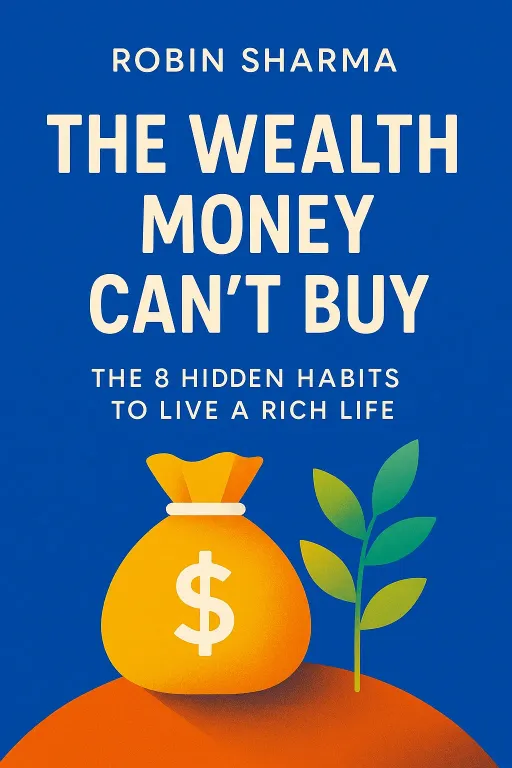
Socrates: Precisely. And that's the very heart of a book I've been immersed in, Robin Sharma's "The Wealth Money Can't Buy." He argues that we've been sold a faulty definition of success. Today, I want to explore that idea with you from two main perspectives.
0109chengzi: I'm ready. I think we need new perspectives.
Socrates: Good. First, we'll expose the common trap of chasing 'fool's gold' by unpacking a powerful parable from the book. Then, and this is the crucial part, we'll reveal the alternative: a practical, eight-part blueprint for building a life of authentic, durable wealth.
0109chengzi: So, diagnose the problem, then offer the solution. I like it. It’s analytical. Let's get into it.
Deep Dive into Core Topic 1: The Illusion of 'Golden Window' Wealth
SECTION
Socrates: To really grasp this idea of 'fool's gold,' Sharma tells a story that's stayed with me. It’s a simple, almost childlike parable, but its message is profound.
0109chengzi: I'm listening.
Socrates: Imagine a young boy living in a small, simple house in the countryside. Every evening, he would sit and watch the sun set. And across the valley, on a faraway hill, there was a house that captivated him. Because as the sun went down, its windows would blaze with a light so brilliant, so pure, that he was convinced they were made of solid gold.
0109chengzi: Okay, I can picture that. The magical house on the hill.
Socrates: Exactly. He became obsessed. He dreamed of this perfect home, believing that if he could just get there, if he could live in a house with golden windows, his life would be perfect. He thought all his problems would vanish. So one day, he packs a small bag and sets off on a journey. He walks for days, through fields and over streams, surviving on the kindness of strangers who admired his determination.
0109chengzi: He's all in on this dream.
Socrates: Completely. Finally, after a long and exhausting journey, he arrives. He climbs the final hill, his heart pounding with anticipation. He rounds a corner and there it is... the house. But his heart sinks. It’s not a palace. It’s a broken-down, abandoned barn. The roof is caving in, the paint is peeling, and the windows… the windows are just old, dirty, cracked panes of glass. There's no gold. There never was.
0109chengzi: Oh, wow. That’s brutal. The disappointment must have been crushing.
Socrates: It was. He sits down, defeated. And as he's sitting there, the sun begins to set behind him. He looks back across the valley, back towards where he came from. And in the distance, he sees a breathtaking sight. A small, simple house on a faraway hill, with windows that are blazing with the light of the setting sun, as if they were made of pure, shining gold. He realizes, of course, that he's looking at his own home. The magic was just an illusion, an optical trick of the light.
0109chengzi: Socrates, that… that hits incredibly close to home, especially from my perspective. As a marketer, we build 'golden windows' for a living. That’s the job. We create a brand image, a perception of perfection, an aspirational lifestyle. We’re selling the feeling of what it would be like to live in that house.
Socrates: An interesting and honest parallel.
0109chengzi: But the danger, and what this story nails, is when we start believing our own marketing in our personal lives. We scroll through LinkedIn or Instagram and see everyone else's 'golden windows'—the promotions, the perfect vacations, the flawless families. We start chasing their light, thinking that if we just get job or salary, we'll be happy. We end up on this long, exhausting journey only to find out it's just a dirty, cracked window.
Socrates: And the real gold was shining on our own house the whole time, but we were too busy looking elsewhere to notice. That is the essence of what Sharma calls fool's gold. The quote he uses from the musician Rick Rubin is, "Success occurs in the privacy of the soul." The world can't give you that.
0109chengzi: Right. It’s an internal state, not an external acquisition. But it's so easy to forget that. So if chasing the golden windows is the trap, what's the way out?
Deep Dive into Core Topic 2: The Blueprint for Authentic Riches
SECTION
Socrates: You've hit on the exact danger Sharma warns about. And that's why he doesn't just identify the problem; he offers a new map. A framework he calls the 8 Forms of Wealth. He says money is only one form, and not even the most important.
0109chengzi: Okay, I'm intrigued. A framework is something my analytical brain can work with. What are they?
Socrates: The eight are: First, Growth—your commitment to lifelong learning and self-improvement. Second, Wellness—your physical and mental health. Third, Family—the quality of your connections with your loved ones. Fourth, Craft—achieving mastery and finding joy in your work. Fifth is Money, which he says is important for the freedom it provides, but it's just one of the eight.
0109chengzi: Only one of eight. That’s a statement in itself.
Socrates: It is. The last three are: Sixth, Community—your sense of belonging and your friendships. Seventh, Adventure—seeking new experiences and embracing novelty. And eighth, Service—contributing to a cause larger than yourself. He tells another story, a real one this time, that brings this to life.
0109chengzi: Let's hear it.
Socrates: He was learning to ski and was on a chairlift with his instructor. Making small talk, Sharma asked him about his life. The instructor, a man who spent his days on a beautiful mountain, said something that stopped Sharma in his tracks. He said, "You know, ski instructors aren't rich, but we have a rich life."
0109chengzi: "We have a rich life." I love that distinction.
Socrates: The instructor went on to talk about his love for his wife and kids, the joy of being in nature every day, the satisfaction of teaching people a skill he was passionate about, the camaraderie with the other instructors. He wasn't a millionaire, but when Sharma looked at the 8 Forms of Wealth, this man was a billionaire. He had incredible wealth in Family, Wellness, Craft, Community, and Adventure. He wasn't chasing golden windows; he was living in the golden house.
0109chengzi: That makes so much sense. It’s like a balanced scorecard for your life. Or a diversified investment portfolio. In marketing, we constantly preach about not relying on a single channel for leads. If your whole business is built on one social media platform and that platform changes its algorithm, you're toast.
Socrates: A perfect analogy.
0109chengzi: Why would we do that with our lives? Why would we build our entire sense of self-worth on a single channel, like 'Money' or 'Craft,' when we know how risky that is? This framework… it reframes 'upskilling' for me completely. My goal to 'upskill to stay competitive' was so focused on the 'Craft' and 'Money' columns.
Socrates: And now?
0109chengzi: Now I see that to be truly competitive, in the long run, I need to be upskilling across the board. I need to intentionally 'skill up' in Wellness by protecting my sleep, in Community by making time for friends, in Adventure by trying something that scares me a little. It’s a much more robust, and frankly, more appealing strategy for success. It’s anti-burnout.
Synthesis & Takeaways
SECTION
Socrates: And there you have it. The two paths. The path of the boy, chasing a singular, external illusion of wealth—the golden windows. And the path of the ski instructor, cultivating a balanced, internal, and authentic richness across a whole portfolio of assets.
0109chengzi: The boy was focused on a single, shiny KPI—Key Performance Indicator—and found it was meaningless. The ski instructor was tracking a whole dashboard of life metrics, and he was thriving. It's a powerful contrast.
Socrates: So, as we close, what is the actionable thought you're taking away from this, for yourself and for others listening who are at that same starting line of their careers?
0109chengzi: I think the key is not to get overwhelmed and feel like you have to overhaul your entire life tomorrow. That’s a recipe for failure. Instead, the challenge I'm taking from this is to do a quick, honest audit. Look at those eight forms of wealth: Growth, Wellness, Family, Craft, Money, Community, Adventure, Service.
Socrates: A personal inventory.
0109chengzi: Exactly. Ask yourself: Which one is my 'golden window' that I'm chasing at the expense of all others? And more importantly, which one have I completely neglected? Which account is sitting at zero? For a lot of us ambitious young professionals, I suspect 'Adventure' or 'Community' might be pretty low.
Socrates: A fair hypothesis.
0109chengzi: So the takeaway is this: just pick one of those neglected areas. And this week, invest one hour in it. Just one. Maybe instead of that extra hour of networking for your 'Craft,' you invest that hour in 'Community' and call an old friend you miss. Or you invest it in 'Adventure' and go explore a neighborhood you've never been to. It’s about rebalancing the portfolio, one small deposit at a time. That's a different kind of ROI, and as Sharma suggests, it's probably a much, much more valuable one in the long run.
Socrates: A beautiful and practical place to end. Rebalance the portfolio. Thank you, 0109chengzi.
0109chengzi: Thank you, Socrates. This was genuinely clarifying.









