

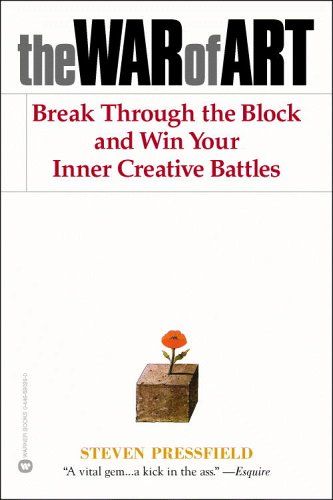
The War of Art
Break Through the Blocks and Win Your Inner Creative Battles
Introduction: The Unlived Life and the Invisible Enemy
Introduction: The Unlived Life and the Invisible Enemy
Nova: Welcome back to the show. Today, we are diving into a book that isn't just a self-help guide; it's a declaration of war against the single greatest obstacle to human achievement. We're talking about Steven Pressfield's seminal work, The War of Art.
Nova: : That title alone sounds intense, Nova. A war? What exactly are we fighting? Is this about external critics or deadlines?
Nova: That’s the brilliant, terrifying twist. Pressfield argues the war isn't fought on the battlefield of public opinion. It’s fought internally, against an invisible, universal, and malevolent force he calls Resistance. It’s the thing that stops you from writing that novel, launching that business, or even just making that difficult, necessary phone call.
Nova: : Resistance. I feel like I know that feeling. It’s that sudden urge to clean the grout in the bathroom when I’m supposed to be outlining a major project. It’s the siren song of social media when the blank page stares back. But Pressfield frames it as a?
Nova: Exactly. He personifies it. Resistance is not just procrastination; it is the enemy of self-realization. It targets anything that moves us toward our highest potential, anything that is truly meaningful. Pressfield claims that if you have a dream, a calling, a piece of work that only you can do, Resistance will show up to stop you. And the more important the work, the stronger the Resistance.
Nova: : So, if I feel intense dread or sudden, overwhelming apathy about starting something I know I should be excited about, that’s not just laziness, that’s the enemy mobilizing?
Nova: Precisely. He links this directly to what he calls 'The Unlived Life.' If you succumb to Resistance, you end up living a life defined by what you do. The book is a survival manual for anyone trying to create something real, something that matters, in the face of this internal sabotage.
Nova: : That’s a heavy premise. It immediately makes me want to put the book down and go check my email, which, I suppose, proves Pressfield’s point immediately. Let’s unpack this enemy first. What are its favorite disguises?
Nova: Let's move into our first core chapter. We need to map the terrain of this internal battlefield.
Key Insight 1: The Nature of the Saboteur
Defining Resistance: The Universal Enemy
Nova: Resistance, according to Pressfield, is a force of nature, like gravity, but it only acts against creative and spiritual endeavor. It’s not a personal failing; it’s an external entity that feeds on our fear. It’s always there, waiting for us to sit down at the desk.
Nova: : If it’s a force of nature, does that mean it’s infallible? Can we ever truly defeat it, or are we just managing it?
Nova: Pressfield is clear: Resistance is infallible in its ability to show up. It never takes a day off. However, he says it has a weakness: it operates by fixed laws. Its primary weapon is fear, and its primary strategy is distraction. Think about the specific ways it manifests. It’s the voice that says, 'You’re not talented enough,' or 'Someone else has already done it better.' It’s the sudden, urgent need to research tangential topics instead of writing the next chapter.
Nova: : I’ve experienced that research rabbit hole firsthand. I’ll be writing about 18th-century naval history, and suddenly I’m three hours deep into the migratory patterns of the Arctic Tern. That’s Resistance using 'curiosity' as a Trojan horse.
Nova: A perfect analogy. Resistance loves complexity and self-doubt. It thrives on the ego. If you are working on something that is purely for ego—say, trying to write a book just to win awards—Resistance might be weaker because the stakes feel lower to the universe, or perhaps the ego itself is too loud to hear the subtle sabotage. But when you are working on something that truly aligns with your soul’s calling, Resistance comes out in full force.
Nova: : So, the more authentic the work, the more vicious the attack. That’s counterintuitive for many people who think success breeds confidence and reduces fear. Pressfield is saying the opposite: greater potential invites greater opposition.
Nova: Absolutely. He notes that Resistance is strongest when we are closest to a breakthrough. Imagine you’re one chapter away from finishing your manuscript. Resistance will throw everything at you: a sudden illness, an urgent family crisis that demands immediate attention, or a crippling bout of perfectionism that makes you want to delete the last five pages.
Nova: : That explains why so many people stall right before the finish line. It’s not exhaustion; it’s a final, desperate siege by the enemy. What about the difference between the amateur and the professional in how they react to this siege?
Nova: That brings us perfectly to the next major theme. The amateur reacts by retreating or negotiating with Resistance. The professional reacts by showing up anyway. It’s the fundamental split in the book.
Nova: : It sounds like the professional has found a way to treat Resistance like bad weather—annoying, but ultimately irrelevant to the schedule.
Nova: Exactly. The professional doesn't wait for the weather to clear. They put on the raincoat and go to work. Pressfield uses powerful language to describe the amateur’s mindset—it’s characterized by waiting for inspiration, waiting for permission, and prioritizing comfort over creation. The professional prioritizes the work itself, above all else. This shift is monumental.
Nova: : I’m fascinated by the idea that Resistance is an external force we can identify. If we can name it, we can fight it. It stops being 'my flaw' and starts being 'the enemy.' That reframing alone must be worth the price of the book.
Nova: It is. It externalizes the problem, which gives us the power to fight back. It’s not 'I am weak,' it’s 'Resistance is trying to stop me.' It shifts the narrative from self-blame to strategic defense. Let’s explore that defense mechanism now: the concept of Turning Pro.
Key Insight 2: Commitment and The Daily Practice
The Amateur vs. The Professional: The Great Divide
Nova: The core of The War of Art is the transition from amateur to professional. The amateur is defined by their relationship to Resistance. They are ruled by it. They treat their creative pursuit like a hobby, something they do when they feel like it, when inspiration strikes, or when the external world permits it.
Nova: : And the professional? What is their defining characteristic? Is it success? Is it getting paid?
Nova: Not necessarily. Pressfield is very clear: the professional is defined by their and their. The professional shows up every day, regardless of how they feel. They treat their art like a job, even if they aren't paid for it yet. They have an internal contract with themselves.
Nova: : So, if I’m a writer who only writes when I’m inspired, I’m an amateur. If I’m a writer who sits down from 9 AM to 1 PM every day, even if I stare at the wall, I’m a professional in training?
Nova: Precisely. The amateur waits for the muse; the professional calls the muse to the office. Pressfield states that the professional understands that inspiration is a byproduct of work, not a prerequisite. He says, 'The amateur waits for inspiration. The professional goes to work.' That simple sentence is the bedrock of the entire book.
Nova: : That requires immense discipline. How does the professional handle the inevitable bad days? The days where the work produced feels like garbage?
Nova: The professional accepts that bad work is part of the process. The amateur sees a bad day’s work as proof that they shouldn't be doing this at all—'See? I told you I wasn't good enough!' The professional sees a bad day’s work as simply paying their dues. They understand that volume and consistency are the only ways to filter out the bad and eventually hit the good. They are playing the long game.
Nova: : It’s like a craftsman. A master carpenter doesn't throw away a whole piece of wood because the first cut was slightly off. They adjust the plane and keep going. The amateur throws the wood away and buys a new piece, blaming the material.
Nova: That’s a fantastic parallel. Furthermore, the professional understands that their commitment is to the, not the. The amateur is obsessed with the result—the book deal, the applause, the recognition. This obsession makes them fragile when Resistance hits, because the outcome feels so far away or so threatened.
Nova: : And the professional? What do they focus on?
Nova: They focus on the next right step. They focus on the next sentence, the next line of code, the next brushstroke. They are present in the work. Pressfield notes that when we are truly present in the work, Resistance loses its footing because it relies on us projecting fear into the future or regret into the past. Presence is anathema to Resistance.
Nova: : I read somewhere that Pressfield suggests that turning pro is like kicking a drug habit—a daily recommitment. That suggests it’s not a one-time decision, but a constant renewal of vows.
Nova: It is a daily rebirth. You wake up, and Resistance is waiting, ready to convince you that yesterday’s success means nothing, or that today you deserve a break. The professional says, 'No, thank you. I have an appointment with my craft.' This daily confrontation is what builds the muscle of creative courage. It’s the difference between having a talent and actually an artist. Talent is a gift; professionalism is a choice.
Key Insight 3: Tools for Victory and Embracing the Struggle
The Path to Pro: Daily Warfare Tactics
Nova: So, we’ve defined the enemy, Resistance, and we’ve defined the ideal warrior, the Professional. Now, we need the tactical manual. What are the concrete actions Pressfield prescribes for winning this war day after day?
Nova: : Beyond just 'showing up,' what are the specific maneuvers? Because showing up when you feel terrible is one thing, but how do you maintain the of that showing up?
Nova: The first tactic is radical self-reliance and detachment from external validation. The professional does not work for praise or money initially. They work because the work demands to be done. Pressfield emphasizes that when you are an amateur, you are constantly looking over your shoulder, checking if people approve. When you turn pro, you look only at the work in front of you.
Nova: : That detachment is hard. We live in a culture that constantly demands we broadcast our process for likes and validation. How do you detach when the whole world is built around sharing?
Nova: You have to create sacred space. Pressfield suggests that the professional’s work is sacred and must be protected. This means setting boundaries, not sharing works-in-progress until they are ready, and refusing to engage in the drama of comparison. You must treat your creative time as non-negotiable, like a doctor’s appointment or a critical meeting with a major client.
Nova: : I like the idea of treating our creative time as a client meeting. It immediately elevates the seriousness of the commitment. What about the fear of failure? That’s a huge component of Resistance for me.
Nova: Pressfield addresses this by reframing failure. For the professional, failure is simply data. It’s a necessary part of the iteration process. The amateur fears failure because they believe it invalidates their inherent worth. The professional knows that the only true failure is not attempting the work at all—that’s the Unlived Life.
Nova: : So, if I write a terrible first draft, the amateur says, 'I’m a fraud.' The professional says, 'Great, now I have something to edit.' It’s about embracing the messiness of creation.
Nova: Exactly. And this leads to the concept of 'doing the work' as a form of spiritual practice. Pressfield often draws parallels between the artist and the monk or the warrior. The discipline required is devotional. You must serve the work, not your ego’s desire for immediate gratification. He suggests that when you are in the flow of serving the work, you are tapping into something larger than yourself—what he sometimes calls the Muse or the higher power.
Nova: : That elevates the entire endeavor. It’s not just about making a living; it’s about fulfilling a higher purpose. Are there any specific, almost ritualistic actions he recommends for maintaining this professional stance?
Nova: Yes. He champions consistency above all. He often cites the idea of 'showing up every day, even if it’s just for fifteen minutes.' It’s about establishing the habit so firmly that Resistance finds it harder to break through the routine. Furthermore, he advises speaking encouragement, not criticism, to yourself and others engaged in similar pursuits. Resistance loves internal and external negativity; starve it of that fuel.
Nova: : So, the tactical summary is: Protect your time fiercely, detach from outcome validation, accept that bad work is part of the contract, and show up consistently, treating the process as sacred service. That feels actionable, even if it’s incredibly demanding.
Nova: It is demanding, but the reward isn't just the finished product; it's the person you become in the process of fighting the war. It’s about forging your character through creative struggle. Let’s wrap this up by synthesizing what this means for our listeners' daily lives.
Conclusion: Winning the War and Living Fully
Conclusion: Winning the War and Living Fully
Nova: We’ve traversed the landscape of creative warfare today, from identifying the insidious nature of Resistance to adopting the unwavering stance of the Professional. The key takeaway, if we distill Pressfield’s powerful message, is that the battle is real, but the tools for victory are simple: commitment and consistency.
Nova: : It’s a powerful reframing. We often look for external validation or a magic trick to unlock creativity. Pressfield tells us the magic trick is just sitting down and doing the work, day after day, treating that commitment as sacred.
Nova: He’s essentially telling us that the path to fulfillment isn't about avoiding the struggle; it’s about choosing the struggle. The struggle against Resistance is hard, but it leads to growth and the creation of something meaningful. The struggle of doing the work leads only to regret and the Unlived Life.
Nova: : So, for our listeners who feel stuck right now—maybe they’re staring at a project that feels too big, too scary, or too pointless—what is the single most actionable piece of advice they can take away from this conversation?
Nova: It’s this: Identify the one thing Resistance is telling you to do today. That is your highest priority. Don't try to conquer the entire mountain; just take the next step toward it. Sit down. Open the file. Write one sentence. Do it without judging it. Do it because you are now a professional, and professionals honor their commitments.
Nova: : And remember that Resistance will scream louder the closer you get to success. Don't mistake that internal noise for a sign you should stop. Mistake it for a sign that you are finally on the right track.
Nova: Exactly. The intensity of the internal battle is a direct measure of the importance of the work. Embrace the war, because winning it means finally living the life you were meant to live. It means becoming the person who does the work.
Nova: : A truly transformative concept. Thank you, Nova, for guiding us through this essential battle plan.
Nova: My pleasure. Keep showing up, keep fighting the good fight, and remember the core lesson: The War of Art is won not by genius, but by tenacity. This is Aibrary. Congratulations on your growth!