

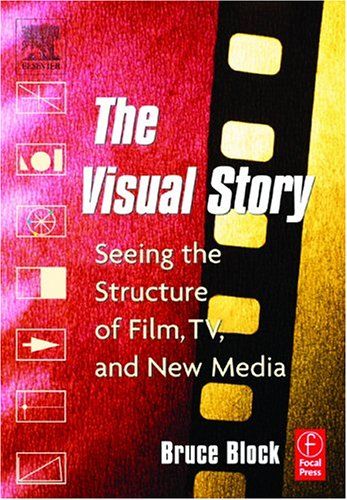
The Visual Story
Introduction
Nova: Picture this. You're watching a film, and something feels off. The scene is supposed to be tense, but somehow you're not on the edge of your seat. Or maybe you're watching a quiet, tender moment that feels oddly chaotic. You can't quite name what's wrong, but your gut knows. Welcome to the hidden world of visual structure — the language every filmmaker speaks, whether they know it or not.
Nova: I'm Nova, and today we're diving into a book that has become nothing short of a bible for visual storytellers: The Visual Story by Bruce Block. It's taught at USC, it's on the shelf of working directors, cinematographers, animators, and game designers — and yet, most people have never heard of it.
Nova: So here's the big question: what if I told you that every single image you've ever seen on screen can be broken down into just seven building blocks? And that the difference between a scene that grips you and one that falls flat comes down to a single principle? That is the radical promise of this book.
Nova: Fair warning — once you learn Bruce Block's framework, you will never watch a movie the same way again.
Who is Bruce Block?
The Man Behind the Method
Nova: So before we unpack the framework, let's talk about the guy who built it. Bruce Block is not just some academic writing from an ivory tower. He's been in the trenches of Hollywood for over four decades. His producing credits include massive hits — Father of the Bride, The Parent Trap, What Women Want, Something's Gotta Give, America's Sweethearts.
Nova: And that's just producing. He's also been a visual consultant on films like As Good As It Gets, Stuart Little, The Holiday, and Spanglish. When James L. Brooks or Nancy Meyers needs someone to look at the visual language of a film, they call Bruce Block.
Nova: But here's what I find most fascinating: for forty-four years, Block has been teaching a course at USC's School of Cinematic Arts called Visual Expression. It's iconic. Generations of filmmakers — some of whom are now running studios — have sat in that room learning to see images differently.
Nova: And The Visual Story, now in its third edition from 2021, is essentially that course in book form. Seven hundred plus full-color illustrations, every principle demonstrated with actual film stills. It's dense, but not in an academic way. It's dense like a toolkit.
Nova: The thing about Block is that he doesn't give you rules. He gives you a vocabulary. He says, look, you wouldn't try to write a screenplay without understanding words and sentences. So why would you try to direct a film without understanding the grammar of images? It's that simple — and that radical.
Space, Line, Shape, Tone, Color, Movement, Rhythm
The Seven Building Blocks
Nova: Alright, let's get into the heart of the book. Block says every image you will ever create — whether it's a film frame, an animation still, or a video game environment — is built from exactly seven visual components.
Nova: Ready? Space. Line. Shape. Tone. Color. Movement. Rhythm.
Nova: Now these aren't just labels. Each one is a dial you can turn. Let's go through them quickly. Space is the foundation. Block breaks it into four types: deep space, which uses perspective and depth cues to create a three-dimensional illusion; flat space, which emphasizes the two-dimensionality of the screen; limited space, which is a hybrid; and ambiguous space, where the viewer can't quite figure out what they're looking at — think of those disorienting shots in a thriller where you don't know the size of a room or where the camera is.
Nova: Then there's Line. Here's a mind-bender: lines don't actually exist. Lines are visible only where there's tonal contrast. A black line on a black background is invisible. Block identifies seven different ways lines appear — edges, contours, intersections of planes, axes, even the invisible tracks left by moving objects.
Nova: Shape follows from Line. And Block is ruthlessly reductive here. He argues that all shapes essentially boil down to three: the circle, the square, and the equilateral triangle. Circles read as friendly and passive. Squares feel direct, industrial, ordered. Triangles? Aggressive, dynamic, chaotic. It sounds absurdly simple until you start noticing it everywhere. Villains are often framed with triangular compositions. Warm family moments lean circular.
Nova: Then Tone — which is just brightness, independent of color. Where does your eye go first in a frame? To the brightest spot. Always. Then Color, which Block treats as its own vast subject, but with a clear system around hue, saturation, and brightness. Then Movement — object movement, camera movement, and the point of attention movement as the viewer's eye tracks across the frame. And finally Rhythm — the pattern of visual events over time, created by alternation, repetition, and tempo.
Nova: Seven components. That's it. Every breathtaking image you've ever seen — from Lawrence of Arabia to Spider-Verse to The Last of Us — is just these seven things arranged in some specific combination.
Contrast, Affinity, and Visual Intensity
The Master Key
Nova: Okay, so you've got your seven components. But what do you actually do with them? This is where Block introduces what he calls the Principle of Contrast and Affinity — and honestly, this is the idea that changes everything.
Nova: Contrast means difference. Affinity means similarity. The principle is shockingly simple: the greater the contrast in any visual component, the greater the visual intensity. The greater the affinity — meaning things are similar — the lower the visual intensity. That's it. That's the whole engine.
Nova: Think about it this way. If you have a frame where everything is the same tone — all mid-gray — you've got high affinity. The image feels calm, maybe even flat. But introduce a single bright white element against a deep black background? Maximum contrast. Your eye snaps to it. Your pulse quickens slightly. The image has visual intensity.
Nova: Now here's where it gets really powerful. This principle applies across all seven components simultaneously. You can have contrast in space — shifting from deep space to flat space between shots. Contrast in line — going from calm horizontals to aggressive diagonals. Contrast in color — warm versus cool. Contrast in movement — stillness versus chaos. And rhythm — slow, regular tempo versus fast, irregular beats.
Nova: Every single cut in a film is an opportunity to increase or decrease contrast in one or more of these components. And Block's big argument is that your visual structure should mirror your narrative structure. When your story's conflict is escalating, your visuals should escalate in contrast. When you reach a moment of resolution, your visuals should shift toward affinity — toward calm.
Nova: This is what Block means when he says visuals aren't decoration. They're a parallel storytelling track. The audience feels it even if they can't articulate it. And when the visual structure contradicts the story — calm visuals during a tense scene, chaotic visuals during a quiet one — the audience experiences a kind of cognitive dissonance. Something feels wrong, and they don't know why.
Training Your Eye and Breaking Stereotypes
Seeing the Unseen
Nova: One of the most practical parts of the book is Block's emphasis on training your perception. He doesn't just want you to understand the theory. He wants you to see it — in real time, while watching a film or walking down the street. And he offers techniques for this.
Nova: For example, he suggests watching a scene with the sound off. What story do the visuals alone tell? If they tell no story — if the visual choices are neutral or random — you're leaving an entire narrative channel unused. Another technique: squint at an image to reduce it to its basic tonal masses and linear motifs. That's a quick way to check what your composition is actually doing.
Nova: He's also very clear about something that a lot of visual theory books get wrong. He warns against visual stereotypes. Red doesn't have to mean danger. A low-angle shot doesn't have to mean power. These are conventions, not laws. If you always reach for the same visual clichés, you end up with boring, predictable images. The point of understanding the components is to make deliberate, thoughtful choices — not to follow a formula.
Nova: And here's a subtle but profound point Block makes: understanding visual structure doesn't kill creativity. It enables it. It's like learning grammar before you write poetry. You can't break the rules intentionally unless you know what the rules are. When a cinematographer like Roger Deakins or a director like Denis Villeneuve makes a bold visual choice, they're not guessing. They know exactly which component they're manipulating and what effect it will have.
Nova: Block also talks about visual progressions — the transformation from one visual state to another over the course of a film. Just as a story has exposition, rising action, climax, and resolution, the visual structure should have a journey too. Maybe the film starts with flat, graphic compositions and gradually opens up into deep, immersive space. Maybe the color palette shifts from desaturated to vibrant. These progressions operate below conscious awareness, but they're felt powerfully by the audience.
Nova: One reviewer of the book put it perfectly: your audience is reading the visuals as story whether you designed them to be read that way or not. The only question is whether you're doing it on purpose.
Conclusion
Nova: So let's bring this home. Bruce Block's The Visual Story gives us a complete grammar of the screen. Seven components — space, line, shape, tone, color, movement, and rhythm. One governing principle — contrast creates intensity, affinity creates calm. And one mission — to make visual structure as intentional and expressive as the words in a script.
Nova: What I find so compelling about this book is that it works at every scale. It applies to the single frame and to the entire arc of a feature film. It works for live-action cinematography, for 3D animation, for video game environment design, and even — as one reviewer noted — for conference posters and graphic design. The fundamentals don't change.
Nova: The actionable takeaway is this: the next time you watch a film or a show, try something Block suggests. Turn off the sound. Watch a scene purely for its visual structure. Where is the contrast? Where is the affinity? What are the lines doing? The shapes? The rhythm? You'll be shocked by how much story is being told through imagery alone.
Nova: And if you're a creator — a filmmaker, a photographer, a designer — the book offers an even bigger challenge. Don't let your visuals be accidental. Don't leave that entire narrative channel unused. Learn the components. Master the principle. Then go break every rule with intention.
Nova: Bruce Block has been teaching this for over four decades, and the book is now in its third edition for a reason. It's not a trendy guide. It's not a bag of tricks. It's the operating system underneath every image you've ever loved.
Nova: This is Aibrary. Congratulations on your growth!