

Beyond the Gym: Mastering Mental Resilience for Peak Performance
Golden Hook & Introduction
SECTION
Nova: What if the biggest barrier to your peak performance isn't stress itself, but your deeply ingrained belief that stress is always bad? We're talking about a fundamental misinterpretation that could be holding back your strategic edge.
Atlas: Wait, so you're saying my drive to avoid stress is actually counterproductive? That feels... inefficient. As someone always looking for the most optimized path, that's almost counterintuitive.
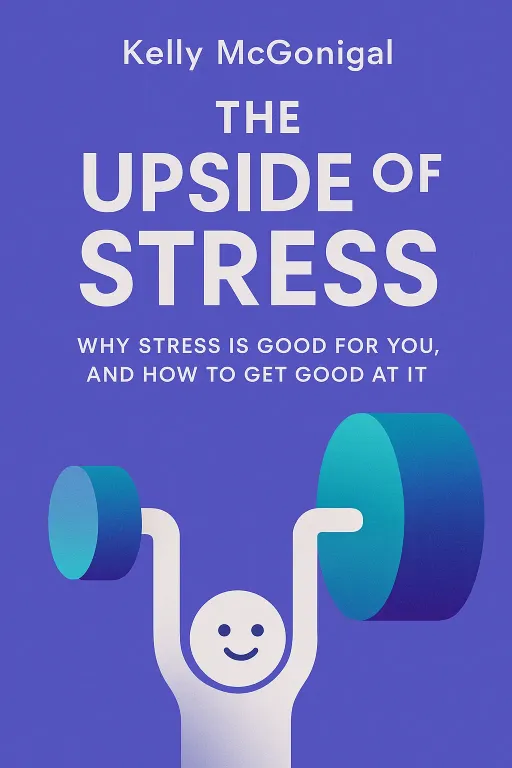
Nova: Absolutely, Atlas. And that's precisely what we're dissecting today. We're diving into a concept that flips that script entirely, largely inspired by Kelly McGonigal's groundbreaking work, "The Upside of Stress." McGonigal, a health psychologist at Stanford, actually started her career advising people to stress, teaching them coping mechanisms. But her research, her deep dives into human physiology and psychology, led her to a profound, almost counter-intuitive realization that completely transformed her perspective and, frankly, the entire field.
Atlas: Oh, I like that. A researcher challenging her own foundational beliefs. That’s the kind of intellectual honesty I respect. But for someone trying to master competitive digital marketing tools, where the pressure is relentless, isn't stress just a signal you're overwhelmed? How is an advantage? It usually feels like a drain on productivity.
Nova: It’s a brilliant question, and it gets to the heart of what McGonigal discovered. See, our bodies react to stress in very specific ways: heart rate increases, breathing quickens, blood flow is redirected to major muscles. For a long time, we were taught to interpret these as signs of fear, of breaking down.
Atlas: Right, like your body is screaming, "Run away!" or "You're not ready!"
Nova: Exactly. But McGonigal found that those very same physiological responses—the racing heart, the quickened breath—are identical to what happens when you’re excited, energized, or preparing for peak performance. It’s your body gearing up, preparing to meet a challenge. The crucial difference isn't the physical response, it's the.
Atlas: So, it's all about narrative? That’s a powerful idea for anyone in marketing, or really, anyone trying to frame a strategy. If I tell myself my racing heart means I’m about to crush this presentation, instead of I’m about to fail, the outcome changes?
The Strategic Reframing of Stress: From Threat to Opportunity
SECTION
Nova: Precisely. And the research supports this with remarkable clarity. In one compelling study, participants were given a high-pressure task, something like a public speaking engagement or a difficult math test under time constraints. Half were told, "Your stress response is a sign that your body is preparing for action; it's giving you energy." The other half received no such instruction.
Atlas: And the measurable outcome? Did the "strategic narrative" group perform better?
Nova: Absolutely. The group that reframed their stress as a performance enhancer didn't just better; they actually performed better on the tasks. Their physiological responses, like their cardiovascular efficiency, became healthier, showing less constriction in their blood vessels, which is typical of a threat response, and more dilation, which is typical of a challenge response. Their bodies were literally more optimized for performance.
Atlas: That’s fascinating. So, for a strategic analyst in a high-stakes environment, facing a new, complex digital marketing tool—let’s say, a cutting-edge AI for predictive analytics—instead of thinking, "This is overwhelming, I might not grasp it," I should think, "My body's preparing to absorb this, to master it"? It's like a pre-game ritual for the mind.
Nova: It's exactly that, Atlas. It's a fundamental shift from perceiving stress as a debilitating force to seeing it as a strategic ally. Think of it like this: when you're about to lift a heavy weight at the gym, your body tenses, your heart rate spikes. You don't interpret that as a sign of weakness; you interpret it as your body getting ready to execute. Why should the mental equivalent be any different?
Atlas: That’s a great analogy. It makes the abstract feeling of stress suddenly feel very concrete and actionable. So, the first tangible improvement here is literally just changing the internal monologue around stress?
Nova: Yes, and it has profound implications for anyone striving for mastery. Because this isn't just about single events; it ties into how we approach continuous learning and long-term growth, which brings us to Carol Dweck's groundbreaking work on "Mindset."
The Growth Mindset: Fueling Continuous Mastery
SECTION
Nova: Dweck's research, especially in her book "Mindset," introduces the powerful distinction between a fixed mindset and a growth mindset. A fixed mindset believes your abilities, your intelligence, your talents, are static. You either have them or you don't.
Atlas: I can already see how that would be a huge barrier to accelerated career growth. If I believe I'm just "not good at coding," for example, I'd never try to master a new programming language crucial for a niche specialization.
Nova: Precisely. And when someone with a fixed mindset encounters a challenge, or experiences stress, they interpret it as a threat to their inherent ability. "If I struggle, it means I'm not smart enough." The stress becomes a confirmation of their inadequacy, leading to avoidance or giving up.
Atlas: That sounds like a fast track to stagnation. But the growth mindset... that's where the opportunity lies, I assume?
Nova: Absolutely. A growth mindset, on the other hand, believes that your abilities can be developed through dedication and hard work. Brains and talent are just starting points. This perspective completely transforms how you approach challenges and, crucially, how you experience the stress that comes with them.
Atlas: So, when I hit a wall trying to integrate a new marketing automation platform, instead of feeling like an imposter, I should see it as a signal that I'm expanding my capabilities? That the struggle itself is part of the learning curve?
Nova: Exactly. Dweck's research with students vividly illustrates this. When students with a growth mindset were faced with difficult problems—problems designed to induce a healthy amount of intellectual stress—they persisted longer. They didn't see the difficulty as a sign of failure but as an opportunity to engage more deeply, to learn new strategies. The was their belief in their ability to grow and improve. The involved interpreting mistakes not as personal shortcomings, but as valuable data points, engaging in deeper processing and problem-solving.
Atlas: And the? More learning, better long-term results, I'm guessing?
Nova: You got it. They showed enhanced learning, greater resilience in the face of setbacks, and ultimately superior long-term achievement. For anyone cultivating a niche specialization or aiming for advanced digital marketing tools, where continuous learning is non-negotiable, this is absolutely critical. The stress of learning something new isn't a barrier; it’s the friction that hones your edge.
Atlas: That’s powerful. But for someone in a high-pressure environment, where failure can feel like a setback to career growth, how do you actively this growth mindset? Is it just positive thinking, or are there concrete steps to make this mindset shift a strategic asset? I need measurable, actionable steps.
Nova: That’s a crucial distinction, Atlas. It's far more than just positive thinking. It's about actionable strategies. First, focus on effort and process over innate talent. When you achieve something, acknowledge the hard work and strategies you employed, not just "I'm good at this." Second, seek feedback not as judgment, but as information for improvement. Every critique, every failed experiment in a campaign, is a data point. Third, view errors as essential parts of the learning journey. A mistake isn't a dead end; it's a detour sign telling you to try a different route.
Atlas: So, if a new campaign flops, instead of "I'm a bad marketer," it's "Okay, what data did this provide? What can I learn to optimize the next one?" It frames failure as input, not identity. That's a huge shift in perspective for anyone driven by measurable outcomes.
Synthesis & Takeaways
SECTION
Nova: It is. And this is where McGonigal and Dweck converge beautifully. The ability to strategically reframe stress, seeing it as your body and mind preparing for action, is fundamentally powered by a growth mindset. It's not just a feel-good psychological trick; it's a strategic feedback loop. The more you believe you can grow, the more effectively you can channel stress into performance.
Atlas: So, it's not just about 'coping' with stress, it's about actively it as a strategic signal, almost like performance analytics, to refine your approach and accelerate your growth trajectory. The stress isn't the enemy; it's the internal alarm system telling you something important is happening, and it's time to engage at a higher level.
Nova: Exactly. For those seeking mastery, for those aiming for competitive advantage and accelerated career growth, stress isn't a bug in the system, but a fundamental feature. It's the body and mind's way of saying, "This matters, engage! This is an opportunity to learn, to adapt, to become more." Embracing that discomfort, that feeling of being challenged, is the clearest indicator that you are on the path to becoming a recognized specialist, to truly mastering your domain.
Atlas: I like that. It reframes the entire experience of high-stakes work. Next time you feel that pressure, that surge of cortisol, ask yourself: Is this truly a threat, or is it my body and mind gearing up for the next level of mastery?
Nova: Embrace that discomfort. It's the signal you're growing. This is Aibrary. Congratulations on your growth!









