Beyond the Band-Aid: Understanding Stress to Build True Resilience.
Golden Hook & Introduction
SECTION
Nova: Here's a radical thought for you, Atlas, and for everyone listening: what if everything you've been told about stress is wrong? What if the very thing we try to avoid at all costs is actually a hidden superpower, waiting to be unleashed?
Atlas: Wait, Nova, you’re telling me all those sleepless nights, the pounding heart, the sheer panic before a big presentation – those weren't just terrible, but potentially… good? Because honestly, that sounds a bit out there. My body certainly doesn't feel like it's discovering a superpower when I'm stressed.
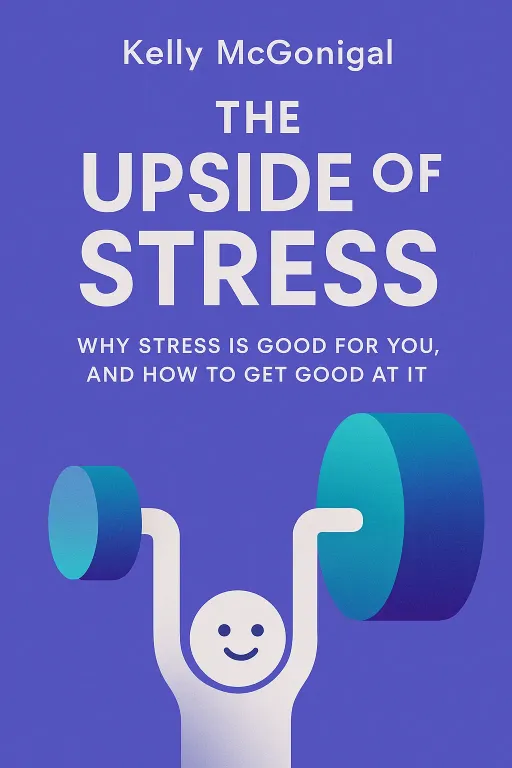
Nova: I know, right? It feels completely counterintuitive. But that's exactly the provocative, deeply researched premise of a book we’re diving into today: "The Upside of Stress" by the brilliant health psychologist, Kelly McGonigal. What’s fascinating about McGonigal is her own journey. She started her career at Stanford teaching a course on stress, actively helping people minimize its impact. But as her research evolved, she had this profound realization that our towards stress, more than the stress itself, dictates its effects. She completely re-evaluated her stance and became an advocate for embracing stress.
Atlas: Oh, I love that – a researcher completely changing their mind based on new evidence. That's a true growth mindset in action! But how does such a fundamental shift in perspective, especially around something as universally dreaded as stress, even begin to happen?
Nova: Well, it really starts by understanding that stress isn’t just one thing. It's not a monolithic villain. It’s a complex physiological and psychological response, and our interpretation of it shapes that response dramatically.
The Transformative Power of Stress Mindset - Threat vs. Challenge
SECTION
Nova: McGonigal’s core argument, which she backs with incredible science, is that how we stress fundamentally changes our body’s reaction. When we see a stressful situation as a 'threat' – something that will overwhelm us, something we can't handle – our body goes into that classic fight-or-flight mode. Our blood vessels constrict, our heart pounds, and we become hyper-focused on survival. It's debilitating.
Atlas: Yeah, I know that feeling all too well. It’s like your body is actively working against you, making it impossible to think clearly or perform your best. But then, what’s the alternative? How does someone actually to see a looming deadline, a tough conversation, or a huge project as a 'challenge' instead of just sheer panic? Can you give an example?
Nova: Absolutely. Think about public speaking. For many, it’s a classic stressor. If you perceive giving a speech as a 'threat' – "I'm going to mess up, everyone will judge me, my career will be over" – your body tenses, your voice might shake, your mind blanks. You're trying to escape. But if you reframe it as a 'challenge' – "This is an opportunity to share my ideas, to connect with the audience, I can push myself and learn" – your body reacts differently. Your heart still pounds, you still feel energized, but your blood vessels constrict. Your body is preparing you for performance, for engagement, not for escape. It’s a readiness response, not a panic response.
Atlas: So, the physical sensations might feel similar – the rush, the heightened awareness – but the internal interpretation completely shifts the physiological outcome. That’s fascinating. It’s like the difference between a car engine redlining because it's about to blow, versus redlining because it's winning a race.
Nova: Exactly! And this is where Carol Dweck’s work in "Mindset" perfectly converges with McGonigal’s. Dweck, as you know, introduced the concepts of fixed and growth mindsets. A fixed mindset believes our abilities are static – "I'm either good at this or I'm not." A growth mindset believes our abilities can be developed through dedication and hard work. When you apply a growth mindset to stress, you automatically start viewing those stressful situations as opportunities for learning and development, rather than insurmountable obstacles that expose your limitations.
Atlas: Okay, I can see how those two ideas reinforce each other. But in the moment of genuine failure, when you feel like you've let everyone down, or a project completely tanks, how do you pivot to 'growth opportunity' instead of 'I'm a complete failure'? That's a tough mental leap, especially for a curious learner who probably puts a lot of pressure on themselves to get things right.
Nova: It is a tough leap, and it’s not about instantly feeling gleeful about failure. It’s about the. Let’s imagine a hypothetical scenario: you've poured months into a major project at work, and it falls completely flat. A threat mindset, or a fixed mindset, might lead you to despair, to hide, to internalize it as "I am a bad project manager." You shut down. A challenge mindset, fueled by a growth mindset, acknowledges the pain, but then pivots to, "What did I learn here? What went wrong? How can I improve next time?" Your body, instead of being flooded with cortisol telling you to escape, is actually preparing you to problem-solve, to connect, to adapt.
Atlas: That's a great example. So it’s not just about positive thinking; it’s about activating a different set of physiological and cognitive resources. It prepares you to engage with the problem, not flee from it. Like a video game boss battle – you don't just stare at the screen and cry, you strategize, you learn attack patterns, you try again.
Nova: Precisely. And McGonigal even talks about the physiological differences: when you view stress as a challenge, your cardiovascular system becomes more efficient. Your heart still beats faster, but your blood vessels stay relaxed. This is a healthier stress response, associated with courage and resilience. When you view it as a threat, your vessels constrict, which over time can be detrimental.
Atlas: Wow, that’s genuinely counterintuitive. We're taught to avoid stress at all costs, to eliminate it. But our culture practically screams that stress is the enemy. How do you really rewire that deeply ingrained narrative? It sounds great in theory, but it feels like fighting an uphill battle against decades of conditioning.
Nova: You're absolutely right, it's a practice, not a switch. It starts with awareness. The next time you feel stress, instead of automatically thinking "this is bad," pause and ask: "What is this stress preparing me for? What challenge is it asking me to meet?" It's about consciously interpreting those physical sensations – the rapid heartbeat, the surge of energy – not as signs of danger, but as your body getting ready to perform. It also helps to remember that humans are hardwired to connect, and stress can actually trigger what's called the "tend and befriend" response.
Deepening the Resilience Connection & Practical Application
SECTION
Nova: This is another incredible insight from "The Upside of Stress." When we're under pressure, our bodies release oxytocin, the "cuddle hormone," which actually motivates us to seek support and strengthen social bonds. So, the very thing that makes us feel overwhelmed can also be a catalyst for deeper connection and collective resilience. Think about communities pulling together after a natural disaster – that intense stress often forges incredible bonds and collective action.
Atlas: So, the very thing that makes us feel isolated can actually be a catalyst for deeper connection? That's genuinely counterintuitive! I always thought stress made people withdraw or lash out. Can you give an example of how this plays out in daily life, beyond a major crisis?
Nova: Of course. Imagine you and your team are facing an impossible deadline for a presentation. Instead of everyone retreating to their own corners, panicking individually, a challenge mindset encourages you to reach out, collaborate, share the burden. You might say, "Hey, this is huge, but we're in this together. How can we combine our strengths to get this done?" That act of reaching out, of tending to your social connections, and befriending your colleagues under pressure, is directly fueled by that stress response. It builds trust and collective resilience, not just gets the job done.
Atlas: That’s a powerful shift. It moves from a solitary burden to a shared mission. It makes me think about the deep question you posed in the book content: "Think of a recent stressful event. How might viewing it as a 'challenge' rather than a 'threat' change your reaction next time?" For me, it would totally change how I approach those moments of overwhelm, looking for connection instead of just white-knuckling it alone.
Nova: Exactly. It's about stepping into that power. It's realizing that the stress response itself isn't the enemy; it's a built-in biological mechanism designed to help us rise to challenges, to learn, to grow, and to connect.
Synthesis & Takeaways
SECTION
Nova: So, ultimately, what Kelly McGonigal and Carol Dweck illuminate for us is this profound truth: stress isn't the problem; our mindset about it is the solution. When we embrace stress, not as a sign of weakness or impending doom, but as an energizing signal that something important is at stake, something worth our effort, we transform it. We turn it into a powerful tool for resilience, for enhanced performance, and surprisingly, for deeper human connection. It's less about eliminating stress, and more about mastering our relationship with it, transforming it into a fuel for growth.
Atlas: That's actually really inspiring. It means we're not victims of our circumstances, but active participants in shaping our internal and external responses. It's a continuous practice, but one that promises a richer, more resilient life. It's about seeing the fire not as something that burns, but as something that forges.
Nova: A beautiful way to put it, Atlas. And it's a shift that's accessible to everyone. The next time you feel that familiar surge of stress, just pause. Ask yourself: "What if this feeling isn’t here to break me, but to make me?"
Atlas: What if, indeed? What a powerful question to carry into our week.
Nova: This is Aibrary. Congratulations on your growth!