

Reclaiming Calm and Unshakable Confidence
Golden Hook & Introduction
SECTION
Nova: Every time you experience a moment of high-stakes pressure, your brain is running a background process you probably haven't optimized. It feels like a personality flaw, but it is actually a recurring logic error.
Atlas: That is a sharp way to put it. Most of us treat stress like an external weather event, something that just happens to us. But if we start looking at it as an inefficient piece of code, we can actually debug it.
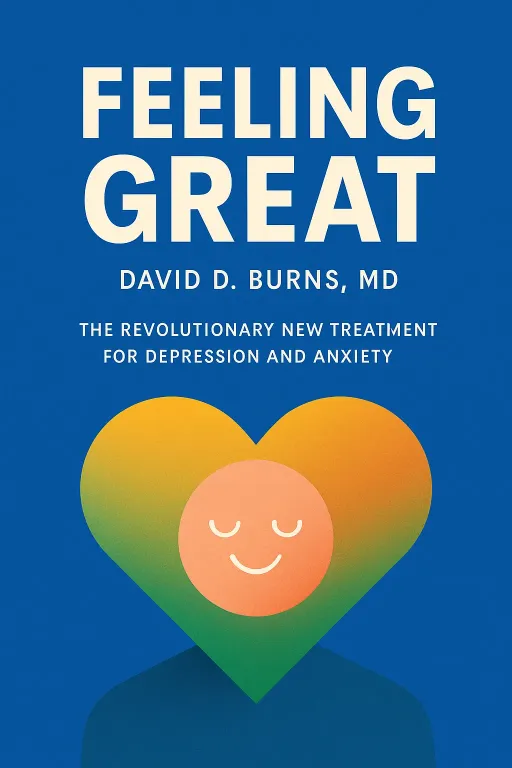
Nova: Exactly. Today we are looking at two very different, yet surprisingly complementary frameworks for reclaiming your mental bandwidth. We are diving into Feeling Great by David D. Burns, who is a pioneer in the field of cognitive behavioral therapy, and The Universe Has Your Back by Gabrielle Bernstein, a teacher who focuses on shifting from fear to trust.
Atlas: These two approach the same problem from opposite ends of the spectrum. Burns is coming from the clinical, data-driven side of psychology, the kind of work he developed during his tenure at Stanford. Bernstein is coming from a perspective of spiritual alignment and surrender. Bringing them together feels like the perfect blueprint for anyone who needs to be both precise and resilient.
The Mechanic of the Mind
SECTION
Nova: Let us start with the mechanics. Burns argues that what we call anxiety or self-doubt is often rooted in what he calls cognitive distortions. These are specific, predictable patterns of thinking that are objectively false. They are the logical fallacies of your own internal monologue.
Atlas: I have always found that concept fascinating because it de-personalizes the struggle. When you have a thought like, I am going to fail this presentation, you feel like that is a truth you are observing. But Burns suggests that is actually a distorted filter on your camera.
Nova: That is the perfect analogy. Imagine you are wearing blue-tinted glasses. Everything you see looks blue. You are not lying to yourself when you say the world is blue, but you are failing to account for the lens you are wearing. For the architects and builders listening, think of this as a diagnostic tool. If your project is failing, you do not just throw the whole thing away; you look for the specific point of failure in the system.
Atlas: That resonates because it turns the emotional experience into a technical challenge. If I am in a meeting and I get a piece of critical feedback, my immediate reaction is often all-or-nothing thinking. I interpret one critique as a total indictment of my competence. That is a distortion, right?
Nova: It is the classic definition of it. You are taking a single data point and extrapolating it to mean the entire system is broken. Burns would tell you to catch that thought, label it as all-or-nothing thinking, and then run a cost-benefit analysis on it. Ask yourself: Is this thought helping me solve the problem, or is it just paralyzing my ability to execute?
Atlas: I can see how that would be incredibly liberating. It moves you from being a victim of your emotions to being an operator of your mind. But what happens when you have diagnosed the distortion and you still feel the weight of the anxiety? Is logic always enough to override the physical sensation of fear?
Nova: That is where the limitation of pure logic becomes clear. You can identify that your fear is irrational, but your nervous system is still responding to the threat. And that is exactly why we need to bridge the gap between the analytical mind and the intuitive, trust-based side of things.
The Strategic Surrender
SECTION
Atlas: That brings us to the other side of the equation. If Burns is about debugging the software, Bernstein seems to be about changing the power source. Her work in The Universe Has Your Back is all about shifting from a state of control to a state of surrender.
Nova: Surrender is a word that can trigger a lot of resistance, especially for high-achievers. It sounds like giving up. But in this context, it means something entirely different. It is about releasing the desperate need to control every single variable in an environment that is fundamentally chaotic.
Atlas: I struggle with that, and I know a lot of our listeners do too. If you are a builder or a leader, your entire value proposition is often based on your ability to control outcomes. You plan, you execute, you mitigate risk. When you talk about surrender, how does that fit into a world where execution is everything?
Nova: Look at it this way. You can control your input, your effort, and your strategy. But you cannot control the market, the timing, or the response of other people. The suffering comes when you try to force an outcome that is outside of your influence. Bernstein argues that when you shift from a fear-based need for control to a trust-based approach, you actually become more effective.
Atlas: That sounds counterintuitive. How does letting go of the outcome make you more effective?
Nova: Because you are reclaiming the energy you were wasting on anxiety. When you are constantly bracing for impact, you are not present. You are operating from a place of defense. When you trust that you can handle whatever outcome arises, you can focus all your resources on the present moment. It is the difference between driving a car with a death grip on the steering wheel versus driving with a relaxed, responsive hand.
Atlas: That is a great analogy. The person with the death grip is going to overcorrect at the first bump in the road. The person who is relaxed is going to steer through it.
Nova: Exactly. Bernstein’s philosophy is that when you stop trying to micromanage the universe, you align yourself with a broader perspective. You stop viewing every setback as a catastrophe and start viewing it as data. It changes your relationship with the unknown.
Synthesis and Application
SECTION
Atlas: So, we have the cognitive tools from Burns to handle the internal logic errors, and we have the philosophical shift from Bernstein to handle the external uncertainty. If I am a builder, how do I actually integrate these two in my daily work?
Nova: You start with the Tiny Step. The next time a wave of self-doubt hits you at work—maybe you are procrastinating on a project because you are afraid of the result—you stop and write it down. You explicitly name the automatic negative thought.
Atlas: Right, like, I am not smart enough to lead this team.
Nova: Then you identify the cognitive distortion. In that case, it is likely labeling or all-or-nothing thinking. Then, you counter it with a realistic, positive truth. You do not just say, I am great. You say, I have successfully led projects before, and I have the resources to learn what I do not know yet.
Atlas: And then, once you have neutralized the distorted thought, you apply the Bernstein layer of surrender. You tell yourself, I have done the work, I have checked my logic, and now I release the need for the outcome to look a specific way. I trust my ability to navigate whatever happens next.
Nova: That is the synthesis. You are using the analytical mind to clear the path and the trust-based mind to walk it with confidence. You are not ignoring the risks, and you are not being naive. You are just refusing to let your own mind sabotage your performance.
Atlas: It makes sense. You are essentially building a system where your internal monologue supports your external goals rather than working against them. You are auditing your thoughts like you would audit a project plan.
Nova: That is the goal. You are not trying to eliminate the human experience of doubt. You are trying to make sure that doubt does not become the architect of your reality.
Atlas: I like that. It moves the needle from just coping to actually building a legacy. It is about balancing that professional success we all crave with the personal peace that makes it sustainable.
Nova: And that is the foundation of true, unshakable confidence. It is not the absence of fear, but the presence of a system that knows how to handle it.
Atlas: This has been a great way to reframe the daily grind. It makes the intangible feel very concrete.
Nova: I am glad we could break it down. It is all about focusing on the few ideas that actually move the needle for you.
Atlas: Absolutely. For everyone listening, take that one thought that has been looping in your head today and try to apply the audit. Label the distortion, find the truth, and then let go of the outcome.
Nova: That is the path forward. This is Aibrary. Congratulations on your growth!









