

From Healing to Creative Flow
Golden Hook & Introduction
SECTION
Nova: The blinking cursor on a blank page is arguably the most judgmental entity in the known universe. It doesn't move, it doesn't blink, it just stares, waiting for you to prove that you have something worth saying.
Atlas: Oh man, that is so true. It’s like a digital interrogation. You sit down, you’ve got your coffee, you’ve got your schedule, and then that little black line just pulsates, mocking your lack of progress.
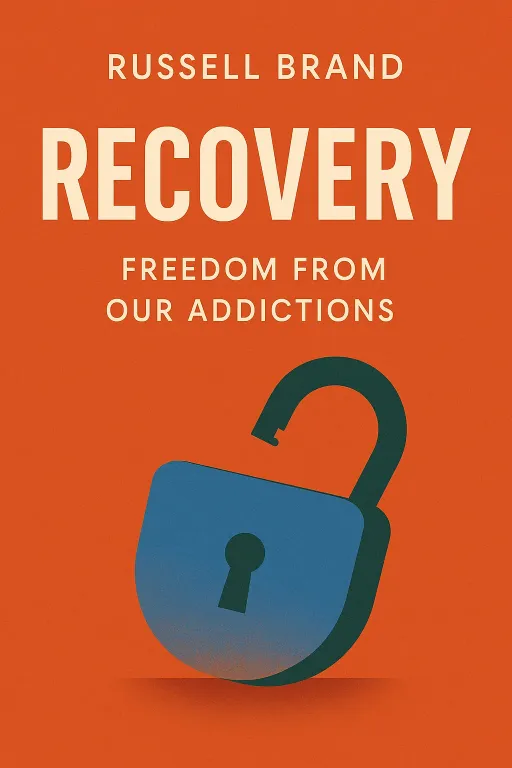
Nova: Exactly. And that pressure to perform is often where the entire creative project goes to die. Today, we are looking at how to stop that silent interrogation. We are pulling wisdom from two very different but surprisingly complementary books. We are diving into Recovery by Russell Brand, and The Universe Has Your Back by Gabrielle Bernstein.
Atlas: That is an eclectic pairing. I mean, on one hand, you have Brand, who is known for this raw, gritty, and deeply honest exploration of human frailty and the mechanics of addiction. And then on the other side, you have Bernstein, who is all about shifting energy, surrendering to the universe, and finding flow. How do these two even talk to each other?
Nova: That is the beautiful tension of today’s conversation. Brand’s book is fundamentally about stripping away the ego and acknowledging our limitations—the "rock bottom" moments that force us to stop pretending. Bernstein’s work is about what happens when you stop gripping the steering wheel of your life so tightly. Both books, in their own way, are asking us to stop fighting reality.
Atlas: I see where you are going with this. It is the classic creative struggle. We fight the reality of our own limitations, and we fight the reality of not being in control of the outcome.
Nova: Precisely. Whether you are a writer, a business strategist, or someone navigating a major career pivot, the friction usually comes from trying to force a result rather than allowing the process to unfold.
The Anatomy of Creative Block and Brand’s Wisdom
SECTION
Atlas: Okay, let's start with Brand. Most people know him for his comedy or his public persona, but Recovery is a heavy, introspective book. Why bring that into a conversation about creative flow? It sounds a bit intense for someone just trying to write a novel.
Nova: Because the creative process is often an addiction in itself. Think about it. We get addicted to the validation of a finished product, or the dopamine hit of a good idea, but we are often terrified of the work required to build it. Brand’s central thesis is that we have to acknowledge our limitations to break destructive habits. In the context of writing, that destructive habit is often perfectionism.
Atlas: That makes sense. But wait, is perfectionism really a limitation? I always thought it was just a high standard.
Nova: That is the trap. Perfectionism is actually a defense mechanism. It is a way to avoid the vulnerability of creating something that might be flawed. Brand argues that when we hide behind these patterns, we are just maintaining a false version of ourselves. If you are a creator, and you are terrified of writing a bad sentence, you will never write a great one. You are limiting your output to keep your ego safe.
Atlas: I have been there so many times. You start a project, you have this grand vision, and the moment the reality on the page doesn't match the vision in your head, you shut down. You walk away. So, you are saying Brand’s approach is to look at that shutdown and say, "Okay, this is just my ego protecting itself"?
Nova: Exactly. He encourages a radical honesty about what we are actually doing. He suggests that we have to look inward and ask, "Why am I really stopping?" Is it because the work is bad, or is it because I am afraid of being seen? For anyone in a high-stakes environment—like someone pivoting their career or building a legacy—that distinction is everything. You have to admit you don't have all the answers. That is the regeneration point.
Atlas: It’s like admitting you are out of fuel before you can actually go to the gas station. If you keep pretending the tank is full, you are just going to end up stranded on the side of the road.
Nova: That is a perfect analogy. And that is where the "Recovery" concept hits home. You aren't just recovering from a substance; you are recovering from the delusion that you are in total control of your talent.
Surrendering Control and Bernstein’s Trust
SECTION
Atlas: Okay, so once you admit you are running on empty, where do you go? That feels like the moment to pivot to Gabrielle Bernstein. Because once you admit you are stuck, the immediate reaction is panic. You think, "Oh no, I have no control, the sky is falling."
Nova: Right. And that is exactly where The Universe Has Your Back comes in. Bernstein talks about transforming fear into trust. She suggests that the moment we let go of the need to control the outcome, we actually open up creative channels that were previously blocked by our anxiety.
Atlas: I am curious about this. How does that look in practice? Because I imagine a lot of our listeners are thinking, "Trust the universe? That sounds nice, but I have a deadline. I have a mortgage. I can't just 'surrender' to the universe and hope the chapter gets written."
Nova: That is the skepticism I love. It is not about being passive. It is about shifting your energy from a state of contraction to a state of expansion. When you are in "control mode," your brain is tight. You are analyzing, you are judging, you are blocking. When you are in "trust mode," you are allowing your intuition to take the driver’s seat.
Atlas: So, it is the difference between trying to force a plant to grow by pulling on the leaves, versus just watering the soil and giving it sunlight.
Nova: Yes, exactly. Bernstein’s point is that we often view our fear—that voice saying "this isn't good enough"—as a protective guard. But it is actually a prison warden. If you can acknowledge the fear, thank it for its input, and then consciously choose to trust that your creative voice has value, you change the biochemistry of your writing session.
Atlas: I see the connection now. Brand is the "stop lying to yourself" phase, and Bernstein is the "start trusting your intuition" phase.
Nova: You nailed it. You cannot trust your intuition if you are still lying to yourself about why you are stuck. You have to clear the debris first, which is the Brand phase, and then you have to plant the garden, which is the Bernstein phase.
Atlas: It sounds like a two-step process for anyone building something new. You have to be honest about the block, and then you have to be brave enough to step into the unknown without needing to see the entire map.
Integrating the Strategy for the Creative Architect
SECTION
Nova: Precisely. And for someone who is a "Creative Architect"—someone who loves structure, who loves building worlds—this is the hardest part. Architects love blueprints. They love knowing exactly where the wall goes and how high the ceiling is. But creativity is not architecture. It is archaeology. You are digging for something that is already buried under the surface.
Atlas: That is a powerful distinction. Archaeology requires patience. It requires the ability to handle dirt and dust. It’s messy. You don't know what you are going to find until you brush away the layers.
Nova: And that is why the "mid-career pivot" is so challenging for people who are used to being in charge. You are used to being the expert, the one with the blueprint. Now, you are stepping into a space where you are a beginner again.
Atlas: I can see how that would be terrifying. You have spent years building a reputation, building a career, and now you are essentially saying, "I am going to stop doing the thing I am known for and try this other thing." That is prime territory for the fear Bernstein talks about.
Nova: It is. And the "limitation" Brand talks about is the fear of being seen as less than competent. But if you can reframe that "limitation"—the feeling of "I don't know what I am doing"—as a "reset," then you have a chance to build something truly authentic.
Atlas: So, how does this look on a Tuesday morning? Let's get practical. If I am sitting there, and I have 60 minutes to write, and I feel that familiar tightening in my chest, what do I actually do?
Nova: This brings us to the takeaway. It is a simple, 10-minute ritual. Before you start the clock on your 60 minutes of writing, you spend 10 minutes acknowledging one specific fear you have about the work.
Atlas: Just 10 minutes? That seems short.
Nova: It is short, but it is focused. You sit down, and you write down the fear. "I am afraid this chapter is boring." "I am afraid people will think this is a mid-life crisis." "I am afraid I have lost my touch." You get it out of your head and onto the paper.
Atlas: And then what? Do you analyze it? Do you try to fix it?
Nova: No. You acknowledge it, and then you consciously choose to let it go. You essentially say to the fear, "I see you, I know you are trying to protect me, but I am going to write anyway." Then you close the journal, take a deep breath, and you start your 60 minutes of creation.
Atlas: I like that because it creates a container for the fear. You are not letting it roam free throughout the whole hour. You are saying, "You get to hang out for 10 minutes, and then you have to leave the room."
Nova: Exactly. And the magic is that once you name the fear, it loses its power. It is no longer this amorphous, terrifying monster in the back of your mind. It is just a thought. And thoughts can be dismissed.
Synthesis & Takeaways
SECTION
Atlas: It is interesting how these two books, which seem so different, really converge on the idea of surrender. Brand’s surrender is to the truth of your situation. Bernstein’s surrender is to the flow of the universe. When you combine them, you get this incredibly stable foundation for creativity.
Nova: You are absolutely right. The stability comes from the fact that you are no longer fighting reality. You are not fighting the fact that you are afraid, and you are not fighting the fact that you don't have all the answers. You are just showing up.
Atlas: And for the people listening who are worried that this sounds too "woo-woo," I think the practical benefit is undeniable. If you spend 10 minutes clearing the mental clutter, you are going to have a much more productive 60 minutes. It is just basic efficiency. You are clearing the operating system before you open the heavy software.
Nova: That is a great way to put it. We spend so much time trying to run high-performance software on a computer that is clogged with viruses and background processes. This 10-minute ritual is the disk cleanup.
Atlas: I am definitely going to try this tomorrow morning. Acknowledge the fear, set it aside, and then just write. No editing. Just creation.
Nova: That is the key. The edit comes later. The creation needs to be free. And remember, this pivot you are in, this transition—it is not a loss of direction. It is a refinement of your purpose. You are not losing your past; you are using it to build something more resilient, something more honest.
Atlas: That is a really encouraging way to look at it. It is not about abandoning who you were; it is about integrating it into who you are becoming.
Nova: Exactly. And that integration is where the best stories come from. It is where the depth is. It is where the human truth lives.
Atlas: I think I have my marching orders for tomorrow morning. 10 minutes of fear-clearing, then 60 minutes of pure, unedited work.
Nova: That is the spirit. And if you find yourself stuck again, just remember: the fear is just a sign that you are doing something that matters. If it didn't matter, you wouldn't be afraid.
Atlas: That is a great final thought. The fear is the compass. It is pointing toward the work that actually counts.
Nova: It really is. Thank you for walking through this with me, Atlas. It is always a pleasure to unpack these ideas with you.
Atlas: Likewise, Nova. This was a great one. To everyone listening, go clear that disk space and get to work.
Nova: Absolutely. This is Aibrary. Congratulations on your growth!









