

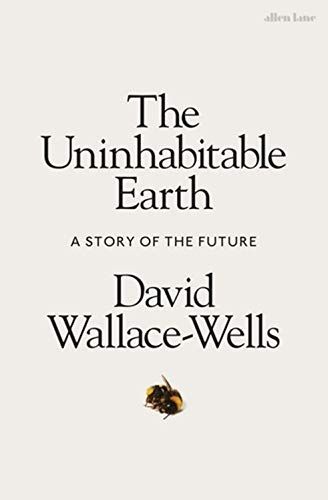
The Uninhabitable Earth
Introduction
Nova: Welcome to Aibrary. I'm Nova, and today we're diving into a book that opens with one of the most arresting first lines in nonfiction: "It is worse, much worse, than you think." That's how David Wallace-Wells begins The Uninhabitable Earth: Life After Warming. And if you think you know where this is going — another climate book telling you to recycle and buy a Prius — you're in for something quite different.
Nova: : That opening line is a gut punch. I remember picking up this book and feeling — and I mean this literally — my heart rate change within the first ten pages. This isn't a gentle nudge. It's a blaring alarm.
Nova: Exactly. And what makes it so effective is that Wallace-Wells isn't a climate scientist or an environmental activist. He's a journalist — the deputy editor at New York magazine — who started collecting stories about warming and was so disturbed by what he found that he felt compelled to write what became the most-read article in the magazine's history in 2017. The book expands that article into a full exploration of what climate change actually means for human life.
Nova: : So set the stage for us. When this book came out in 2019, it was this massive cultural moment — but also deeply controversial. What was the core argument that got everyone talking?
Nova: The core argument is that we've been telling ourselves comforting stories about climate change — that it's slow, that it only affects faraway places, that technology will save us, that wealth can insulate us. Wallace-Wells argues all of these are myths. More than half of all carbon emissions from burning fossil fuels have happened in just the last three decades. That means the planet has been brought to the brink of catastrophe within a single lifetime — and the responsibility to avert disaster belongs to a single generation too. Ours.
How the Book Is Built to Unsettle You
The Architecture of Catastrophe
Nova: Let's talk about how Wallace-Wells structures this book, because it's deliberately engineered to break through our psychological defenses. The book has four parts: Cascades, Elements of Chaos, The Climate Kaleidoscope, and The Anthropic Principle.
Nova: : Walk me through Cascades first. That word alone sounds ominous.
Nova: It is. Cascades is the overture, and it establishes the central idea that climate change isn't a single problem with a single solution — it's a cascade of interconnected disasters that compound each other. Wallace-Wells gives this devastating example: warmer temperatures melt Arctic ice, which means less white surface reflecting sunlight back into space, so darker ocean absorbs more heat, which warms the planet faster, which melts more ice. Each disaster feeds the next in a chain reaction.
Nova: : That feedback loop is terrifying. But isn't that what climate scientists have been saying for a while? What makes Wallace-Wells different?
Nova: Great question. What's different is the framing. He argues that most climate coverage is narrow and muted — focused almost entirely on sea-level rise. He says if your anxiety about global warming is dominated by fears of sea-level rise, you're barely scratching the surface. He then lays out that at two degrees of warming — which is now almost certainly locked in — four hundred million people will face water scarcity and the equatorial band of the planet becomes unlivable. At three degrees, southern Europe enters permanent drought. At four degrees, global damages could exceed six hundred trillion dollars — more wealth than exists in the entire world today.
Nova: : Six hundred trillion — more wealth than exists. That number doesn't even compute.
Nova: And that's Wallace-Wells's point. He wants us to understand that we lack the language and the reference points for the scale of what's coming. He quotes the theorist Timothy Morton, who calls climate change a "hyperobject" — something so vast and complex that, like the internet, it can never be properly comprehended by the human mind. The book is an attempt to make the incomprehensible feel real.
Nova: : But isn't there a risk here? If you tell people things are this catastrophically bad, don't they just shut down?
Nova: This was the core of the controversy around the book. And we're going to get into that. But Wallace-Wells's counterargument is fascinating: he says that knowing global warming is entirely human-caused should be empowering, not paralyzing. We are the authors of this crisis — which means we remain in command. We're still writing the story.
Nova: : That's a genuine twist on the usual climate narrative. Most of the time, the message is: repent, feel guilty, scale back. Wallace-Wells is saying: you built this, so you can build something else.
Elements of Chaos and the Many Faces of Warming
The Twelve Horsemen
Nova: The second section of the book, Elements of Chaos, is its longest and most harrowing. Wallace-Wells lays out twelve distinct categories of climate suffering. And I want to highlight a few that might surprise you, because they go way beyond the usual talking points.
Nova: : Twelve? Let me guess — heat waves, floods, hurricanes...
Nova: Those are in there, but he starts with something called Heat Death. He points out that humans evolved within an incredibly narrow temperature range — the "Goldilocks zone" — and we have already exited it, probably permanently. By 2100, large swaths of the Middle East, South Asia, and parts of Africa could experience heat waves so extreme that being outdoors for more than a few hours is lethal. He mentions that the annual pilgrimage to Mecca may become physically impossible for millions of Muslims due to scorching temperatures.
Nova: : That's a profound cultural and spiritual loss wrapped inside a physical one. What else?
Nova: Hunger. Here's a brutal statistic: for every degree of warming, staple cereal crop yields decline by about ten percent. And Wallace-Wells connects this to "carrying capacity" — how many people the planet can sustain. He argues climate change isn't just one input in that equation; it's the entire set of conditions under which all other challenges will be met.
Nova: : So it's not that climate change causes a food crisis on top of everything else. It's that the food crisis and the water crisis and the migration crisis are all happening inside climate change. It's the container for all of them.
Nova: Precisely. And then there's the chapter on drowning — sea-level rise. He notes that the UN projects two hundred million climate refugees by 2050. That's equal to the entire global population at the peak of the Roman Empire. And he has chapters on wildfire — at three degrees, the annual area of the United States scorched by wildfire increases by six hundred percent. On disease — tropical diseases migrating into what we now call the Arctic. On economic collapse. On conflict and war. Even on the psychological trauma of watching the world transform around you.
Nova: : When you list them like that, the cascade metaphor makes total sense. You can't isolate any one of these. Rising food prices trigger political instability, which triggers migration, which triggers conflict, which disrupts supply chains, which raises food prices further.
Nova: And Wallace-Wells makes a point that really stuck with me: we have no language for this scale of mass death. He notes that millions already die each year from the effects of air pollution alone, and at two degrees of warming, that number could reach one hundred and fifty million annually. There is simply no reference point in human experience for suffering at that magnitude.
Nova: : You mentioned earlier that the book was controversial. What exactly did the critics say?
Nova: This is where it gets really interesting. Let's dig into the firestorm.
Alarmism, Accuracy, and Whether Fear Works
The Great Controversy
Nova: When the original 2017 New York magazine article came out, it provoked an immediate and fierce backlash. Climate scientists lined up to critique it. The nonprofit Climate Feedback summarized reviews from dozens of scientists, saying that while many explanations were correct, readers were left with an overall conclusion that was "exaggerated compared to our best scientific understanding."
Nova: : What specifically did they object to?
Nova: The most prominent factual criticism came from climate scientist Michael Mann and others, who challenged Wallace-Wells's description of Arctic methane emissions. The article suggested that thawing permafrost could release catastrophic amounts of methane in a relatively short timeframe. Scientists said those scenarios were based on studies with enormous uncertainties and that Wallace-Wells presented remote, worst-case possibilities without appropriate context. In a later conversation with Mann at NYU, Wallace-Wells admitted that if he were to write the piece again, he would not include those comments on methane release.
Nova: : So there were genuine errors.
Nova: Yes. The Guardian review also flagged that the book claimed Bitcoin consumes more electricity than all the world's solar panels combined — off by a factor of about a hundred. But the deeper criticism wasn't just about factual errors. It was about strategy. Jason Samenow at the Washington Post called it a "climate doom piece" and a case study in how not to communicate risk. Eric Holthaus at Grist said bluntly: "scaring the hell out of people is a really bad strategy for getting them to address climate change."
Nova: : And there's social science backing that up, right? Studies show apocalyptic messaging makes people disengage?
Nova: That's exactly what the critics argued. Decades of social psychology research suggest that hope and optimism are crucial for motivating action. Dire messages about the future tend to produce weaker support for climate policies. The fear is that Wallace-Wells shocks readers into paralysis, not mobilization.
Nova: : But here's what I find fascinating — his article was the most-read in the magazine's history. The book was a New York Times bestseller. Clearly, a huge audience wanted this story. So maybe the question isn't whether fear works, but whether different audiences need different messages.
Nova: That is precisely Wallace-Wells's defense. In a Rolling Stone interview, he said: "I think in general too much energy has been spent within the world of climate writing and activism on the questions of 'What is the way to tell the story? What is the way to mobilize?' There is no one way — it is every way." He also said: "If there's a one percent chance that we've set off a chain reaction that could end the human race, then that should be something that the public knows and thinks about."
Nova: : That's a compelling position. You can't ask people to respond to a crisis they don't understand the scale of. But I have to ask — does the book offer any way out? Or does it just leave you drowning in despair?
Solutions, Stories, and the Anthropic Principle
The Kaleidoscope and the Exit
Nova: This is where the book takes an unexpected turn. After the relentless horror of the first two sections, Part Three — The Climate Kaleidoscope — shifts gears. Wallace-Wells examines the tools we have: politics, technology, economics, even philosophy. And Part Four, The Anthropic Principle, is where he makes his most surprising move.
Nova: : I'll be honest — when I first heard "Anthropic Principle" in a climate book, I thought, what does cosmology have to do with this?
Nova: It's a fascinating pivot. The Anthropic Principle, in physics, observes that the universe seems fine-tuned for human existence. Wallace-Wells repurposes this idea to argue that humans occupy a uniquely powerful position — we are both the problem and the solution. He writes that we possess just the right combination of ego and humility: the ego to believe we can reshape the world, and the humility to recognize when we've gone too far.
Nova: : So he's making a philosophical argument that our exceptionalism — the very thing that got us into this mess — is also what can get us out?
Nova: Exactly. But I want to be fair to the critics here. The Public Books review by Imani Radney points out that Wallace-Wells's treatment of solutions is asymmetrical compared to his treatment of problems. He devotes enormous energy to painting the worst-case scenarios in vivid, unforgettable detail. But when it comes to solutions — the Green New Deal, collective action, youth movements — his treatment is scattershot and sometimes dismissive. He calls collective action "dramatically, a snore."
Nova: : That's brutal. And also kind of revealing. He's a journalist who excels at narrative disaster, not at narrating the slow, unglamorous work of political organizing.
Nova: That's the critique. And yet — Wallace-Wells ends the book on a note of genuine, hard-won optimism. Over the course of writing, he and his wife had a daughter. And he writes that he believes his daughter's generation will live "the greatest story ever told" — the story of whether humanity can face its own self-created apocalypse and choose otherwise. He says: "The fight is, definitively, not yet lost — in fact will never be lost, so long as we avoid extinction, because however warm the planet gets, it will always be the case that the decade that follows could contain more suffering or less."
Nova: : That's a moral framework, not a scientific prediction. He's saying: the question isn't whether we've already lost, but whether we'll continue to fight. And for him, having a child in the middle of writing this book is itself an act of defiance.
Nova: Precisely. And he's clear-eyed about what's required. He argues that individual lifestyle changes — going vegan, flying less — are insufficient unless scaled by politics. He writes that the richest ten percent of the world's population needs to dramatically reduce its carbon footprint, and that political mandates must place the onus of change on corporations, not individuals. Carbon capture technology and other innovations still hold potential. But the core message is: we have the tools. What we lack is the will.
Conclusion
Nova: So where does The Uninhabitable Earth leave us? I think the book's lasting contribution is that it refuses to let us look away. Wallace-Wells insists that climate change is not an environmental issue — it's an everything issue. It will reshape economics, politics, culture, psychology, and what it means to be human. And it's happening faster than almost anyone acknowledges.
Nova: : What I take away is the tension at the heart of the book: the facts are hysterical, but we cannot afford hysteria. The cascades are terrifying, but paralysis is its own form of complicity. Wallace-Wells gives us the nightmare in high resolution, and then he says: now that you've seen it, what are you going to do?
Nova: He also challenges the story we tell ourselves about progress. In the modern West, we've believed that history moves in one direction — forward, always improving. But climate change means each generation from here on could be worse off than the last. That's not just an economic reality; it's an existential reorientation. It asks us to reconsider the entire project of modernity.
Nova: : And yet he doesn't end in despair. He ends with a newborn daughter and a conviction that the story isn't finished. I find that almost unbearably moving — to catalog the worst possible future and still choose to bring a child into it, not out of denial but out of stubborn hope.
Nova: The book's final insight is that climate change is a story we are telling ourselves — and we can tell it differently. The science is clear, but the human response is not yet written. Wallace-Wells's great contribution is to make us feel, in our bones, that the stakes are everything. And then to remind us that we are, improbably, the ones holding the pen.
Nova: : If you're looking for a comfortable read, this isn't it. But if you're looking for a book that will fundamentally reorganize how you think about the future — and your place in it — The Uninhabitable Earth delivers. Thank you for joining us.
Nova: This is Aibrary. Congratulations on your growth!