

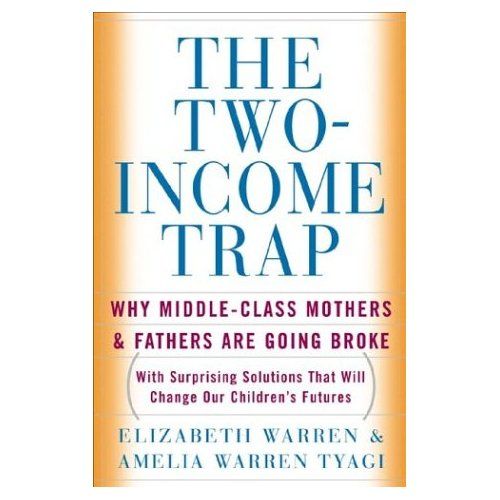
The two-income trap
Why Middle-Class Mothers and Fathers Are Going Broke
Introduction: The Paradox of Progress
Introduction: The Paradox of Progress
Nova: Welcome to Aibrary. Today, we are diving into a book that fundamentally changed how many Americans view their own financial struggles: Elizabeth Warren and Amelia Warren Tyagi’s 2004 bombshell, The Two-Income Trap.
Nova: : Wait, Nova, I thought the story of the last fifty years was about progress. More women in the workforce, higher overall household earnings. Where’s the trap?
Nova: That’s the paradox, and it’s what makes this book so compelling. Imagine your grandparents, maybe in the 1970s, living comfortably on one solid income. Now look at a modern dual-income family. They are earning significantly more money, yet they feel constantly on the edge of financial ruin. That feeling isn't paranoia; it’s the trap itself.
Nova: : So, this isn't about poor budgeting or avocado toast. This is about systemic economic shifts making the middle-class dream unattainable, even with double the effort?
Nova: Exactly. Warren and Tyagi argue that the structure of the American economy has shifted, loading the dice against the very families who are doing everything right—getting educated, working hard, and bringing in two paychecks. We’re going to break down how this happened and why it still matters today.
Nova: : I’m ready to be enlightened, and maybe a little horrified. Let’s start with the core math behind this trap.
Key Insight 1: The Income vs. Discretionary Income Gap
The Statistical Squeeze: 75% More Income, Less Security
Nova: Let’s hit them with the headline statistic right away. The research found that a typical two-income family today earns about 75 percent more in nominal income than its single-income counterpart from a generation ago. That sounds like a massive win, right?
Nova: : Seventy-five percent more! That should mean they are living like royalty compared to their parents. I’m picturing bigger houses, more vacations, massive savings accounts.
Nova: The reality is the opposite. Warren and Tyagi calculated that after accounting for the necessary costs of maintaining that middle-class lifestyle, the modern dual-earner family has about 25 percent discretionary income than the single-earner family did back then. That is the trap in a nutshell.
Nova: : Twenty-five percent less security, despite working twice as hard. That’s a brutal equation. So, what is consuming that extra 75 percent of income? Where is the money going that it never touches the family’s actual quality of life?
Nova: It’s not being spent on luxuries. It’s being poured into the necessities that have become wildly inflated. The book identifies three primary culprits that form the jaws of the trap: housing, healthcare, and education. These aren't optional expenses; they are the price of entry into the middle class now.
Nova: : It seems like a vicious cycle. You need two incomes to afford the house, but the fact that everyone needs two incomes to afford the house is what drives the price of the house up in the first place.
Nova: You’ve hit on the feedback loop perfectly. It’s a self-fulfilling prophecy of rising costs. If a family only had one income, they might be able to afford a modest home, but that home might be zoned for a lower-rated school district. And that brings us to the first major component of the trap.
Nova: : So, the desire for a better future for the kids—which is the classic American dream motivation—is actually what financially breaks the parents?
Nova: Precisely. The pressure to secure that perceived advantage in education forces both parents into the workforce, effectively inflating the market for everyone else trying to do the same thing. It’s a collective action problem where individual rational choices lead to collective financial distress.
Nova: : It’s almost like the economy is punishing prudence. If you try to save money by sticking to one income, you risk being locked out of the best opportunities.
Nova: That’s the psychological weight of the trap. It forces compliance with the two-income standard, even if it leaves the family financially brittle. We need to look closer at how housing specifically acts as the anchor dragging these families down.
Key Insight 2: The Cost of Entry
The Bidding War for the Basics: Housing and Education
Nova: Let’s focus on housing, which the book highlights as perhaps the most aggressive component of the trap. Warren and Tyagi noted that in desirable areas, especially those with high-performing public schools, housing costs skyrocketed precisely because dual-income families could bid higher.
Nova: : I remember reading that the book points out that the quality of the house itself isn't the main driver; it’s the zip code. The value is tied to the school district rating.
Nova: Absolutely. They found that the premium paid for a house in a top-tier school district often dwarfs the actual cost difference in construction or amenities. You are essentially paying a massive mortgage premium for a perceived educational advantage. And this premium is only payable with two salaries.
Nova: : And this is where the comparison to the past gets stark. A single-income family in the 1970s could buy a home that was, by today's standards, quite comfortable, without needing a second earner to compete in that specific, hyper-inflated housing market.
Nova: Correct. And the problem compounds when you factor in the second major cost: higher education. College tuition has seen astronomical increases, far outpacing inflation and wage growth. For the middle class, college is no longer a luxury; it’s the expected ticket to a stable job, which means it’s treated like a necessity.
Nova: : So, the parents are working two jobs just to afford the mortgage on the house that gets their kid into the right high school, so that kid can get into college, which they will likely have to finance because the parents’ two incomes were already maxed out on the mortgage and healthcare premiums.
Nova: It’s a perfect, self-reinforcing economic vise. And don't forget healthcare. While the book was written before the Affordable Care Act, the rising cost of employer-sponsored health insurance premiums and deductibles has only accelerated this pressure. That second income often goes directly to covering the second person’s health coverage.
Nova: : It makes you wonder if the entire structure of middle-class aspiration has become financially unsustainable. If the baseline cost of entry requires two full-time workers, what happens when one of those workers gets sick or laid off?
Nova: That leads us directly to the fragility aspect, which is the most alarming part of their analysis. The trap isn't just about being broke; it's about being one emergency away from total collapse.
Key Insight 3: The Bankruptcy Risk
The Fragility Factor: Living Without a Cushion
Nova: When a family relies on two incomes, they are essentially operating with zero margin for error. The book meticulously details how this lack of a financial cushion dramatically increases the risk of personal bankruptcy.
Nova: : If you’re living paycheck-to-paycheck, even with a combined income of, say, $150,000, that’s not because you’re frivolous. It’s because $145,000 of that is already committed to non-negotiable costs like the mortgage, car payments, insurance, and childcare.
Nova: Exactly. The traditional safety net—the ability to cut back on non-essentials during a downturn—is gone because the non-essentials have been redefined as essentials. A job loss, a major medical event, or even a significant home repair can instantly push a family from solvent to drowning in debt.
Nova: : I recall reading that the book showed that dual-earner families were filing for bankruptcy at higher rates than single-earner families did in previous decades. That’s a staggering reversal of fortune.
Nova: It is. They demonstrated that the financial stress placed on these families means they are far more likely to use high-interest credit cards to bridge short-term gaps, which then spirals into unmanageable debt loads. The very structure designed to secure a better future ends up being the mechanism that destroys security.
Nova: : It’s a fascinating sociological point, too. The cultural expectation shifted. It became socially unacceptable, even irresponsible, for a mother not to work, even if the family could technically manage on one income. The market dictated the behavior, not personal choice.
Nova: That cultural pressure is immense. And the book challenges the notion that this is solely a failure of individual responsibility. When the cost of housing in a safe area rises by 300% over two decades, no amount of personal frugality can overcome that structural gap.
Nova: : So, if the problem is structural—driven by inflated costs in key sectors—then the solution can't just be telling people to save more. What did Warren and Tyagi propose as the way out of this economic cul-de-sac?
Key Insight 4: Reforming the System
Beyond the Paycheck: Structural Solutions
Nova: The proposals in The Two-Income Trap are less about personal finance tips and more about broad economic and regulatory reform. Since the trap is built on inflated costs, the solutions focus on deflating those costs or providing structural support.
Nova: : I imagine this includes things like reforming bankruptcy laws to give families a real fresh start, which was a major focus for Warren later on, right?
Nova: Absolutely. They advocated for making it easier for honest, hardworking families to discharge debt through bankruptcy, rather than being crushed by it for decades. But the bigger pieces target the drivers we discussed.
Nova: : Such as?
Nova: On the housing front, they suggested policies aimed at increasing the supply of affordable housing, especially in high-opportunity areas, to break that bidding war dynamic. If supply meets demand more effectively, the price premium for the zip code drops.
Nova: : And for education? That’s the trickiest one, since school quality is so localized.
Nova: They looked at ways to decouple the quality of public education from the property tax base of the immediate neighborhood, perhaps through state-level funding equalization. If a family knows their child will receive a high-quality education regardless of which middle-class neighborhood they can afford, the pressure to overpay for housing eases significantly.
Nova: : So, the solutions require government intervention to correct the market failures that the two-income necessity created. It’s a call for systemic change to restore the financial viability of the middle class.
Nova: Precisely. The book argues that the American dream shouldn't require both parents to work 50 hours a week just to tread water. It’s a critique of an economic structure that demands maximum labor input for minimum security output.
Nova: : It’s interesting how much of this analysis foreshadowed the political career that followed. It laid the groundwork for focusing on consumer protection and structural economic fairness.
Nova: It certainly did. And while the book is over two decades old, the core mechanism—the cost of housing and education outpacing wages—remains a defining feature of modern economic life. It’s a powerful reminder that sometimes, working harder isn't the solution; changing the rules of the game is.
Conclusion: The Enduring Relevance of the Trap
Conclusion: The Enduring Relevance of the Trap
Nova: So, as we wrap up our look at The Two-Income Trap, what’s the biggest takeaway for our listeners today? It’s that financial stress is often systemic, not personal.
Nova: : The key insight for me is the 75% income increase versus the 25% discretionary income. That statistic perfectly encapsulates the feeling of running faster just to stay in the same place. It validates the struggle many dual-earner families feel.
Nova: It does. And the actionable takeaway isn't necessarily to quit your job, but to recognize that your financial fragility is rooted in the inflated costs of housing, healthcare, and education. Understanding the trap allows you to push back against the cultural pressure to overspend on those specific items.
Nova: : It forces a re-evaluation. Is the premium we pay for that specific zip code truly worth the risk of having zero savings buffer? It’s a tough question, but one we need to ask.
Nova: Absolutely. The book serves as a powerful economic diagnosis, showing how the very mechanism intended to secure the middle class—the second income—has been co-opted by rising costs to create a more precarious existence. The fight for economic security, as Warren and Tyagi argued, must be a fight for structural fairness.
Nova: : A sobering, yet essential, listen for anyone navigating modern finances. Thank you for guiding us through this analysis, Nova.
Nova: My pleasure. We’ve explored the mechanics of the trap, the drivers of inflation, and the need for systemic fixes. This is Aibrary. Congratulations on your growth!