

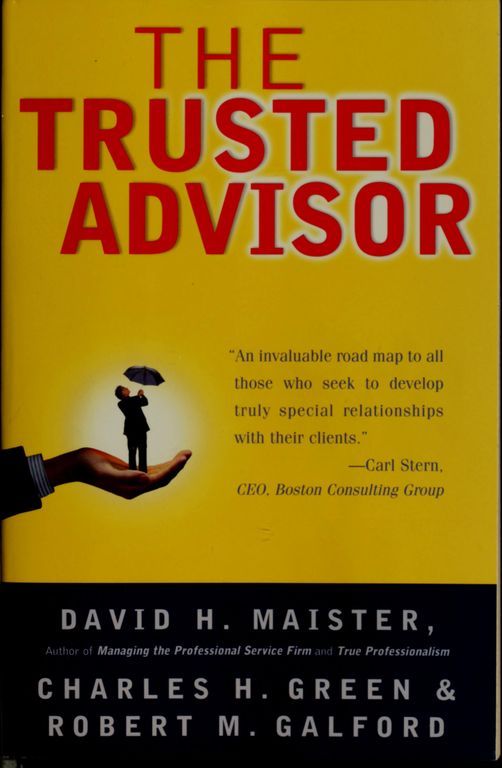
The trusted advisor
Introduction
The Currency of Modern Business: Why Trust Trumps Talent
Nova: Welcome to The Strategy Session. Today, we’re diving into a book that redefined professional services two decades ago, and frankly, remains more relevant than ever: The Trusted Advisor by David H. Maister, Charles H. Green, and Robert M. Galford.
Nova: : That’s right, Nova. If you’ve ever felt like you’re technically brilliant but your clients still go elsewhere, this book is the diagnosis. Maister argues that in a world saturated with expertise, trust isn't a soft skill; it’s the hard currency of success.
Nova: Exactly. The core thesis is that technical skill is now a baseline requirement, not a differentiator. The real competitive edge comes from earning the client's confidence. But how do you measure something as nebulous as trust? That’s where the genius of this book lies.
Nova: : It’s not just philosophy, is it? They give us a formula. A mathematical model for something we usually treat like magic. It’s like they handed us the blueprint for becoming indispensable.
Nova: They did. And we’re going to break down that blueprint today, piece by piece. We’re talking about the famous Trust Equation. Why does it matter now? Because clients are more informed, more skeptical, and they have more options than ever before. They don't just want an answer; they want a partner they can bet their career on.
Nova: : And that partnership requires vulnerability, which is a tough ask for many high-powered professionals. So, let’s start at the very beginning. What is this equation, and why is it so powerful?
Key Insight 1: Defining Trust Mathematically
The Trust Equation: From Feeling to Formula
Nova: Let’s lay out the core concept. Maister and his co-authors present the Trust Equation. It’s not just a nice idea; it’s presented as a functional model. Can you state the equation for us?
Nova: : Absolutely. The equation is: Trustworthiness equals Credibility plus Reliability plus Intimacy, all divided by Self-Orientation. Or, T equals divided by S. The beauty is that it forces us to stop talking about trust as a vague feeling and start treating it as a set of controllable variables.
Nova: That denominator, 'S' for Self-Orientation, is what immediately grabs my attention. It’s the only thing in the bottom half of the fraction. What does Self-Orientation actually mean in this context?
Nova: : It means how much the client perceives that you are focused on your own needs—your fees, your reputation, your next promotion—versus how much you are focused on needs and success. If S is high, your trust score plummets, no matter how good C, R, and I are.
Nova: So, if I walk into a meeting focused on how much I’m going to bill them, even if I’m the smartest person in the room, my S is high, and the client instantly puts up a defensive wall. It’s the professional equivalent of a used car salesman’s reputation.
Nova: : Precisely. And that’s why they call it the denominator. It has a disproportionately negative effect. A small increase in Self-Orientation can wipe out massive gains in the other three areas. Think about it: if you’re perceived as self-serving, the client assumes your advice is tainted by your self-interest.
Nova: Let’s look at the numerator then. Credibility, Reliability, Intimacy. These sound like the three pillars of a good relationship. How do they differ in the context of professional advice?
Nova: : Credibility is about you say. It’s your track record, your expertise, your perceived honesty. It’s the intellectual foundation. If you say the sky is blue, your credibility determines if I believe you based on past performance.
Nova: Reliability is about. It’s consistency. Did you deliver the report on time? Did you follow up when you said you would? This is where many technically brilliant people fail. They have the C, but they lack the R because they are disorganized or over-committed.
Nova: : And Reliability is often easier to control than Credibility, which can be subjective. You can choose to be reliable. You can choose to hit every deadline. It’s an action, not just a perception of knowledge.
Nova: That leaves Intimacy. This is the one that often makes traditional consultants uncomfortable. It’s not about friendship, right? It’s about emotional safety.
Nova: : That’s the key distinction. Intimacy is the degree to which the client feels safe sharing sensitive, personal, or career-threatening information with you. It’s the comfort level. If a client has to filter their true concerns because they fear judgment or that the information will be used against them, Intimacy is low. And low Intimacy means low trust, even if you are credible and reliable.
Nova: So, to summarize this first chapter: Trust isn't a feeling you hope for; it’s a score you earn by maximizing C, R, and I, while ruthlessly minimizing S. It’s actionable data.
Key Insight 2: Building Credibility, Reliability, and Intimacy
Mastering the Numerator: C, R, and I in Practice
Nova: Let’s get granular on the numerator. How does a professional, say a senior lawyer or a management consultant, actively build Credibility beyond just having the right degree?
Nova: : Credibility is built by demonstrating expertise. It’s not enough to say, 'I’ve worked on 50 mergers.' You need to say, 'I’ve worked on three mergers in your exact industry, facing the exact regulatory hurdle you are facing right now.' It’s specificity that builds C.
Nova: : And a huge part of Credibility is admitting what you know. The book stresses that trying to fake knowledge destroys Credibility faster than anything. If you don't know the answer, saying, 'That’s a critical point; let me research that and get back to you by 3 PM tomorrow,' actually your Credibility because it demonstrates honesty.
Nova: That’s a fantastic counter-intuitive point. Now, let’s tackle Reliability. We mentioned deadlines, but what about the deeper level of reliability? I remember reading about the concept of 'under-promising and over-delivering.' Is that still the rule?
Nova: : It is, but it’s more nuanced. Reliability is about managing expectations so effectively that the client is never surprised by a negative outcome. If you know a project has a 60% chance of hitting a snag, you communicate that 60% risk upfront. If you deliver on time, the client sees you as reliable. If you mention the risk and then hit the snag, you’ve destroyed Reliability, even if you fix the snag quickly.
Nova: So, Reliability is about managing the, not just the destination. It’s about transparency in the process.
Nova: : Exactly. Now, Intimacy. This is where the rubber meets the road for many advisors. How do you foster emotional safety without becoming overly familiar or unprofessional? The key is active, empathetic listening.
Nova: I think people confuse Intimacy with being a therapist. What is the practical application here?
Nova: : It’s about asking the right questions and truly absorbing the answer. For example, instead of just asking, 'What is your budget for this project?' a high-Intimacy advisor asks, 'What happens to your team if we solve this problem in the next six months? What are the personal stakes for you?'
Nova: : That second question taps into the client’s vulnerability and career risk. When you acknowledge that risk—when you show you understand the emotional weight of their decision—you build Intimacy. You’ve signaled, 'I see you, and I’m on your side in this fight.' That’s the safety they crave.
Nova: So, C is the brain, R is the hands, and I is the heart. If you have all three working together, you have a very strong numerator. But we know that strong numerator can still be sunk by a massive denominator. Let’s turn our attention to the villain of the equation: Self-Orientation.
Key Insight 3: The Ego Check
The Denominator Dilemma: Conquering Self-Orientation (S)
Nova: Self-Orientation, S. This is the make-or-break variable. Maister suggests that the most successful advisors are those who have successfully subordinated their own ego. How does an advisor, who is often highly paid and highly accomplished, actually subordinate their ego?
Nova: : It starts with a fundamental shift in mindset. You must genuinely believe that your success is dependent on the client’s success. If you are focused on the fee, the next client, or proving you are smarter than the client’s internal team, S is high.
Nova: : A practical way to lower S is to focus on the client’s rather than the you are paid to perform. If you are hired to implement new software, your task is implementation. Your client’s outcome is increased efficiency and reduced errors. If you prioritize the outcome, you naturally lower S.
Nova: I’ve seen this play out in consulting firms where the partner is more concerned with billable hours than the actual impact of the work. That focus on the internal metric—the billable hour—is pure Self-Orientation.
Nova: : Precisely. And the book gives a great example of how S manifests in communication. If a client asks a question, a high-S advisor answers immediately with the most complex, technically perfect answer they can muster, just to demonstrate their intelligence. That’s S talking.
Nova: Whereas a low-S advisor would pause, perhaps rephrase the question back to the client to ensure understanding, and then deliver an answer tailored to the client’s level of understanding, focusing on utility over complexity.
Nova: : Absolutely. The low-S advisor is thinking, 'How can I make this information most useful to right now?' The high-S advisor is thinking, 'How can I make look good with this information?'
Nova: This also ties back to the concept of 'telling the client what they need to hear, not what they want to hear.' If telling the hard truth risks your relationship or your fee, you might hedge. Hedging is S creeping in.
Nova: : Hedging is the enemy of Credibility, which is in the numerator, but the you hedge is usually Self-Orientation. You fear the client’s reaction to the truth because you prioritize your comfort over their need for accurate information.
Nova: So, the ultimate move for a Trusted Advisor is to make the client’s success the metric that matters. If you can truly internalize that, S approaches zero, and trust skyrockets. But what about the final piece? We’ve built the trust; how do we ensure we deliver the results that sustain it?
Key Insight 4: The Role of Results and Managing Expectations
From Advice to Action: Sustaining Trust Through Results
Nova: The book doesn't stop at the equation; it talks about the advisor’s role in achieving results. Trust is earned, but it must be maintained by delivering on the promise that the trust implies. How does the book frame the advisor's responsibility for results?
Nova: : The authors make a crucial distinction: Advisors are responsible for the, but the client is responsible for the. A trusted advisor’s job is to give the best possible advice, clearly and compellingly, and then help the client navigate the organizational politics and internal resistance required to implement it.
Nova: That’s a huge relief for many service providers! It means you aren't personally accountable if the client’s CEO ignores your brilliant strategy. But it also means you can’t just drop the report on their desk and walk away.
Nova: : Exactly. The moment you hand over the advice, your Reliability and Intimacy are tested again. If the client struggles to implement it, the trusted advisor doesn't say, 'Well, I gave you the answer.' They say, 'I see you’re running into resistance on point three. Let’s strategize how to get buy-in from the finance department.' That follow-through is what keeps Reliability high.
Nova: This brings us back to managing expectations, which is the practical application of maintaining Credibility and Reliability over time. What’s the Maister prescription for setting expectations?
Nova: : It’s about defining the scope of the relationship upfront, explicitly. They advocate for a 'contract' that covers not just deliverables, but also the of advising. For instance, defining how often you will challenge the client, how you handle disagreements, and what the client commits to providing you in terms of access and candor.
Nova: So, you are essentially building the rules of engagement into the trust framework itself. If the client violates the agreed-upon process—say, they refuse to give you access to a key stakeholder—that’s a breakdown in Reliability on their side, which you can address without destroying your own standing.
Nova: : Precisely. It turns the relationship from a vague, emotional contract into a professional partnership with clear boundaries. And this clarity is what allows the advisor to deliver difficult messages—the ones that might temporarily lower Intimacy but are necessary for long-term Credibility.
Nova: It sounds like the entire framework is cyclical. High trust allows you to give tough advice, which, if delivered well, reinforces Credibility and Reliability, further lowering Self-Orientation because the client trusts your motives are pure.
Nova: : It is a virtuous cycle, but it requires constant maintenance. Trust isn't a destination you reach; it’s a resource you must continuously replenish. Every interaction is a deposit or a withdrawal from that trust account. If you have a high C, R, and I, you have a massive buffer, but even a large buffer can be depleted by a single, massive act of Self-Orientation.
Conclusion
The Takeaway: Becoming Indispensable
Nova: We’ve spent this episode dissecting the Trust Equation: T equals divided by S. If listeners take away only one thing, what should it be?
Nova: : It must be the denominator. Focus relentlessly on minimizing S, Self-Orientation. Ask yourself before every client interaction: 'Am I doing this for my ego, my fee, or for the client’s best outcome?' If you can shift that focus, the other variables become much easier to manage.
Nova: And for the numerator, remember the distinct roles: Credibility is your knowledge base, Reliability is your consistency in execution, and Intimacy is the emotional safety you provide by truly understanding their stakes.
Nova: : The ultimate lesson is that technical skill is the price of admission, but trust is the ticket to the VIP section. The Trusted Advisor isn't the smartest person in the room; they are the person the client to be the smartest person in the room.
Nova: It’s a powerful framework for anyone selling advice—whether you’re a lawyer, a marketer, a software developer, or even an internal leader managing stakeholders. It forces accountability onto the advisor.
Nova: : It truly is the essential guide for navigating the modern professional landscape. Stop hoping for trust, start engineering it.
Nova: Fantastic breakdown of a truly foundational text. Thank you for guiding us through the math of influence today.
Nova: : My pleasure, Nova. Always happy to discuss the mechanics of earning a seat at the table.
Nova: That’s all the time we have for today’s deep dive into The Trusted Advisor. We hope this has given you actionable steps to audit your own professional relationships. This is Aibrary. Congratulations on your growth!