

Beyond the Individual: The Power of Social Networks
Golden Hook & Introduction
SECTION
Nova: We boast about our independence, our self-made journeys, our unique paths. We love to think we’re the masters of our own destiny, charting our course with fierce autonomy. But what if the most crucial decisions you've ever made—the very shape of your happiness, your health, even your success—were never truly 'yours' alone?
Atlas: Oh, I like that. You're hitting right at the core of something many of us inherently but rarely articulate: that constant tension between individual effort and the invisible currents pulling us in different directions. It almost sounds like you're suggesting we're less 'self-made' and more 'socially-influenced.'
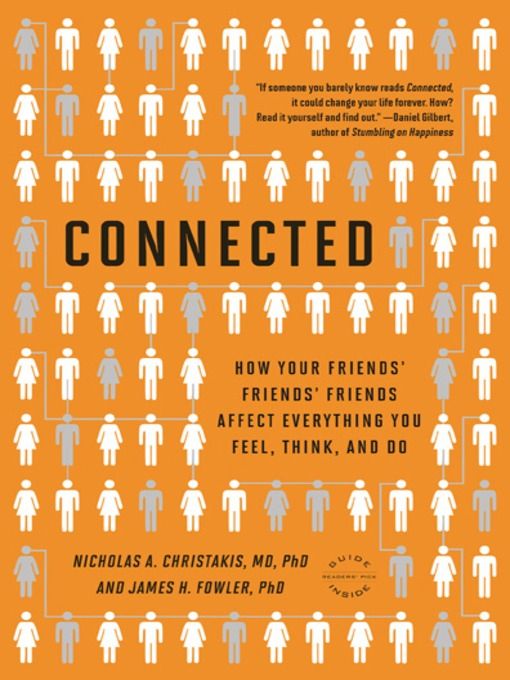
Nova: Precisely, Atlas! And that's exactly what we're diving into today, with two books that fundamentally shifted how we understand human connection. First, we have by Nicholas A. Christakis and James H. Fowler. These two are a powerhouse duo—Christakis, a physician and sociologist, and Fowler, a political scientist—who brought a rigorous, scientific lens to mapping and understanding these invisible webs.
Atlas: And it’s fascinating how their work, with its deep dive into data and long-term studies, complements another seminal book that brought these ideas to a much wider audience: Malcolm Gladwell's. Gladwell, with his incredible knack for storytelling, took these complex sociological concepts and made them not only accessible but utterly captivating, showing us how ideas and trends can explode into cultural phenomena.
Nova: Together, these books expose what I call our "individual blind spot." We are so trained to focus on individual actions and achievements, that we often miss the intricate, deeply woven fabric of social networks that shapes everything from our health choices to our emotional states. Overlooking this connection means missing a key driver of human behavior and, frankly, a huge lever for impact.
Atlas: That’s a powerful idea, the "individual blind spot." So, you're saying that even when we think we're making a purely personal decision, there's always this unseen hand of our social connections at play? How do Christakis and Fowler even begin to prove something so… invisible?
The Invisible Architecture of Connection: How Social Networks Shape Us
SECTION
Nova: They prove it with decades of meticulous data, Atlas. One of their most famous insights comes from analyzing the Framingham Heart Study, an ongoing cardiovascular study that began in 1948. Researchers initially just tracked health data, but importantly, they also meticulously recorded participants' social ties—who was friends with whom, who was a spouse, a sibling, a neighbor.
Atlas: Okay, so they had this incredibly rich dataset of not just health, but actual human relationships over generations. That's rare.
Nova: Exactly. And what they discovered was mind-blowing. They found that if your friend became obese, your own chances of becoming obese increased by 57%. If your friend’s friend became obese, your chances still went up by 20%. And even if your friend’s friend’s friend—someone you likely don't even know—became obese, your chances increased by 10%.
Atlas: Whoa. Hold on. So, you're saying my friend's friend's friend's friend could literally make me gain weight, without me ever meeting them? That sounds a bit out there. How does that even work? Is it some kind of psychic connection?
Nova: Not psychic, Atlas, but deeply social. It works through what they call "social contagion." It's not just about direct influence; it's about the norms and behaviors that spread through the network. If your social circle starts to normalize larger portion sizes, or more sedentary lifestyles, or even simply shifts their perception of what a healthy weight looks like, that subtly influences behavior. It’s often subconscious. It’s like a ripple effect across a pond.
Atlas: I guess that makes sense. If everyone around me starts doing something, it starts to feel normal, or even desirable. It's not necessarily a direct command, but an ambient pressure or example. So it’s not just obesity; they found this with other things too, right? Like happiness?
Nova: Absolutely. They found that happiness spreads even more effectively than unhappiness. If a friend became happy, your chances of feeling happy increased by 15%. If a co-worker became happy, 8%. And even neighbors influenced each other. It means our emotional states are not purely internal; they are incredibly permeable to the emotional states of those around us, and those connected further out.
Atlas: That’s actually really inspiring. It suggests that if you cultivate positive connections, you're not just improving your own life, but potentially sending out these positive ripples that extend far beyond your immediate interactions. For anyone trying to build a positive culture, whether in a team or a community, that's a profound insight. It means the environment you create, or choose to be in, isn't just decorative; it's fundamentally shaping outcomes.
Nova: Exactly. It challenges the individualistic narrative that we are solely responsible for our health, wealth, and happiness. While personal effort matters, these books reveal that our lives are deeply embedded in a social ecosystem, and that ecosystem exerts a powerful, often invisible, pull. Recognizing these invisible forces helps you better understand and shape the cultures you inhabit or create.
From Individual Influence to Collective Tipping Points: The Mechanics of Spread
SECTION
Nova: But what happens when those subtle, rippling influences reach a critical mass? What happens when a behavior or an idea doesn't just quietly spread, but explodes, transforming a niche phenomenon into a widespread cultural shift? That's where Malcolm Gladwell's comes in, building on the understanding of networks to explain the mechanics of rapid social epidemics.
Atlas: Ah, the Tipping Point! That’s a phrase that’s entered our everyday language, but what does it actually mean in the context of these networks? Is it just when enough people do something?
Nova: It's more nuanced than that. Gladwell argues that for a social epidemic to "tip," three key agents are often at play. He calls them the "Law of the Few," the "Stickiness Factor," and the "Power of Context." But the "Law of the Few" is particularly relevant to our network discussion. He identifies three types of people crucial to the spread of ideas: Connectors, Mavens, and Salesmen.
Atlas: Okay, so not all people are created equal when it comes to spreading ideas. Can you break those down?
Nova: Think of Connectors as people with vast social networks, who know everyone from every walk of life. They're the social glue. Mavens are information specialists—they accumulate knowledge, they know to get the best deal, or the best information, and they love to share it. And Salesmen are persuaders, charismatic individuals who can effortlessly convince others. For an idea or trend to tip, you need these specific individuals acting as conduits.
Atlas: So, it's not just about the sheer number of people, but the people in the network. That makes me wonder, how does something seemingly trivial, like a fashion trend, suddenly become ubiquitous? Can you give an example where these "few" really made a difference?
Nova: Gladwell famously uses the example of Hush Puppies shoes in the mid-1990s. They were a dying brand, seen as unfashionable. But then, a few "Connectors" and "Mavens" in the ultra-hip fashion districts of downtown Manhattan started wearing them ironically. These were people with huge social reach and influence. They weren’t paid endorsers; they just genuinely picked up on something.
Atlas: Right, like those early adopters who always seem to be ahead of the curve.
Nova: Exactly. These "Connectors" then showed up at parties, and other "Mavens" noticed. The "Salesmen" of the group would then passionately advocate for them. Suddenly, a few dozen pairs being worn by a handful of trendsetters created a powerful signal. Within a year, Hush Puppies sales skyrocketed from 30,000 pairs to 430,000 pairs. It wasn't a massive marketing campaign; it was an organic social epidemic driven by the right people at the right nodes in the network.
Atlas: That's incredible. It highlights that impact isn't always about top-down directives or massive budgets; it can be about understanding the inherent dynamics of human connection. It makes me think about a recent trend I observed—the sudden explosion of interest in AI art generation. It went from niche tech forums to mainstream social media almost overnight. How might the spread of something like that be explained by these social network dynamics?
Nova: That’s a brilliant example, Atlas! You had the "Mavens" in the tech community who understood the underlying technology, sharing their incredible creations. Then "Connectors" on platforms like Twitter or Instagram, with massive followings, amplified those creations. And then the "Salesmen"—the influencers and early adopters—demonstrated how accessible and fun it was, convincing others to try it. It tipped because the technology itself had a "stickiness factor"—it was novel, engaging, and easy to use—and the right people with the right network influence propelled it into the mainstream.
Atlas: It’s like a viral contagion, but for ideas. It makes you realize how powerful these unseen forces are, shaping not just our personal lives, but entire cultural landscapes.
Synthesis & Takeaways
SECTION
Nova: Absolutely, Atlas. What Christakis and Fowler show us with "Connected" is the inescapable, often subtle, influence of our inherent interconnectedness on our individual well-being and choices. We are always part of something larger. And then Gladwell, with "The Tipping Point," illuminates how these connections can, under the right circumstances, ignite rapid, widespread change.
Atlas: So, if we synthesize these two, it's about moving beyond our individualistic blind spot to recognize that we live in a fundamentally networked world. And that understanding isn't just academic; it's a superpower for anyone looking to make a meaningful impact. What does this mean for someone trying to build a resilient team, foster innovation, or cultivate a positive company culture?
Nova: It means you don’t just focus on individual performance metrics or top-down directives. You pay attention to the of your team's social network. Are there silos? Are there "Connectors" who can bridge different departments? Are there "Mavens" whose knowledge isn't being shared effectively? It’s about intentionally designing environments and connections that foster the spread of positive behaviors, shared knowledge, and collective well-being. It’s about building systems for people, understanding that the human element is inherently networked.
Atlas: That’s a profound shift in perspective. It means impact isn't just about what do, but how you orchestrate the connections around you. It gives you a new lens through which to view every interaction, every team dynamic, every trend you observe.
Nova: Indeed. We encourage our listeners to take a moment this week and reflect on a recent trend they've noticed, or a behavior within their own team. How might its spread be explained by the dynamics of social networks? Where are the Connectors, the Mavens, the Salesmen? Where are the invisible threads shaping the outcome?
Atlas: That’s a fantastic challenge. It’s about seeing the hidden architecture that underpins so much of our world.
Nova: This is Aibrary. Congratulations on your growth!