

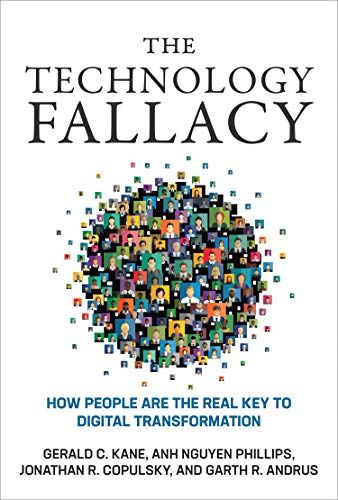
The Technology Fallacy
Introduction
Nova: Picture this. A major retailer spends 200 million dollars on a state-of-the-art digital platform. Cutting-edge AI, seamless mobile integration, the works. Two years later, the platform is a ghost town. Employees are still using spreadsheets and email. What went wrong? Welcome to Aibrary. I'm Nova.
Nova: : And I'm. So, Nova, let me guess — the technology failed?
Nova: That's exactly what most executives would say. And that,, is precisely the trap. Today we're diving into The Technology Fallacy by Gerald C. Kane and his co-authors — Anh Nguyen Phillips, Jonathan Copulsky, and Garth Andrus. The book is built on a massive four-year research project involving over 16,000 surveys and more than 75 in-depth interviews with business leaders worldwide.
Nova: : Sixteen thousand people? That's not a survey, that's a census. What did they find?
Nova: They found something counterintuitive. The central argument is right there in the subtitle: How People Are the Real Key to Digital Transformation. The technology fallacy is the mistaken belief that because digital disruption is caused by technology, the solution must also be technological. Kane and his team discovered that 87 percent of businesspeople agree digital disruption will transform their industries — yet most believe their companies are responding inadequately.
Nova: : So the problem isn't the tech. It's us.
Nova: Exactly. And here's the kicker: when survey respondents were asked to name the biggest barriers to digital transformation, the number one answer wasn't budget, wasn't legacy systems, wasn't even competition. It was internal issues — lack of agility, complacency, and an inflexible culture. Organizations are their own worst enemy.
Nova: : That's both terrifying and oddly reassuring. Terrifying because we're sabotaging ourselves, but reassuring because it means the solution is within our control. Let's unpack this.
Why Technology Isn't the Answer
The Core Fallacy
Nova: Let's start with the fallacy itself. Kane and his team argue that when leaders see disruption — think Amazon decimating retail, Uber upending transportation, Airbnb transforming hospitality — their instinct is to reach for a technology fix. Buy the latest platform. Hire data scientists. Implement blockchain.
Nova: : Which sounds reasonable on the surface. If a digital competitor is eating your lunch, fight fire with fire, right?
Nova: That's the trap. The authors point to Borders and Blockbuster as canonical examples. Borders didn't fail because they lacked access to e-commerce technology. They failed because their organizational structure, culture, and leadership couldn't adapt to a world where books were sold online. Blockbuster had the chance to buy Netflix for 50 million dollars and passed. The technology was available. The organizational will was not.
Nova: : So it's not about having the tools. It's about having the organizational capacity to use them.
Nova: Precisely. Kane uses a wonderful metaphor from The Wizard of Oz. Digital disruption is like the cyclone that picks up Dorothy's house and drops it in a completely new world. You can't just paint the house a different color and call it adapted. You're in Oz now. Everything is different. The rules, the landscape, the threats, the opportunities — all transformed.
Nova: : And what do companies typically do instead?
Nova: They implement a new CRM system and declare victory. The authors call this the difference between doing digital and being digital. Doing digital means bolting technology onto existing processes. Being digital means fundamentally rethinking how the organization operates — its structure, its decision-making, its talent strategy, its culture.
Nova: : Give me a concrete example of doing versus being.
Nova: Think about a bank that launches a mobile app. That's doing digital. The app is nice, but behind it, the same slow approval processes, the same siloed departments, the same risk-averse culture persists. Now think about a bank that reorganizes into cross-functional product teams, empowers those teams to make decisions without layers of approval, and builds a culture where launching and iterating quickly is celebrated. That's being digital. The app is just the visible tip of a much deeper transformation.
Nova: : So the app is almost beside the point.
Nova: It's not irrelevant — technology matters — but it's secondary. Kane's research found that the most digitally mature companies spend proportionally less time worrying about which technologies to adopt and far more time cultivating the organizational conditions that make any technology adoption successful. The technology is the easy part. Changing how thousands of people think, collaborate, and make decisions — that's the hard part.
Why Culture Eats Digital Strategy for Lunch
The Culture Imperative
Nova: If there's one chapter of this book that should be required reading for every executive, it's the one on culture. Kane's team discovered that a single set of cultural characteristics consistently correlates with digital maturity — and this holds across industries, company sizes, and geographies.
Nova: : What are those characteristics?
Nova: Five key traits. First, digitally mature organizations are less hierarchical and more distributed in leadership. Second, they're collaborative and cross-functional rather than siloed. Third, they encourage experimentation and continuous learning. Fourth, they're bold and exploratory with a higher tolerance for risk. And fifth, they're agile and quick to act.
Nova: : That sounds like every management book ever written. Agile, collaborative, innovative — it's practically a buzzword bingo card.
Nova: I hear the skepticism, and the authors actually address this head-on. They acknowledge that many companies talk a good game about agility and risk-taking. But the data reveals a stark gap. C-level executives consistently rate their organizations as transparent, open to risk, and high-morale. But as you move down the hierarchy, managers and employees tell a completely different story. They report low trust, fear of failure, and rigid processes.
Nova: : So the CEO thinks the culture is great, and everyone else is rolling their eyes.
Nova: Exactly. And this perception gap is dangerous because it means leaders are making decisions based on a fantasy version of their organization. The book provides a framework called digital DNA — 23 specific traits that organizations can use to honestly assess where they stand. The key insight is that digital maturity is usually unevenly distributed. One department might be highly mature while another is stuck in the 1990s.
Nova: : How do the most mature companies actually drive cultural change?
Nova: This is one of the book's most fascinating findings. Early-stage companies push digital transformation through top-down mandates. Management decrees a new initiative and expects compliance. Developing-stage companies take a build it and they will come approach — they implement the technology and assume employees will naturally adopt it.
Nova: : Both of which sound like they'd fail spectacularly.
Nova: They do. The research shows that top-down mandates often trigger active resistance or passive foot-dragging. And the build-it-and-they-will-come approach ignores a critical finding: when employees adopt a new digital platform, their performance actually drops for the first few months. It takes about six months before organizations see significant improvement. Expecting people to maintain pre-adoption performance while learning entirely new systems is unrealistic.
Nova: : So what do mature companies do differently?
Nova: They pull transformation through culture rather than pushing it through mandates. Nearly 60 percent of respondents from digitally mature companies said their organizations drive digital efforts by cultivating a strong culture that prizes risk-taking, collaboration, agility, and continuous learning. They create the conditions where transformation emerges organically. The authors use a fish tank analogy: if you don't get the water chemistry right, the fish die. Culture is the water.
Nova: : And this isn't accidental — the culture is intentional.
Nova: Right. The book profiles Salesforce as an example. Their VP of employee marketing says, Culture is not something that happens to us. They're very intentional, building everything around the Hawaiian concept of 'ohana — extended family bound together and responsible for each other. It's reinforced from day one through actions, programs, and initiatives. Not posters on the wall. Actual practices.
Will Over Skill
Talent, Mindset, and Leadership
Nova: Let's talk about people — because ultimately, that's what this entire book is about. Kane's team uncovered something that challenges a lot of conventional hiring wisdom.
Nova: : Let me guess — hire young, digitally native employees?
Nova: That's exactly the assumption they debunked. The data shows that age is not the determining factor for digital success. The real differentiator is mindset. Drawing on Carol Dweck's research, the authors distinguish between a fixed mindset — the belief that your abilities are static — and a growth mindset — the belief that you can develop new capabilities through effort.
Nova: : So a 55-year-old with a growth mindset outperforms a 25-year-old with a fixed mindset?
Nova: In the long run, absolutely. And here's why this matters so much: even the most technically skilled person's knowledge becomes obsolete within about five years if they're not continuously learning. The half-life of technical skills keeps shrinking. So hiring for current technical expertise without assessing mindset is like buying milk that's already near its expiration date.
Nova: : The authors call this will over skill.
Nova: Exactly. Will over skill. The willingness to learn, adapt, and grow matters more than any specific technical competency. And this applies at the organizational level too. Companies with a fixed mindset about their own capabilities — we're a manufacturing company, we don't do digital — are doomed. Companies that believe they can evolve and develop new organizational muscles are the ones that thrive.
Nova: : What about leadership specifically? What did the research reveal there?
Nova: Several critical insights. First, leadership must be distributed, not concentrated at the top. Digitally mature organizations push decision-making authority down to cross-functional teams. Second, leaders need to model the behaviors they want to see — taking calculated risks, admitting when they don't know something, actively learning. Third, and this is uncomfortable, leaders need to recognize that they're probably overestimating their organization's digital readiness.
Nova: : Because of that perception gap we talked about.
Nova: Right. The C-suite sees the organization through rose-colored glasses. Kane recommends that leaders actively seek out dissenting voices and create channels for honest feedback. One practical tool from the book is the digital DNA assessment — surveying employees across all levels to get an accurate picture of where the organization actually stands on those 23 traits.
Nova: : What about employee development? How do mature companies handle that?
Nova: This is where the data gets really striking. Digitally mature companies are dramatically more likely to be actively developing their employees' skills than less mature companies. They carve out dedicated time for learning. They rotate people through different roles. They create environments where it's safe to experiment and fail. The authors found that in many traditional companies, employees want to develop new digital skills but feel they simply don't have the time or support to do so.
Nova: : Because they're expected to maintain full productivity while somehow magically acquiring new capabilities.
Nova: Exactly. And remember that finding about the six-month performance dip after adopting new technology? That means organizations need to explicitly plan for a learning curve. Give people space to struggle, to figure things out, to integrate new tools into their workflow. Most companies don't do this, and then they're surprised when their expensive digital initiatives fail.
Nova: : It sounds like the message is: slow down to speed up.
Nova: That's a great way to put it. Invest in people, invest in culture, invest in creating the right conditions — and the technology adoption will follow. Skip those steps and throw technology at the problem, and you're just burning money.
Practical Takeaways from the Research
The Path to Digital Maturity
Nova: So let's get practical. If you're a leader listening to this and thinking, okay, I'm convinced — where do I actually start?
Nova: : Yes, because culture change sounds enormous and vague.
Nova: The authors offer several concrete starting points. First, assess honestly. Use the digital DNA framework to survey your organization across those 23 traits. Find out where you actually are, not where you think you are. Pay special attention to the gaps between leadership perception and employee reality.
Nova: : What's the second step?
Nova: Start with culture before technology. Before you even begin discussing which platforms to implement, ask whether your organization has the cultural characteristics to make any technology adoption successful. Are teams empowered to make decisions? Is experimentation rewarded or punished? Do people collaborate across departments or hoard information?
Nova: : And if the answer to those questions is no?
Nova: Then work on those cultural foundations first. The authors are clear that you can begin the process of digital transformation from a single place — developing those hallmark cultural characteristics. Even if you don't know your exact digital strategy yet, becoming more agile, more collaborative, more experimental, and more risk-tolerant will serve you regardless of which technologies emerge.
Nova: : What about the talent piece?
Nova: Hire for growth mindset over current technical skills. Build continuous learning into the fabric of the organization — not as a once-a-year training program, but as an ongoing expectation with dedicated time and resources. And critically, retain your talent. The research found that employees who understand the threat of digital disruption but believe their organization isn't adequately preparing are likely to jump ship. Your best people may already be updating their resumes.
Nova: : That's a scary thought.
Nova: It is. And it creates a vicious cycle — the people most capable of driving transformation leave because they don't see transformation happening. The authors also emphasize that there's no one-size-fits-all digital transformation playbook. You can't just copy what Google or Amazon does. Every organization has its own digital DNA, its own starting point, its own industry context. The path to maturity has to be authentic to who you are.
Nova: : So the final message is: don't panic-buy technology.
Nova: Don't panic-buy technology. The technology fallacy is seductive because it offers a seemingly simple solution — just implement this platform, just adopt this tool, just hire these data scientists. But the research is unambiguous. Digital transformation is a people challenge, a culture challenge, a leadership challenge. The technology is the easy part. The hard part — and the part that actually determines success or failure — is the human part.
Conclusion
Nova: So let's bring this home. Gerald C. Kane and his co-authors spent four years studying how organizations respond to digital disruption, and their conclusion is both humbling and empowering. Humbling because it reveals that most of us have been asking the wrong question. We've been asking, what technology do we need? When we should have been asking, what kind of organization do we need to become?
Nova: : And empowering because the answer is within our control. We can change our culture. We can develop our people. We can distribute leadership and encourage experimentation. None of that requires a billion-dollar technology investment.
Nova: Exactly. The book leaves us with a few enduring insights. One: digital disruption is primarily about people, not technology. Two: culture is not optional — it's the foundation everything else rests on. Three: a growth mindset, at both the individual and organizational level, is the single most important predictor of success. Four: you can't mandate transformation from the top — you have to cultivate the conditions where it emerges. And five: the gap between leaders and laggards is widening, and at some point it becomes unbridgeable.
Nova: : So the time to act is now.
Nova: The time to act is now. Not by rushing out to buy the latest technology, but by taking an honest look at your organization's culture, talent, and leadership. Are you doing digital — slapping technology onto old ways of working? Or are you being digital — fundamentally rethinking how your organization operates in a world where change is the only constant?
Nova: : And if you're not sure, ask your employees. They probably know.
Nova: They definitely know. And they're waiting for leadership to catch up. The technology fallacy is believing the solution is technological. The truth, as Kane and his team have demonstrated with overwhelming evidence, is that the solution is human. Always has been.
Nova: : This is Aibrary. Congratulations on your growth!