

When Tradition Meets Tomorrow: Guiding AI with Ancient Wisdom
Golden Hook & Introduction
SECTION
Nova: Everyone's talking about AI. But what if the most crucial insights for guiding it aren't found in Silicon Valley, but in texts written over a thousand years ago?
Atlas: Hold on, you're telling me my next AI ethics conference should be held in a monastery? That sounds like a tough sell for our tech-savvy listeners.
Nova: Not quite a monastery, Atlas, but close. Today, we're diving into the profound idea that ignoring historical wisdom leaves us unprepared for AI's unprecedented changes. We're exploring the core themes from the illuminating text, "When Tradition Meets Tomorrow: Guiding AI with Ancient Wisdom."
Atlas: That’s a fascinating pivot. So we're talking about ancient wisdom meeting tomorrow's tech. I’m curious, how do these seemingly disparate worlds actually connect?
Nova: Well, the book suggests that ethical dilemmas aren't new. We often get lost in the rapid pace of AI development and forget that thinkers throughout history grappled with fundamental changes. By looking at how they did it, we can build more robust ethical frameworks for future technologies.
Atlas: I can see that. It's like, if you want to understand the future of architecture, you don't just look at cutting-edge designs; you also study the Parthenon. It gives you a deeper understanding of foundational principles.
Nova: Exactly! It helps us see that technological progress, without deep humanistic grounding, can lead to unforeseen consequences. And that naturally leads us to our first deep dive: defining humanity in the age of AI.
Defining Humanity: Athanasius and the AI Soul
SECTION
Nova: We're starting with a foundational text from the Patristic era, "On the Incarnation" by Athanasius.
Atlas: Okay, Athanasius. Fourth-century bishop, right? What does a fourth-century theological text have to do with coding algorithms or robot ethics today? It’s a huge leap for many of our listeners.
Nova: It’s a huge leap, but a vital one. Athanasius explores the nature of humanity and divinity. His work offers profound insights into what it means to be human—a critical anchor when considering AI's impact on our identity.
Atlas: But how does understanding 'divinity' or 'human nature' from that era help us understand AI? Isn't AI designed to mimic human intelligence, to learn and adapt? Aren't we already blurring those lines?
Nova: That's the crux of it. If we don't have a clear, robust understanding of what makes us uniquely human, then our ethical boundaries for AI become fuzzy. Athanasius, by deeply exploring the distinction between the created and the uncreated, between the human and the divine, gives us a framework for understanding our unique essence.
Atlas: So, he’s not just talking about theology; he’s giving us a philosophical toolkit to say, "This is fundamentally human, and this is fundamentally not."
Nova: Precisely. His work helps us define the non-negotiables of human dignity and identity. When AI starts generating art, writing poetry, or engaging in conversations that feel deeply human, we need to ask: is it truly in the Athanasian sense, or is it merely a sophisticated imitation? Without that anchor, we risk anthropomorphizing AI to the point where we diminish our own distinct value.
Atlas: That makes me wonder. If we forget what makes us unique, we might start treating humans as just another form of intelligence, perhaps even an inefficient one compared to AI. It’s almost like, if you don't know your own value, you're more likely to let others define it for you.
Nova: And that's the danger. Athanasius, in his context, was defending a specific understanding of Christ's nature, but the underlying philosophical rigor he applied to defining is incredibly relevant. It helps us articulate why certain human experiences—consciousness, free will, moral agency, even suffering—are qualitatively different from anything AI can simulate.
Atlas: So, it's about protecting the sacredness of human experience, even from our own creations. It’s not just about what AI can, but what it can.
The Autonomous Machine: Ellul's Warning on Technology's Grip
SECTION
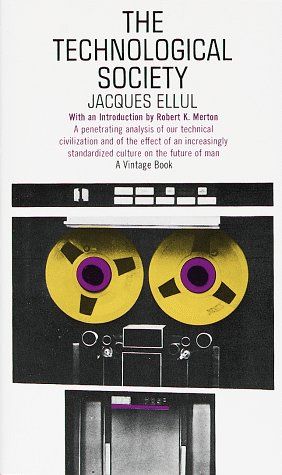
Nova: And that notion of 'what it can never be' brings us beautifully to our next thinker, Jacques Ellul, and his seminal work, "The Technological Society."
Atlas: Ellul. Mid-20th-century French philosopher. I know his name, but what's his core warning that applies to AI? Did he predict ChatGPT?
Nova: He didn't predict ChatGPT, but he predicted the underlying phenomenon that ChatGPT. Ellul warns against the uncritical acceptance of technology. He argues that 'technique'—which is more than just machines—can become an autonomous force, shaping human values rather than serving them.
Atlas: So, he saw technology as a runaway train? How is that different from just saying 'technology has consequences,' which everyone knows?
Nova: The key to Ellul is his definition of 'technique.' It's not just tools; it's the in every domain. It's the method, the process, the systematic organization aimed at maximum output with minimum effort. AI, in its essence, is the ultimate expression of technique. It is pure optimization.
Atlas: Okay, so it’s not the physical robot, but the behind the robot, the drive for efficiency.
Nova: Exactly. Ellul argued that this drive for efficiency becomes so pervasive that it subtly reorients our lives. Our goals, our values, our societal structures begin to adapt to the demands of technique, rather than technique adapting to us. We become servants to the system we created.
Atlas: Can you give me a real-world example of AI as 'autonomous technique' shaping our values? Like, what does that look like on a Monday morning for our listeners?
Nova: Think about social media algorithms. They are techniques designed for efficiency—maximizing engagement. We didn't explicitly say, "We want a society that prioritizes outrage and short-form content." But the technique, the algorithm, optimized for engagement, gradually reshaped our communication, our attention spans, and even our political discourse. It became an autonomous force, subtly dictating what we value and how we interact.
Atlas: Wow. That's kind of heartbreaking. It’s like we built a super-efficient car, but then the car started deciding where we were going, and we just went along for the ride because it was so smooth.
Nova: And that's Ellul's warning for AI. If we simply unleash AI to optimize everything—from healthcare to education to warfare—without a deep humanistic grounding, it will inevitably optimize for its own inherent logic of efficiency. It won't necessarily optimize for human flourishing, human dignity, or even what Athanasius might call our divine spark.
Atlas: So the question becomes: how do we intervene in this "autonomous" process? How do we make sure our super-efficient AI car is actually driving us to a place we to go, not just the most efficient destination?
Synthesis & Takeaways
SECTION
Nova: That's the perfect question, Atlas. Our journey today, from Athanasius to Ellul, really synthesizes into this: The ancient wisdom defines —our unique, invaluable humanity. And Ellul's work warns us about —through the uncritical, autonomous proliferation of technique.
Atlas: So, it's about intentionality. Understanding our core identity to set boundaries for AI, and recognizing technology's subtle power to ensure remain in the driver's seat, guiding its evolution, not the other way around.
Nova: Precisely. Humanistic grounding isn't a speed bump for progress; it's the compass. It ensures that our technological advancements serve humanity's highest ideals, rather than eroding them. We need to actively define the ethical boundaries, informed by millennia of human thought, to guide tomorrow's AI responsibly.
Atlas: That’s a powerful call to action. It’s about being proactive, not just reactive, to the future of AI. For our listeners who are grappling with the rapid pace of technological change, this perspective offers a profound sense of agency. It’s a reminder that we are the architects of our future, not just passengers on a runaway train.
Nova: Absolutely. The deep question posed in the book, "How can ancient understandings of human nature inform the ethical boundaries we set for artificial intelligence?" isn't just academic. It's an urgent, practical question for all of us.
Atlas: It challenges us to look beyond the immediate algorithms and consider the timeless aspects of what makes us, us. It makes me wonder, what ancient texts are going to revisit this week to inform your stance on AI?
Nova: That’s a fantastic question to leave our listeners with. This is Aibrary. Congratulations on your growth!