

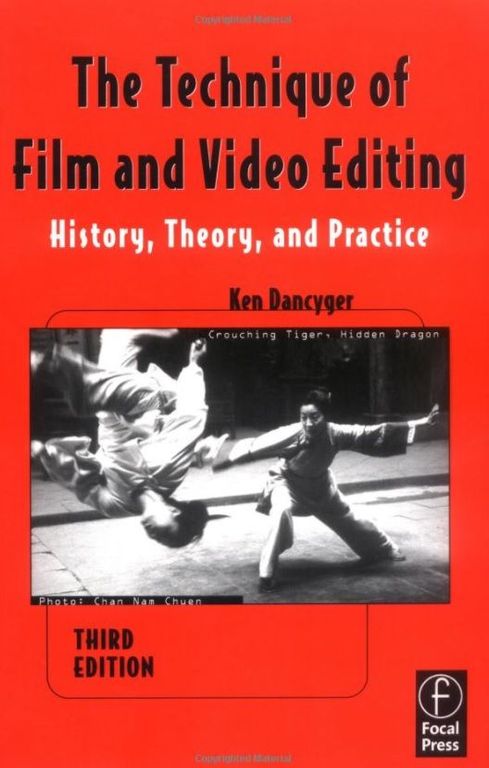
The technique of film and video editing
history, theory, and practice
Introduction
Nova: Imagine you are sitting in a dark theater, completely absorbed in a film. Your heart is pounding during a chase sequence. You are holding your breath in a quiet conversation. And you have absolutely no idea why you feel this way. That is the invisible art of editing. And today, we are diving into the book that has become the definitive guide to that art: The Technique of Film and Video Editing by Ken Dancyger.
Nova: : Nova, I have to admit, when I first heard about this book, I figured it was just another software manual. Like, here is how to use Premiere Pro, here is where the razor tool is.
Nova: And that is exactly what it is not. Dancyger, who has been a professor at NYU's Tisch School of the Arts for decades and chaired undergraduate film studies there, wrote a book that is essentially a manual for storytelling with cuts. He states his goal right up front: to be practical and concerned with aesthetic choices, but not overly absorbed with the mechanics.
Nova: : So it is more like learning how to think like an editor, not just how to push buttons.
Nova: Exactly. And here is the thing that really gets me. Dancyger lays out this almost counterintuitive principle: if the audience notices the editing, the editor has failed. The best editing is invisible. It works on you without you ever realizing it. And across seven editions since 1993, this book has unpacked exactly how that magic happens, through history, theory, and practice.
Nova: : Alright, I am intrigued. Where does this journey begin?
The Birth of Editing Language
From Silence to Montage
Nova: The book starts where film itself starts: the silent era, around 1895. And Dancyger makes a fascinating argument that the silent period was actually the golden age of editing experimentation. Without sound to worry about, filmmakers treated editing as a pure visual art form.
Nova: : Wait, are you saying the earliest filmmakers were actually more radical than a lot of what we see today?
Nova: In many ways, yes. Dancyger walks us through the pioneers. First, Edwin S. Porter with The Great Train Robbery in 1903, who basically invented the concept of film continuity. Then D. W. Griffith, who Dancyger calls the acknowledged father of film editing in the modern sense. Griffith gave us dramatic construction through editing. By 1919, with Broken Blossoms, he was using close-ups and cross-cutting to build emotional intensity in ways audiences had never experienced.
Nova: : So Griffith built the grammar, but then the real revolutionaries came along?
Nova: Right, and this is where Dancyger's book really shines. The Soviet filmmakers of the 1920s, particularly Sergei Eisenstein, developed something called the Theory of Montage. And Dancyger breaks it down into five distinct types. Do you want to hear them?
Nova: : Absolutely, lay them on me.
Nova: First, Metric Montage: cutting based purely on the length of shots. Shorter shots equal more tension. Second, Rhythmic Montage: continuity based on matching action and screen direction. Third, Tonal Montage: establishing the emotional character of a scene through editing. Fourth, Overtonal Montage: combining the first three to mix pace, ideas, and emotions simultaneously. And finally, Intellectual Montage: introducing abstract ideas into a highly emotional sequence.
Nova: : So Eisenstein was essentially saying that the collision of two images creates a third meaning in the viewer's mind that was not present in either image alone.
Nova: That is exactly it. And Dancyger emphasizes that Eisenstein was both a theoretician and an aesthete. He was not just making films; he was building a philosophy of how images communicate. The famous Odessa Steps sequence from Battleship Potemkin is the textbook example Dancyger returns to again and again.
Nova: : What about the other Soviet filmmakers? Was Eisenstein the only one?
Nova: Not at all. Dancyger gives equal attention to Vsevolod Pudovkin, who championed constructive editing and heightened realism rather than Eisenstein's more intellectual approach. And then there is Dziga Vertov, whose experiment of realism with Man with a Movie Camera pushed documentary editing into radical new territory. Dancyger argues that these competing philosophies, Eisenstein versus Pudovkin versus Vertov, essentially established the fundamental tensions that editors still navigate today.
Technology as Creative Force
Sound Arrives and Everything Changes
Nova: One of the most compelling threads running through Dancyger's book is the relationship between technology and creativity. He does not treat them as separate things. When sound arrived in 1927 with The Jazz Singer, it was not just a new gadget. It fundamentally rewired how editors thought about storytelling.
Nova: : I would imagine the first sound films were pretty clunky. Did Dancyger address that?
Nova: He does, and he is remarkably specific about it. He describes how early sound technology was incredibly limiting. Cameras had to be encased in soundproof boxes. Microphones were primitive. Editors who had spent decades developing fluid visual storytelling suddenly found themselves shackled to dialogue.
Nova: : So sound initially made films worse?
Nova: In terms of visual dynamism, yes. But Dancyger points to Alfred Hitchcock's 1929 film Blackmail as the turning point. Here is this fascinating detail: Blackmail was shot partly as a silent film and partly as a sound film. And even at this incredibly early stage, Hitchcock was using sound editing to create foreboding and suspense. There is a famous sequence where a woman hears the word knife repeated over and over, and Dancyger shows how Hitchcock used sound not just to support the image but to create psychological interiority.
Nova: : That is so ahead of its time. What other early sound innovators does he highlight?
Nova: He devotes serious analysis to Fritz Lang's M from 1931. Lang used sound to establish time and place in ways that were revolutionary. And Rouben Mamoulian's Applause demonstrated what Dancyger calls the dynamic of sound, using overlapping dialogue and ambient noise to create a sense of lived reality that silent film could never achieve.
Nova: : So Dancyger is essentially arguing that every technological shift, however disruptive, eventually expands the editor's creative toolkit.
Nova: Exactly. And he traces this argument through the entire century. The arrival of widescreen formats in the 1950s changed how editors thought about character and environment within the frame. Lightweight handheld cameras enabled cinema verite documentary, which brought a whole new aesthetic of immediacy. Then television and MTV in the 1980s and 90s introduced faster cutting rhythms, disjunctive editing, and what Dancyger calls the obliteration of time and space.
Nova: : And now digital?
Nova: The sixth and seventh editions grapple extensively with nonlinear digital editing. But here is what makes Dancyger's perspective valuable: he does not fetishize the technology. He keeps asking the same questions. Does this serve narrative clarity? Does it create dramatic emphasis? The tools change, but the goals remain constant.
A Framework for Decision-Making
The Five Goals of Every Edit
Nova: This brings us to what I think is the beating heart of the book. Section two is called Goals of Editing, and Dancyger lays out five distinct goals that every editor should be thinking about. Narrative clarity, dramatic emphasis, subtext, surprise, and aesthetics.
Nova: : Five goals. That sounds deceptively simple.
Nova: It is simple to state, but applying it is where the art lives. Let us start with narrative clarity. Dancyger says that narrative clarity is achieved when a film does not confuse viewers. He breaks this down into plot-driven films versus character-driven films. For a plot-driven film like Invictus, editing choices must prioritize the forward momentum of events. For a character-driven film like Hannah and Her Sisters, the editing must illuminate inner life and relationships.
Nova: : So the editor has to be a diagnostician first. What is this scene actually trying to do?
Nova: Precisely. Dancyger asks the editor to constantly answer two questions: which visual information is dramatically interesting, and which visual information is dramatically necessary. Those are not the same thing. Something can be interesting but unnecessary. The discipline is cutting what does not serve the story.
Nova: : What about dramatic emphasis? How is that different from narrative clarity?
Nova: Great question. Dancyger uses the film United 93 as a case study. The narrative is already clear: a plane is hijacked on September 11th. But dramatic emphasis is about where you place the weight. Do you emphasize the close-ups of passengers? The chaos in the control rooms? The juxtaposition of both? Dancyger shows how the editor uses dynamic montage, close-ups, juxtaposition, and pace to create a specific emotional experience.
Nova: : And subtext? That seems like the trickiest one.
Nova: Subtext is what is not being said. Dancyger analyzes films like The Departed, Lust Caution, and There Will Be Blood to show how editing can reveal what characters are actually thinking and feeling beneath their words. A lingering shot held a beat too long. A cutaway to a telling detail. These are editing decisions that create layers of meaning.
Nova: : And surprise?
Nova: Surprise is about subverting audience expectations. Dancyger's case study of American Sniper is particularly compelling. The film's editing keeps shifting between the external action of war and the internal psychological toll. The audience is constantly destabilized, never allowed to settle into a comfortable viewing pattern.
Nova: : And finally, aesthetics?
Nova: Aesthetics is the pure beauty of the cut. Dancyger examines films like The Third Man and The Passion of the Christ, where editing choices are driven by visual poetry as much as narrative logic. It is the least utilitarian goal and, in some ways, the most purely cinematic.
Hitchcock, Altman, and the Editor as Artist
Masters of the Cut
Nova: Dancyger dedicates entire chapters to filmmakers whose work represents editing at its most expressive. He devotes a full chapter to Alfred Hitchcock, breaking down specific techniques that feel almost like a magician revealing his tricks.
Nova: : What kind of techniques are we talking about?
Nova: Let me give you a few. Parallel action, which is cutting between two events happening simultaneously to build tension. The sound cut, where a dramatic punctuation happens through an abrupt shift in audio. Cutting on motion, where a character's movement carries us from one scene to another seamlessly. The extreme long shot to create suspense. And the extreme close-up to make a single moment feel like eternity.
Nova: : That extreme close-up one is interesting. Can you give an example?
Nova: Think of any Hitchcock film where a character discovers something terrible. The camera pushes in tight on their eyes, and the editing holds on that close-up just long enough to make the audience squirm. Dancyger argues that this manipulation of dramatic time and pace is the editor's superpower. You can make a second feel like an hour or an hour feel like a second.
Nova: : And then there is Robert Altman, who seems like the complete opposite of Hitchcock in some ways.
Nova: Exactly right. While Hitchcock is about control, Altman is about what Dancyger calls the freedom of chaos. In films like Nashville and Short Cuts, Altman uses overlapping dialogue, wandering camera work, and editing that refuses to privilege any single character. Dancyger shows how this requires a completely different editing philosophy. You are not guiding the audience to one clear meaning. You are creating a tapestry and letting the audience find their own path through it.
Nova: : There is also a chapter on editors who became directors, right? Robert Wise and David Lean.
Nova: Yes, and this is one of the most unique sections. Dancyger traces how Robert Wise went from editing Citizen Kane to directing West Side Story, and how David Lean's editing background shaped his directorial vision. The argument is that editors who become directors have an innate understanding of coverage. They know exactly what shots they need because they have sat in the editing room, desperate for a cutaway that was never filmed.
Nova: : That makes so much sense. It is like a chef who started as a sous chef. They understand every station.
Nova: Perfect analogy. And Dancyger also explores newer voices. Martin Scorsese, whose editing creates what Dancyger calls the dramatic document. Spike Lee, whose editing pace amplifies social action. Kathryn Bigelow. The Wachowskis. Each one is treated as a case study in how editing style reflects a director's worldview.
Nova: : It sounds like Dancyger is arguing that editing is never just technical. It is always philosophical.
Nova: That might be the single most important thesis of the entire book. Every cut is a choice about what matters, what to show, what to hide, what to emphasize, what to elide. Editing is a moral and philosophical act, not just a technical one.
Editing Across Forms and Eras
Genre, Documentary, and the Future
Nova: The third section of the book is entirely devoted to editing for specific genres: action, dialogue, comedy, and documentary. And Dancyger makes the case that each genre demands its own editing logic.
Nova: : Let us start with action. I imagine that is all about pace.
Nova: Pace is central, yes, but Dancyger goes deeper. He compares an early action sequence from Buster Keaton's The General with Raiders of the Lost Ark and then with The Bourne Ultimatum. The General uses wide shots and long takes because the comedy comes from seeing the full physical gag. Raiders uses classical continuity but accelerates the cutting rhythm during set pieces. Bourne uses what Dancyger calls the ultimate use of pace, with rapid-fire cuts that create disorientation and visceral intensity.
Nova: : So the same genre evolves radically over time?
Nova: Exactly. And Dancyger also examines alternatives to the dominant style. His case study of A History of Violence shows how an action sequence can be edited for psychological horror rather than kinetic thrill. The editing choices are completely different because the goal is completely different.
Nova: : What about comedy? That seems like the hardest genre to edit.
Nova: It is, and Dancyger breaks comedy down into character comedy, situation comedy, satire, and farce. Each has its own editing concerns. Comedy lives and dies on timing. A reaction shot held one frame too long or too short can kill a joke. He analyzes The Lady Eve and Victor/Victoria to show how role-reversal comedies require editing that supports dramatic irony.
Nova: : And documentary? You mentioned Dancyger gives it unusual attention.
Nova: This is one of the things that sets Dancyger's book apart. Most editing books focus almost exclusively on narrative fiction. But Dancyger devotes multiple chapters to documentary, including experimental documentary. He traces cinema verite from the National Film Board of Canada to modern personal documentaries. He analyzes the role of the narrator, from observer to investigator to guide to provocateur. And in the seventh edition, he even includes experimental documentaries like Agnes Varda's The Beaches of Agnes.
Nova: : So what does Dancyger say about where editing is heading?
Nova: The latest edition grapples extensively with digital reality. He examines how CGI and special effects have changed what editors work with. But his core argument remains consistent. Whether you are cutting film, digital video, or entirely computer-generated imagery, the fundamental questions are the same. What is the narrative? Where is the dramatic emphasis? What is the subtext? The seventh edition adds new chapters analyzing recent biopics like Oppenheimer and Maestro, comparing them with earlier films like The Life of Emile Zola. The technology changes, but the storytelling imperatives endure.
Conclusion
Nova: So here is what I think makes The Technique of Film and Video Editing such an enduring book. It is now in its seventh edition, spanning over thirty years since its first publication in 1993, and it has been through the transition from celluloid to digital, from theatrical to streaming, from classical to experimental. And yet its core insight has never wavered.
Nova: : Which is?
Nova: That editing is not about software. It is about storytelling. Every single cut is a decision about what the audience needs to know in this moment, what they need to feel, and what they need to wonder about. Dancyger gives us the framework: narrative clarity, dramatic emphasis, subtext, surprise, aesthetics. He gives us the history, from Porter and Griffith through Eisenstein and Hitchcock to Scorsese and beyond. He gives us the practical principles: continuity, pace, sound, coverage. But ultimately, he gives us a way of seeing.
Nova: : That phrase, a way of seeing, really resonates. Because after reading this book, you do not just watch movies the same way anymore.
Nova: Exactly. You start noticing when a scene holds on a character's face an extra beat. You notice when the sound from the next scene bleeds in before the cut. You notice what is not shown. And you realize that every single one of those choices was made deliberately by an editor collaborating with a director to shape your experience.
Nova: : What would you say is the single most practical takeaway for someone who wants to become a better editor?
Nova: I would point to Dancyger's framework for evaluating every edit. Ask yourself two questions. First, which visual information is dramatically interesting? Second, which visual information is dramatically necessary? The gap between those two answers is where great editing happens. Cut what is merely interesting. Keep what is necessary. And never forget Dancyger's ultimate standard: if the audience notices your editing, you have failed. The best editing is the editing nobody sees.
Nova: : That is both humbling and inspiring.
Nova: It really is. Dancyger's book reminds us that film editing is this strange, beautiful profession where your greatest triumphs are invisible. The audience walks out of the theater talking about the performances, the story, the cinematography. And somewhere, the editor smiles, because they know that without their work, none of it would have held together. This is Aibrary. Congratulations on your growth!