Personalized Podcast
Golden Hook & Introduction
SECTION
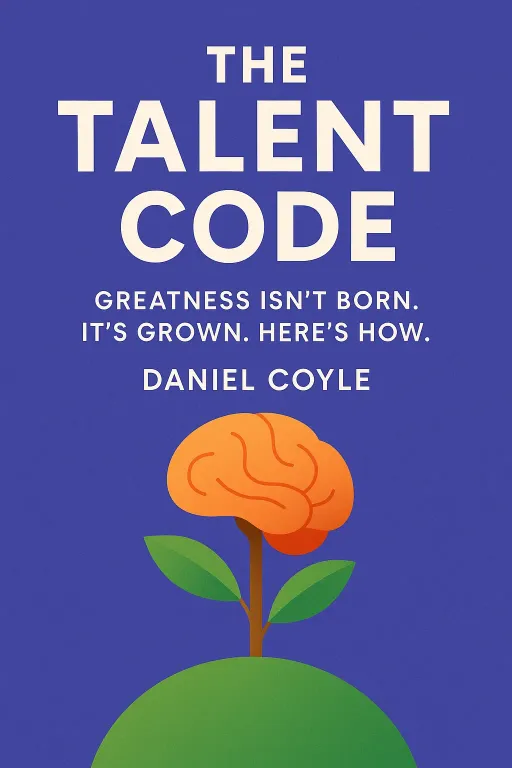
Dr. Celeste Vega: What if I told you that greatness isn't something you're born with, but something you physically grow inside your brain? Imagine your neural pathways as thin, leaky copper wires, and every time you struggle to learn a new skill, your brain wraps those wires in high-speed fiber-optic insulation. Today, we are cracking open Daniel Coyle's masterpiece,, to explore how this biological insulation, a substance called myelin, is the secret software behind all human extraordinary ability. We're going to tackle this from three fascinating angles. First, we'll look at the cellular mechanics of deep practice and how struggling at the edge of your ability actually builds biological broadband. Second, we'll dive into the concept of ignition, the motivational spark that fires up these neural engines. And finally, we'll look at master coaching, the art of delivering precise, error-correcting feedback to optimize these growing circuits. I'm joined today by Abeeb, a researcher passionate about neuroscience and machine learning. Welcome, Abeeb!
Abeeb: Thanks, Celeste! It's great to be here. You know, when I first read, my machine learning brain immediately started making connections. In computer science, we talk about optimizing neural networks, adjusting weights, and minimizing error. But Coyle shows us that the human brain has its own physical optimization algorithm, and it's incredibly elegant. It's not about magic; it's about biological wiring.
Dr. Celeste Vega: Exactly! It demystifies genius. We often look at prodigies and think they have some divine spark, but Coyle argues that talent hotbeds, from Russian tennis clubs to classical music academies, all share the exact same neurological blueprint.
Abeeb: Right, and as a first-born and a college student still navigating my own path, understanding this blueprint is incredibly empowering. It means our potential isn't fixed at birth. We are dynamic, self-wiring systems.
Deep Dive into Core Topic 1 - The Biological Broadband: Myelin and Skill Acquisition
SECTION
Dr. Celeste Vega: Let's start with the heart of the talent code: deep practice. Coyle introduces us to a young girl named Clarissa. She's a thirteen-year-old clarinet student, and by all accounts, she's musically mediocre. She doesn't have a great ear, her rhythm is average, and her motivation is usually pretty low. But researchers Gary McPherson and James Renwick caught a six-minute clip of her practicing that changed everything.
Abeeb: Ah, yes! The "Golden Wedding" story. I love this case study because it perfectly illustrates the difference between passive repetition and active, error-focused optimization.
Dr. Celeste Vega: It really does. Clarissa was working on a new jazz piece called "Golden Wedding" by Woody Herman. Now, instead of just playing through the song from start to finish, she did something highly unusual. She played a few notes, made a mistake, stopped, and stared at the sheet music. She squinted, hummed the melody to herself, and then started over. She backtracked, isolated the difficult measure, slowed it down to a crawl, and repeated it until she got it right. She was actively embracing the struggle.
Abeeb: And the result was mind-blowing, right? In just six minutes of that intense, focused struggle, she accelerated her learning speed by ten times. She accomplished what would normally take her a week of mindless practice. But then, right after that, she played another song, "The Blue Danube," and she just sailed through it without stopping, ignoring all her mistakes. It sounded terrible because she wasn't thinking, learning, or building anything. She was just on autopilot.
Dr. Celeste Vega: Yes! McPherson said it was like watching someone on a moving sidewalk. And this is where the neuroscience comes in. Why does that painful, slow, error-correcting struggle work so much better than smooth, effortless repetition? The answer lies in a specialized type of glial cell in our brain called oligodendrocytes. When we fire a neural circuit, these cells sense the electrical activity and wrap a fatty substance called myelin around the nerve fiber.
Abeeb: Think of myelin as the ultimate insulation. Uninsulated nerve fibers leak electrical signals, making the transmission slow and noisy. But every time you fire that circuit during deep practice, the oligodendrocytes add another layer of myelin. Coyle notes that myelin can increase signal speed by up to a hundred times and decrease the refractory time, allowing the brain to process information up to three thousand times more efficiently! It's literally upgrading your brain's dial-up connection to high-speed fiber-optic broadband.
Dr. Celeste Vega: I love that metaphor, Abeeb! It makes the biology so tangible. And the key is that myelin is completely meritocratic and indiscriminate. It doesn't care who you are, what your IQ is, or how much money you have. It only cares about which circuits you fire, and how urgently you fire them.
Abeeb: That's a massive point. In machine learning, we train models using gradient descent, where the system constantly calculates its error and adjusts its parameters to minimize that error. If a model never encounters errors, it never learns. Clarissa's brain was doing the exact same thing. By slowing down and focusing on the errors, she was giving her biological neural network the precise feedback it needed to adjust its weights.
Dr. Celeste Vega: Yes, and that's why Coyle says deep practice is built on a paradox: struggling in targeted ways, operating at the very edge of your ability where you make mistakes, actually makes you smarter. We have this cultural myth that learning should be effortless and beautiful, but biologically, effortless performance is a terrible way to learn.
Abeeb: It really is. If you're not making mistakes, you're not growing myelin. It reminds me of another great example from the book: the rise of Brazilian soccer. For decades, the world has wondered how a developing nation produces so many incredibly skilled players. Coyle traces this back to a very specific training tool called futsal.
Dr. Celeste Vega: Futsal is such a fascinating piece of the puzzle. For those who don't know, futsal is a variation of soccer played indoors on a small court, about the size of a basketball court, with a ball that is smaller and much heavier than a standard soccer ball.
Abeeb: Right, and because the space is so compressed and the ball doesn't bounce much, players are forced to make decisions in fractions of a second. Research shows that futsal players touch the ball six times more often per minute than players in conventional soccer. The tight space means they are constantly making mistakes, correcting their ball control, and improvising. It's a high-repetition, high-feedback environment.
Dr. Celeste Vega: It's a myelin factory! When Simon Clifford, an English coach, visited Brazil and saw futsal, he realized it was the missing link. He brought the game back to Leeds, England, and his under-fourteen team, practicing futsal, ended up defeating the Scottish and Irish national youth teams. It proved that the Brazilian "magic" was actually a highly optimized training system.
Abeeb: It's all about data density. By compressing the game, futsal maximizes the number of training epochs per minute. It's the exact same principle we use when training machine learning algorithms: more high-quality data points with immediate feedback loops lead to faster convergence and superior performance.
Deep Dive into Core Topic 2 - Optimization Algorithms: Deep Practice vs. Machine Learning
SECTION
Dr. Celeste Vega: That transition from biological learning to machine learning is so natural, Abeeb. Let's dive deeper into that. In the book, Coyle outlines the three rules of deep practice: chunk it up, repeat it, and learn to feel it. Let's break those down, starting with "chunking."
Abeeb: Chunking is incredibly elegant. When we look at an expert performing a skill, we see a seamless, fluid motion. But that motion is actually made up of tiny, discrete neural circuits, or "chunks." Master chess players, for example, don't look at individual pieces; they recognize complex patterns of pieces.
Dr. Celeste Vega: Yes, Coyle references the classic experiment by Adriaan de Groot. He showed chess masters and novices a chess board from a real game for just five seconds. The masters could recall the positions of almost all the pieces perfectly, while the novices struggled. But when they showed them a board with randomly scattered pieces that could never happen in a real game, the masters did no better than the novices.
Abeeb: Exactly! Because the masters weren't memorizing individual coordinates. They were retrieving pre-myelinated "chunks" of patterns from their long-term memory. In deep practice, you have to absorb the whole skill first, then break it down into the smallest possible chunks, and practice those chunks individually before linking them back together.
Dr. Celeste Vega: And the second rule is "repeat it." But as we saw with Clarissa, this isn't mindless repetition. It's attentive, urgent repetition. You have to fire the circuit repeatedly to signal the oligodendrocytes that this pathway needs insulation. There's a physical limit to this, though. Coyle points out that even the most elite performers in the world, whether they are concert pianists or Olympic athletes, rarely engage in deep practice for more than three to five hours a day.
Abeeb: That makes total sense from an energy perspective. Myelination is an active metabolic process. It requires significant cognitive energy and focus. In machine learning, if you train a model on the same data over and over without variation, it overfits. It becomes rigid and can't adapt to new situations. Attentive repetition with slight variations prevents biological overfitting, keeping the skill flexible.
Dr. Celeste Vega: That leads perfectly to the third rule: "learn to feel it." Deep practice has a distinct physical sensation. It's not comfortable. It feels like reaching for something just out of your grasp, failing, feeling that slight irritation, and reaching again. Coyle describes it as a state of high concentration, where you are hyper-aware of the gap between your target and your actual reach.
Abeeb: That "feeling" of the gap is literally the brain calculating the loss function! In optimization algorithms, the loss function measures how far off our predictions are from the actual targets. The algorithm uses that error signal to update its parameters. If you don't feel the struggle, you don't have a clear error signal, and your brain can't update its neural connections.
Dr. Celeste Vega: It's so true. And this is where the second element of the talent code comes in: ignition. You can't sustain that uncomfortable, energy-intensive deep practice without a massive amount of motivational fuel. Coyle talks about "primal cues" that trigger this ignition. These are often subtle environmental signals that tell our subconscious: "You need to pay attention to this to survive or belong."
Abeeb: Yes! Like the breakthrough success of a role model. Look at Se Ri Pak. In 1998, she became the first South Korean golfer to win a major LPGA tournament. Before her, no South Korean had succeeded in professional golf. But her victory sent a massive primal cue to millions of young girls in South Korea: "If she can do it, I can do it too." Within ten years, South Korean women dominated the LPGA tour.
Dr. Celeste Vega: It's a social ignition switch. Another fascinating primal cue Coyle discusses is scarcity and belonging. He looks at the Opus 118 violin program in Harlem, started by Roberta Tzavaras. They had a massive waiting list, and they had to hold a lottery for kids to get a violin. That scarcity made the violins incredibly valuable in the minds of the children. It triggered a primal urge to belong to that exclusive group, which fueled hours of deep practice.
Abeeb: It's a brilliant design strategy. In machine learning, we talk about initialization. If you initialize a model with random, chaotic weights, it takes a long time to train. But if you initialize it with a strong, directed signal—like a powerful motivational cue—it converges much faster. Ignition is the brain's initialization phase.
Synthesis & Takeaways
SECTION
Dr. Celeste Vega: This brings us to the final element of the talent code: master coaching. If deep practice is the engine and ignition is the fuel, the master coach is the GPS. Coyle spent time observing legendary coaches, like vocal coach Linda Septien and basketball coach John Wooden. He expected to find charismatic, inspirational leaders giving grand speeches. Instead, he found quiet, observant individuals who delivered short, highly targeted bursts of information.
Abeeb: Yes, the study of John Wooden by Ronald Gallimore and Roland Tharp is legendary. They recorded over two thousand discrete acts of teaching during his practices. They found that Wooden almost never gave pep talks or praise. Instead, seventy-five percent of his communication was pure, actionable information. He would say things like: "Take the ball softly; you're receiving a pass, not intercepting it."
Dr. Celeste Vega: It's what Coyle calls the "GPS reflex." A master coach doesn't judge or preach; they simply state where you are, where you need to go, and the exact step to get there. They are master builders of myelin, helping students identify their errors and adjust their circuits in real-time.
Abeeb: It's real-time error correction. In machine learning, we call this supervised learning, where a supervisor provides the correct labels for the data. A master coach is the ultimate supervisor, ensuring the biological network doesn't myelinate incorrect pathways. Because, as Coyle warns, myelin wraps but it doesn't unwrap. Once you build a bad habit, it's incredibly hard to undo because that circuit is already insulated. You have to build a whole new, stronger circuit to override it.
Dr. Celeste Vega: That is such a crucial warning for anyone learning a new skill. Practice doesn't make perfect; practice makes myelin, and myelin makes permanent. We have to be so deliberate about how we practice. Abeeb, as we wrap up, how do you see yourself applying these principles to your own life, especially with your studies in machine learning and neuroscience?
Abeeb: For me, it completely changes how I approach difficult subjects. When I struggle with a complex machine learning algorithm or a difficult neuroscience concept, I used to feel frustrated, like I wasn't smart enough. Now, I recognize that frustration as the physical sensation of myelination. I tell myself: "My oligodendrocytes are active right now. I am building the broadband." It makes me embrace the struggle rather than run from it.
Dr. Celeste Vega: That is a beautiful and powerful shift in mindset. To our listeners, we want to leave you with a challenge. Think about a skill you've been trying to master. Are you practicing like Clarissa on "The Blue Danube," just sailing through on autopilot? Or are you willing to step into the sweet spot, slow down, embrace the errors, and build your own biological broadband?
Abeeb: Find your sweet spot, embrace the struggle, and start wiring your own greatness.
Dr. Celeste Vega: Thank you so much for joining us, Abeeb. This was an incredibly insightful conversation.
Abeeb: Thank you, Celeste! It was an absolute pleasure.
Dr. Celeste Vega: Until next time, keep practicing deeply, keep your ignition burning, and let your myelin grow!