

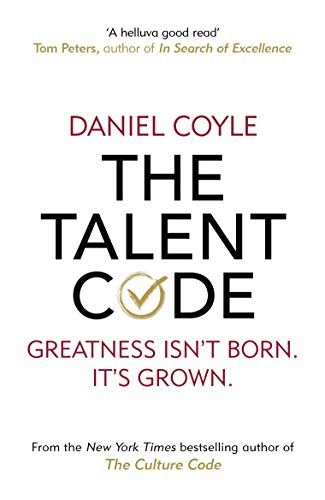
The talent code
Introduction
Nova: Imagine a tiny, run-down tennis club in Moscow called Spartak. It has exactly one indoor court. It is freezing cold for half the year. And yet, for a period in the early 2000s, this one humble club produced more top-twenty ranked women players than the entire United States combined. How is that even possible?
Nova: It sounds impossible, right? But it is not a glitch. It is a pattern. Whether it is Brazilian soccer stars, world-class musicians from a tiny school in the Adirondacks, or math geniuses from a specific neighborhood, these hotbeds of talent keep popping up in the most unlikely places. And today, we are diving into the book that decodes exactly how they do it: The Talent Code by Daniel Coyle.
Nova: That is exactly the myth Coyle wants to bust. He spent years traveling to these hotbeds, and what he found is that talent is not something you are born with. It is something you grow. And the best part? There is a very specific biological mechanism in your brain that makes it happen.
Nova: Exactly. It is about a substance called myelin, and once you understand how it works, it changes everything you thought you knew about practice, coaching, and even your own potential.
Key Insight 1
The Myelin Revolution
Nova: To understand the Talent Code, we have to start with the biology. Coyle introduces us to a substance called myelin. Think of your brain as a massive network of electrical wires. Every time you do anything—swing a tennis racket, play a chord on a guitar, solve a math problem—your brain sends an electrical signal through those wires.
Nova: Precisely. It is a fatty tissue that wraps around the nerve fibers, the axons. But it is not just passive insulation. Every time you fire a specific neural circuit, a little more myelin wraps around it. The thicker the myelin, the faster and more accurately the signal travels. We are talking about speeds up to two hundred miles per hour.
Nova: In a way, yes! Myelin is the broadband of the brain. It turns a dial-up connection into fiber-optic. The more you fire the circuit, the more myelin you get. And the more myelin you have, the more effortless and precise the skill becomes. This is why world-class athletes or musicians look like they are not even trying. Their circuits are so heavily insulated that the signal has no choice but to go exactly where it is supposed to go.
Nova: Exactly. And here is the kicker: myelin does not care who you are. It does not care about your IQ or your parents' bank account. It only cares about how many times you fire that circuit and how you fire it. It is a democratic biological process.
Nova: That is the million-dollar question, Leo. And that brings us to the first pillar of the Talent Code: Deep Practice. It is not just about the quantity of practice; it is about the specific quality of the struggle.
Key Insight 2
Deep Practice and the Sweet Spot
Nova: Coyle talks about something called the Sweet Spot. Most of us, when we practice, we either do things that are too easy, which is boring, or things that are too hard, which is frustrating. Deep Practice happens right on the edge of your ability, where you are constantly making mistakes and correcting them.
Nova: It is the opposite! In the Talent Code, mistakes are information. Coyle uses the example of Brazil and soccer. Why does Brazil produce so many legends? Is it the sand on the beaches? The culture?
Nova: That is part of it, but the secret weapon is actually a game called futsal. It is played in tight spaces with a smaller, heavier ball that does not bounce much. Because the space is so cramped, players touch the ball six times more often than in regular soccer. They have to make decisions faster. They make more mistakes, and they have to correct them instantly.
Nova: Exactly. Coyle calls this chunking. You break a skill down into tiny, bite-sized pieces. You learn one tiny movement, then another, then you link them together. He visited the Meadowmount School of Music, where students learn months of material in weeks. Their secret? They play so slowly that a listener wouldn't even recognize the tune. It sounds like a series of disconnected notes.
Nova: Because when you go slow, you can see the mistakes. You can feel the exact moment the circuit misfires. By slowing it down, you ensure that you are wrapping the myelin correctly. If you practice fast and messy, you are just insulating a messy circuit. You are literally hard-wiring your mistakes.
Nova: Right. Deep practice is exhausting. It is not fun in the traditional sense. Coyle says that world-class performers can usually only handle about three to five hours of deep practice a day. It drains the brain because you are essentially performing surgery on your own neural pathways.
Key Insight 3
Ignition: The Motivational Spark
Nova: Now, if deep practice is so exhausting and difficult, why would anyone do it? That leads us to the second pillar: Ignition. This is the fuel, the motivational spark that keeps you going when the struggle gets real.
Nova: Not quite. Coyle looks at ignition as a set of primal cues. One of the most powerful cues is the idea of belonging or future security. He points to the Kournikova effect. Before Anna Kournikova, there were almost no Russian women in the top ranks of tennis. Then she had a bit of success, and suddenly, every girl in Russia saw her and thought, If she can do it, I can do it.
Nova: Precisely. It is a signal that says, This is who I am, and this is what I am going to do. Coyle found that many world-class performers had a significant loss or a major challenge early in life. This creates a primal cue that the world is not safe, and they need to build a skill to survive or belong. It is like a switch being flipped in the brain.
Nova: That is a great way to put it. The brain is a miser. It does not want to waste energy. Ignition is the signal that tells the brain, Hey, this skill is a matter of life and death, or at least a matter of who we are. Start wrapping the myelin!
Nova: You can definitely cultivate it. It is about surrounding yourself with the right images and stories. It is why being part of a group of high-achievers is so powerful. When you see someone just like you working hard and succeeding, it sends a constant ignition signal to your brain. It is not about being inspired once; it is about being ignited every single day.
Key Insight 4
Master Coaching
Nova: The final piece of the puzzle is Master Coaching. And this was one of the most surprising parts of Coyle's research. When he went to these talent hotbeds, he expected to find these charismatic, shouting, larger-than-life coaches. You know, the Hollywood version of a coach.
Nova: Exactly! But what he found was the opposite. The master coaches were often quiet, older, and incredibly observant. They weren't giving long, inspiring speeches. They were giving tiny, surgical instructions.
Nova: Instead of saying, Great job, keep it up, a master coach would say, Tighten your wrist two inches higher. Or, Listen to the rhythm of that third note again. They are like human GPS systems. They watch the student, they see where the circuit is misfiring, and they give a tiny nudge to correct it.
Nova: Exactly. Coyle calls them talent whisperers. They have spent decades building their own mental maps of the skill, so they can recognize a mistake before the student even makes it. They don't want to be the center of attention. They want to be the mirror that reflects the student's performance back to them with perfect clarity.
Nova: That is it. They understand that the learning is happening inside the student's brain, not in the coach's mouth. They provide the scaffolding, but the student has to do the climbing. Coyle noticed that these coaches often have a certain look—they are constantly squinting, as if they are trying to see the electrical signals moving through the student's nerves.
Conclusion
Nova: So, when you put it all together—Deep Practice, Ignition, and Master Coaching—you get the Talent Code. It is a blueprint for building greatness from the ground up. It takes the mystery out of talent and replaces it with a process that anyone can follow.
Nova: Precisely. The main takeaway is that struggle is not a sign that you lack talent. Struggle is the biological requirement for growing it. Every time you fail and correct, you are adding another layer of myelin. You are literally becoming a better version of yourself, one neural wrap at a time.
Nova: That is the spirit. Remember, your brain is a living, changing organ. It is designed to grow. You just have to give it the right signals. If you want to dive deeper, I highly recommend picking up Daniel Coyle's book. It is filled with even more incredible stories and practical tips.
Nova: Go for it, Leo. This is Aibrary. Congratulations on your growth!