

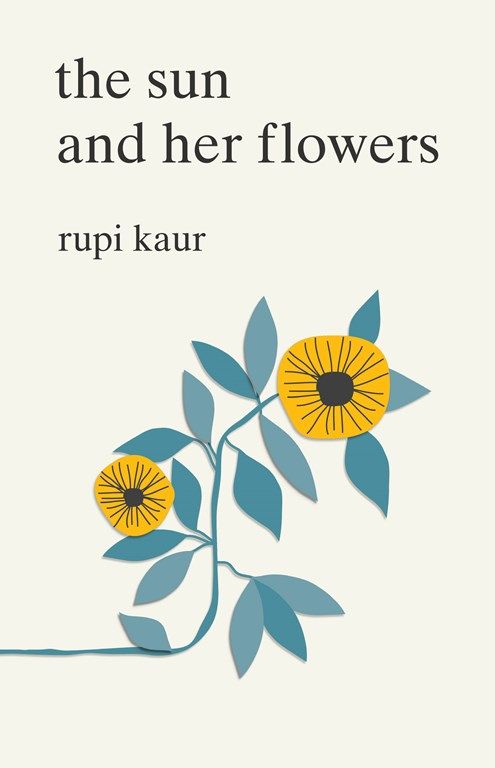
the sun and her flowers
Introduction
Nova: Picture this: it's 2017, and a poetry book, a poetry book of all things, debuts at number one on global bestseller lists and sells over two million copies in its first three months. That book is the sun and her flowers by Rupi Kaur. I'm Nova.
Nova: That's exactly the reaction millions of readers have had, and it's also the source of one of the most fascinating literary debates of the last decade. The sun and her flowers is Rupi Kaur's second poetry collection. It came out on October 3, 2017, following her blockbuster debut Milk and Honey, and together her collections have now sold over twelve million copies worldwide and been translated into more than forty languages.
Nova: That's exactly what we're going to explore today. The title itself gives us our first clue. Kaur has said she was going through a difficult breakup and became fascinated by sunflowers, how they rise with the sun and follow it across the sky. She thought, what if the sun represents a woman, and the flowers represent all the relationships and experiences she moves through in life?
Nova: Exactly. And that reframing carries through the entire book's architecture. Let's dig into how this collection is built.
How Five Chapters Mirror a Flower's Life
The Architecture of Growth
Nova: The sun and her flowers is organized into five chapters: Wilting, Falling, Rooting, Rising, and Blooming. This structure comes directly from a poem Kaur credits to her mother, which opens the book. It goes: this is the recipe of life, said my mother, as she held me in her arms as I wept, think of those flowers you plant in the garden each year, they will teach you that people too must wilt, fall, root, rise, in order to bloom.
Nova: And each chapter maps to a phase of emotional experience. Wilting focuses on heartbreak and the end of a relationship, that initial shock of loss. Kaur writes, "i think my body knew you would not stay." It's about the intuition we often ignore.
Nova: Right. And then Rooting, which we'll explore in depth shortly, takes a dramatic turn outward into ancestry, immigration, and cultural identity. Rising is the ascent, the rebuilding of self-worth. And Blooming is joy reclaimed, a celebration of self-love and even imagining the next generation.
Nova: Kaur has actually said she thinks of the book as one continuous poem stretching across 250 pages. Sometimes it's hard to tell where one poem ends and another begins. And her signature style, all lowercase letters, only periods for punctuation, is partly an homage to Punjabi, her mother tongue, where capitalization conventions are different. It also creates this intimate, whisper-close feeling.
Immigration, Mothers, and the Search for Home
Rooting in Identity
Nova: Let's talk about the Rooting chapter, because Kaur herself has said it's her favorite, and it's where the book takes its biggest thematic swing compared to her debut. This is where she moves beyond personal romantic loss into something much larger: what it means to be the child of immigrants, what it means to carry a hyphenated identity.
Nova: There's a long poem called "home" where she traces the immigrant experience from a macro perspective: people packed onto boats, refugees fleeing war, the fear of capsizing. And then she zooms in to the intimate: her mother missing India, her father pulling the family toward a new life. She writes, "perhaps we are all immigrants trading one home for another, first we leave the womb for air, then the suburbs for the filthy city in search of a better life, some of us just happen to leave entire countries."
Nova: And then there's "broken english," one of the most discussed poems in the collection. Kaur reflects on her parents' accented English and reframes what society treats as a deficiency into a point of pride. She writes about how her mother's broken English speaks volumes that fluent English never could. It's a reclamation of identity.
Nova: And the answer, for Kaur, seems to be: you acknowledge the pain. You don't bypass it. She writes: "i stand on the sacrifices of a million women before me, thinking what can i do to make this mountain taller so the women after me can see farther." That's not just gratitude, it's responsibility. Legacy as an active practice.
Criticism, Backlash, and the Battle Over What Counts as Poetry
The Instapoet Firestorm
Nova: We can't talk about the sun and her flowers without addressing the controversy. Rupi Kaur is perhaps the most famous example of the "Instapoet" phenomenon, poets who built massive audiences through Instagram before traditional publishing. And with that visibility came intense criticism.
Nova: And to be fair, that poem did get 175,000 likes on Instagram. The viral nature of her work makes it easy to parody. People online have created parodies like "I wanted Chick-fil-A but you were a Sunday morning." The line break style is distinctive and easy to mimic.
Nova: And there's also the plagiarism controversy. Another Instapoet, Nayyirah Waheed, accused Kaur of similarities between their work, particularly around metaphors of honey and water. But as critics have pointed out, those metaphors have existed in poetry for thousands of years, going back to Sappho in the sixth century BC. What's really happening is the emergence of a movement of young women of color poets, from Kaur to Waheed to Warsan Shire to Yrsa Daley-Ward, who are writing about shared themes: anger at how the world treats young women, defiance in the face of dismissal, celebrations of modern femininity.
Nova: Kaur herself has said she stopped reading comments because she didn't want external opinions to change what she wrote about. In an interview with Teen Vogue, she said: "my job is to focus on the work and the art and that's what drives me." Whether you find her work profound or shallow, the numbers don't lie: she reached readers who felt poetry wasn't for them, and she brought them to the table.
Self-Love, the Body, and the Next Generation
Blooming Into Wholeness
Nova: The final two sections, Rising and Blooming, chart the upward arc. And this is where Kaur's quiet strength becomes most visible. She writes: "what is stronger than the human heart which shatters over and over and still lives."
Nova: The idea that home is not a person or a place but an internal agreement between your mind and your body, that is the destination the entire book has been building toward. And for Kaur, the body is central. She writes about the female body without shame, about menstruation, about sexuality, about the pressure of beauty standards.
Nova: And by the Blooming chapter, she's unapologetically in love with herself. She writes an ode imagining her future daughter, saying: "when my daughter is living in my belly I will speak to her like she's already changed the world. She will walk out of me on a red carpet fully equipped with the knowledge that she's capable of anything she sets her mind to."
Nova: And the book ends on a note of cosmic self-acceptance. She writes: "the universe took its time on you, crafted you precisely so you could offer the world something distinct from everyone else." It's a benediction. After all the pain, the loss, the grappling with identity, the final message is: you were made on purpose.
Conclusion
Nova: So what makes the sun and her flowers such a phenomenon? I think it comes down to three things. First, the structure. The flower lifecycle gives readers a roadmap for their own pain. It says: you are not broken, you are just in a phase. Wilting is followed by falling, but falling is followed by rooting.
Nova: And third, the accessibility. Whether you call it Instapoetry or a new literary movement, Kaur removed the gatekeepers. She showed millions of readers, especially young women of color, that their experiences deserve to be poetry. The lowercase letters, the simple words, the line drawings, all of it says: you belong here.
Nova: And perhaps that's the ultimate meaning of the title. We are each our own sun, and the flowers, the relationships, the experiences, the losses and the rebirths, they orbit around us not to define us, but because we give them light.
Nova: Wherever you are in the cycle, the lesson of the book, the lesson Kaur's mother gave her, is that every phase has its purpose. Even the wilting.