The Success Algorithm: Decoding Canfield's Principles for a Competitive Edge
Golden Hook & Introduction
SECTION
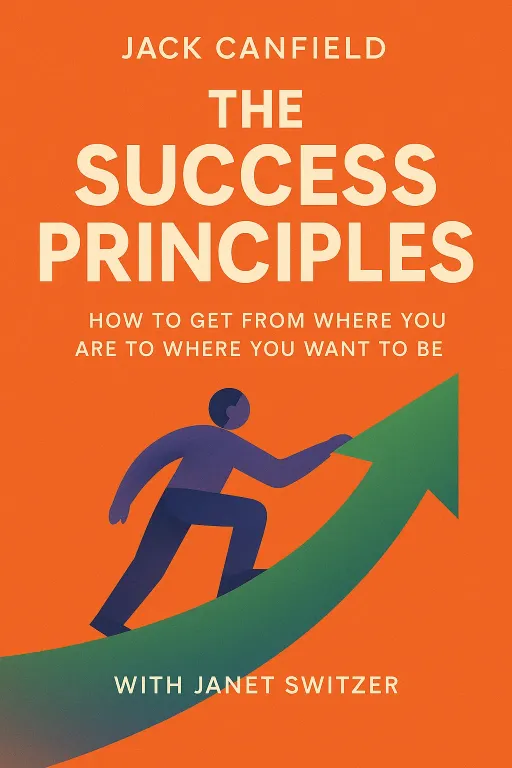
Nova: What if I told you that every outcome in your life—your career trajectory, your stress levels, your successes and failures—could be boiled down to a simple, elegant formula? An equation as fundamental as E=mc². Today, we're diving into Jack Canfield's classic, 'The Success Principles,' to uncover this exact formula. We're not talking about vague platitudes; we're treating this as a practical operating system for achievement.
Nova: Today we'll dive deep into this from two perspectives. First, we'll explore the most powerful variable you can control in any situation: your own response. Then, we'll discuss how to strategically build a support network to amplify your greatest strengths and accelerate your journey. And to help us decode this, we have Sikons928, a Data Analyst in the healthcare field who lives and breathes systems, data, and outcomes. Welcome, Sikons928!
Sikons928: Thanks for having me, Nova. I love this framing. As an analyst, I'm always looking for the underlying rules or the model that explains the results. The idea of a book that lays out the 'source code' for success is immediately appealing. It’s less about just 'wanting' a good outcome and more about understanding the mechanics of how to produce one.
Nova: Exactly! It’s a user manual for high-achievers. And Canfield's most fundamental piece of code, the one the entire operating system is built on, is a beautifully simple principle. It’s the one that, once you see it, you can't unsee it everywhere in your life.
Deep Dive into Core Topic 1: The Master Variable
SECTION
Nova: He calls it Principle 1: Take 100% Responsibility for Your Life. And he boils it down to this formula: E + R = O. That’s Event plus Response equals Outcome. The core idea is that for any Outcome you experience, it’s the result of how you Responded to an earlier Event. We can't always control the Event, but we have 100% control over our Response.
Sikons928: That’s a powerful claim. It removes all the excuses. It’s saying the external world is just a set of inputs, but the processing—the 'R'—is all on you.
Nova: Precisely. And Canfield tells this incredible story to illustrate it. It was 1994, right after the Northridge earthquake in Los Angeles. A major freeway had collapsed, so a commute that normally took an hour was now taking two or three. A CNN reporter was out in the gridlock, interviewing drivers.
Nova: The first driver she talks to is just fuming. He's leaning on his horn, red-faced, screaming about the government, the traffic, how he's going to be late, how his whole day is ruined. He's miserable. His Outcome is pure stress and anger.
Sikons928: Right. He's blaming the Event—the earthquake, the traffic.
Nova: Exactly. Then the reporter walks over to another car, just a few feet away. The guy inside is smiling, he looks relaxed. The reporter is baffled and asks him, "You don't seem upset. What's going on?" And the man says, "I can't do anything about the traffic. I knew this would happen, so I left home an hour early. I've got a bunch of language-learning tapes in my car, I've got water and some snacks, and I'm just using this time to learn Spanish. I've got my phone if I need to make a call. I'm fine."
Sikons928: Wow. That's a perfect A/B test, isn't it? The Event is identical for both of them—a massive traffic jam. But their Responses are polar opposites, which leads to completely different Outcome metrics. The first driver's outcome is high blood pressure and frustration. The second driver's outcome is a new skill and a sense of peace.
Nova: It's such a clear example! The second driver wasn't just enduring the event; he was actively designing a better outcome by controlling the only variable he could: his response. How does that resonate with you, in a field as complex as healthcare analytics?
Sikons928: Oh, it's the daily reality. It’s the difference between a junior and a senior mindset. A classic 'Event' for us is receiving a messy, incomplete dataset for a critical project. The junior response is to complain. To blame the data source, to say "we can't proceed," and to stop. The Outcome is a stalled project and frustrated stakeholders.
Nova: And the senior response?
Sikons928: The senior response is to accept the Event. "Okay, the data is messy." Then, you architect a better Response. You say, "My response will be to write a data-cleaning script to fix what I can. I'll document the specific issues and send them back to the source team with recommendations for future improvement. And in the meantime, I'll build a preliminary model using the 70% of the data that clean, and I'll clearly state the limitations." The Outcome is progress, not a roadblock. You've created value instead of just pointing out a problem. You've taken 100% responsibility for moving the project forward.
Nova: I love that. You're not a victim of the data; you're the one who tames it. It's such a powerful shift in perspective.
Sikons928: It is. It turns every problem into an opportunity to demonstrate capability.
Deep Dive into Core Topic 2: Building Your Human API
SECTION
Nova: Exactly. And once you've mastered that internal response, Canfield argues the next step is to optimize your external world to support your goals. This brings us to our second idea, which comes from Part Three of the book: Build Your Success Team. I like to think of this as designing your own 'Human API'.
Sikons928: A 'Human API'... I'm intrigued. An Application Programming Interface. So, a set of defined functions you can call on to get specific results.
Nova: You got it. Canfield's point is that truly successful people don't do everything themselves. They identify their 'Core Genius'—the thing they are uniquely brilliant at—and then they build a team to handle everything else. This isn't about being lazy; it's about strategic resource allocation. He tells this wild story about a man named Raymond Aaron who decided to move.
Nova: Now, for most of us, moving is a nightmare of boxes, logistics, and stress. But Raymond was a master delegator. He called his assistant and gave her a clear set of parameters: "I want a one-bedroom luxury apartment near my office with an exercise facility." That was it. He then went on vacation.
Sikons928: He just left?
Nova: Completely. His assistant found the apartment, negotiated the lease, hired the movers, managed the packing at his old place, and oversaw the complete unpacking and setup at the new one. When Raymond came back from his vacation, he just took a taxi to his new, fully furnished, perfectly organized apartment. He didn't lift a single box.
Sikons928: That's a level of trust and system-building that is just... mind-blowing. It's not just 'handing off a task.' It's defining the parameters and trusting the 'function' to return the correct 'output.' In project management, we call that defining the scope and deliverables, but to apply it to your personal life with that level of commitment is a whole other level.
Nova: It really is. And as someone who's actively focused on upskilling to stay competitive, how does this idea of delegating to focus on your 'core genius' land with you? Does it feel possible, or just like a fantasy?
Sikons928: It feels essential. My 'core genius,' where I provide the most value, should be finding the signal in the noise of complex healthcare data. That's the work that advances my career and helps my company. But how much of my day, or anyone's day, is spent on lower-value tasks? Answering routine emails, formatting a presentation, scheduling the five people needed for a 30-minute meeting... that's all 'overhead.'
Nova: The stuff that drains your battery.
Sikons928: Precisely. Canfield's point, as I see it, is that to truly level up, you have to be ruthless in protecting your time for the 20% of activities that generate 80% of the value. That might mean hiring a virtual assistant for a few hours a week. It could be as simple as trading tasks with a colleague—'You're great at design, I'm great at data. You polish my slides, I'll pull the numbers for your report.' It’s about building that 'Human API' you mentioned. You identify a need, and you call a function—a person, a service—that is optimized for that task.
Nova: So it's not just for CEOs. It's a strategy anyone can start implementing on a small scale.
Sikons928: Absolutely. It's a mindset of strategic leverage. You're leveraging other people's time and genius so you can more fully leverage your own. That's how you accelerate growth.
Synthesis & Takeaways
SECTION
Nova: I think that's the perfect way to tie it all together. We have these two powerful, interconnected ideas from "The Success Principles." First, master your internal world by taking 100% responsibility for your responses with E + R = O.
Sikons928: And second, architect your external world by building a team—your Human API—that lets you operate in your zone of genius.
Nova: They're two sides of the same coin, really. One is about personal accountability, the other is about strategic leverage.
Sikons928: And both are about making a conscious shift from a reactive to a proactive stance. You stop being a passive observer of your life's data and start becoming the lead architect of your own success algorithm.
Nova: Beautifully put. So for everyone listening, here's the challenge for this week, inspired by our conversation today. First, look at the week ahead. What is one predictable 'Event' that usually leads to a negative 'Outcome' for you? Maybe it's a difficult meeting or a tedious report. And what is one small change you can make to your 'Response' to engineer a better outcome?
Sikons928: And just as importantly, what is one five-minute task you can delegate, automate, or trade with someone else this week, to buy yourself back that precious time to focus on what truly matters for your growth?
Nova: It's about taking that first small step to redesign your own system. Sikons928, thank you so much for helping us decode these principles today.
Sikons928: It was my pleasure, Nova. A great reminder that the best systems start with the person running them.