

The Unconventional Ledger: Redefining Success Beyond the Bottom Line
Golden Hook & Introduction
SECTION
Nova: You're told to chase your dreams, be the best, get the corner office, have it all. But what if the secret to a good life isn't about more achievements, but about consciously, carefully the things you care about?
Mike Kensley Landais: That's a pretty radical idea, especially for someone my age. We're constantly bombarded with messages about maximizing every opportunity.
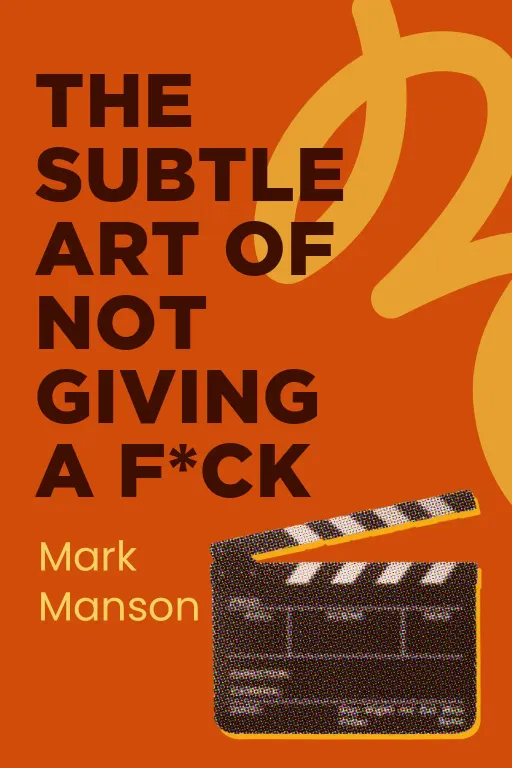
Nova: Exactly! And that's why we're diving into Mark Manson's "The Subtle Art of Not Giving a F*ck" today. It’s not about being indifferent; it’s a masterclass in becoming a strategic investor of your own energy. Welcome to the show, Mike. It’s great to have you here.
Mike Kensley Landais: Thanks for having me, Nova. As a finance student, the idea of strategically investing my energy really resonates. I'm excited to get into it.
Nova: I’m so glad. Because this book offers a powerful framework for anyone, but especially for a young, analytical mind like yours, on the cusp of a demanding career. Today we'll dive deep into this from two perspectives. First, we'll explore the liberating power of taking responsibility, even for things that aren't our fault. Then, we'll discuss how to build a life of meaning by choosing better values to guide our actions and define our success. Ready to flip some conventional wisdom on its head?
Mike Kensley Landais: Absolutely. Let's do it.
Deep Dive into Core Topic 1: The Power of Radical Responsibility
SECTION
Nova: Alright, so where do we start on this journey of strategic caring? Manson argues it begins with a really tough pill to swallow: the idea that we are always choosing. We don't always control what happens to us, but we control how we interpret it and how we respond.
Mike Kensley Landais: That’s a big claim. It’s easy to feel like a victim of circumstances sometimes. A bad grade, a tough job market, a project that goes wrong... our first instinct is often to look for something or someone to blame.
Nova: It is! And that’s what Manson calls the Responsibility/Fault Fallacy. We confuse being for a situation with being at for it. He tells this incredible story about William James, who's now known as the father of American psychology. But as a young man, he was a complete mess.
Mike Kensley Landais: What was his story?
Nova: Imagine this: born into a wealthy family, but plagued with debilitating health problems his whole life. Severe back spasms, stomach issues, hearing problems. He tried to be an artist, but felt like a failure. His father constantly ridiculed him. He was deeply, suicidally depressed. He felt powerless, like life was just happening him.
Mike Kensley Landais: Sounds like he had every reason to feel that way. It sounds like none of that was his fault.
Nova: Exactly. It wasn't his fault. But then, after a particularly brutal trip to the Amazon where he got smallpox and was basically left for dead, he hit rock bottom. Back home, contemplating suicide, he came across the writings of a philosopher and decided to conduct an experiment on himself. For one year, he would choose to believe he was 100% responsible for everything in his life.
Mike Kensley Landais: Wow. So even for his genetic health problems? For the economy? Everything?
Nova: Everything. He wasn't saying it was his he had bad eyesight. He was saying it was his to deal with it. It was his responsibility to find a way to live a meaningful life despite his circumstances. And that single shift in mindset, that choice to take responsibility, changed everything. He went on to become one of the most influential thinkers of his time.
Mike Kensley Landais: That's fascinating. It's the opposite of how we're often taught to think about problems. In finance, for instance, we do root cause analysis to find the 'fault' in a system or a trade that went bad. But James's approach is about forward-looking accountability. It's not about the past; it's about 'what's my move now?' That feels like a much more powerful position to be in.
Nova: It’s the difference between being a passenger and being the driver, right? Blaming keeps you in the passenger seat. Responsibility puts your hands on the wheel. You might not have chosen the road or the car, but you get to choose where you steer.
Mike Kensley Landais: And it removes the emotional baggage of blame. If you're just responsible, it becomes a practical problem to solve, not a moral failing to agonize over. For a leader, that's a critical distinction. You're responsible for your team's morale, even if you didn't cause the external market pressure that's stressing them out. Your job is to respond.
Nova: You've hit the nail on the head. It’s about owning your response. And that, Mike, naturally leads us to the next big question Manson poses…
Deep Dive into Core Topic 2: The Architecture of Good Values
SECTION
Nova: Once you've taken responsibility and put yourself in the driver's seat, what do you choose to? This is where Manson gets into the difference between what he bluntly calls 'shitty values' and 'good values.'
Mike Kensley Landais: I have a feeling 'shitty values' are pretty common.
Nova: Oh, they are. And they're seductive! Manson defines them as things that are generally outside of our control. Think about values like: pleasure, material success, always being right, or even just 'staying positive.' They're poor metrics for a life because they're either fleeting or dependent on external factors.
Mike Kensley Landais: So, if my core value is 'be rich,' I'm setting myself up for misery because the market could crash tomorrow, and my sense of self-worth would crash with it.
Nova: Precisely. Your happiness becomes a puppet, and the world holds the strings. Good values, on the other hand, are internal, process-oriented, and within our control. Things like honesty, creativity, vulnerability, standing up for yourself, continuous learning. You can be honest right now. You can choose to learn something new right now. No one can take that away from you.
Mike Kensley Landais: It’s about choosing a game you can actually win, because you define the rules.
Nova: You got it. And the most powerful story Manson uses to illustrate this is the tale of two musicians who got kicked out of their bands right before they became global superstars.
Mike Kensley Landais: I think I know one of them. Dave Mustaine from Metallica?
Nova: That's the one! In 1983, just as Metallica is about to record their first album and explode, they kick him out. He's devastated, furious. He vows to start a new band that will be so successful it will make Metallica regret their decision. He forms Megadeth.
Mike Kensley Landais: And Megadeth became huge! They sold tens of millions of albums. That’s a success story.
Nova: It should be, right? But here's the thing. In an interview decades later, after all that success, he was still miserable. He confessed that he considered himself a failure. Why? Because no matter how big Megadeth got, they were never as big as Metallica. His value, his metric for success, was "be more successful than Metallica." It was an external, uncontrollable comparison.
Mike Kensley Landais: So he was playing that unwinnable game we talked about. His happiness was always dependent on someone else's success.
Nova: Exactly. Now, contrast that with Pete Best. He was the original drummer for The Beatles. Kicked out in 1962, right before they became... well, The Beatles. The biggest band in history. He was depressed for years. But eventually, he did something different. He re-evaluated his values. He decided that what he really wanted was a family, a stable life. He met a woman, got married, raised kids, and worked a steady job. In an interview years later, he said he was happier than he ever would have been with The Beatles.
Mike Kensley Landais: He changed his metric. He switched from an external value—fame and rock stardom—to an internal one: a loving family and a peaceful life. He chose a game he could win.
Nova: He chose a better struggle. And that's the core of it. That story is such a powerful illustration of relative vs. absolute metrics. It makes me think about the pressure in college, especially in competitive fields like yours, to get an internship at top firm, not just good firm.
Mike Kensley Landais: Absolutely. The value becomes 'prestige'—which is external and comparative—instead of 'learning' or 'growth,' which are internal and controllable. Manson's framework would suggest focusing on the latter. It’s a much more resilient strategy for a career. You're not chasing a logo; you're building a skill set.
Nova: And that's a foundation no market crash can ever take away from you.
Synthesis & Takeaways
SECTION
Nova: So, as we bring this all together, it feels like a really clear, two-step process for building a more authentic life. Step one, as we saw with William James, is to take radical responsibility. Put yourself in the driver's seat.
Mike Kensley Landais: And step two, illustrated by Dave Mustaine and Pete Best, is to choose your destination carefully. Point that responsibility toward good, controllable, internal values, not shitty, external ones.
Nova: It’s simple, but as Manson says, it’s not easy. It requires constant self-awareness. So, to make this real for you and for everyone listening, I want to ask you, Mike: what's one 'shitty value'—maybe a metric of comparison or a need for external validation—that you could consciously choose to give less of a f*ck about this week?
Mike Kensley Landais: That’s a great question. I think for me, and probably for a lot of students, it’s the value of looking like I have it all figured out. The pressure to have the perfect career path planned, to always have the 'right' answer in class. It's a value based on external perception. This week, I'm going to try to replace that with the value of 'curiosity.' Instead of trying to look smart, I'm going to focus on asking the questions I'm genuinely curious about, even if they sound basic. I'm going to choose the struggle of potential embarrassment for the reward of actual learning.
Nova: I love that. Choosing the struggle of looking foolish for the reward of getting smarter. That is the subtle art in action. Mike, thank you so much for this conversation. Your insights were fantastic.
Mike Kensley Landais: Thank you, Nova. This was incredibly clarifying. I have a lot to think about.









