

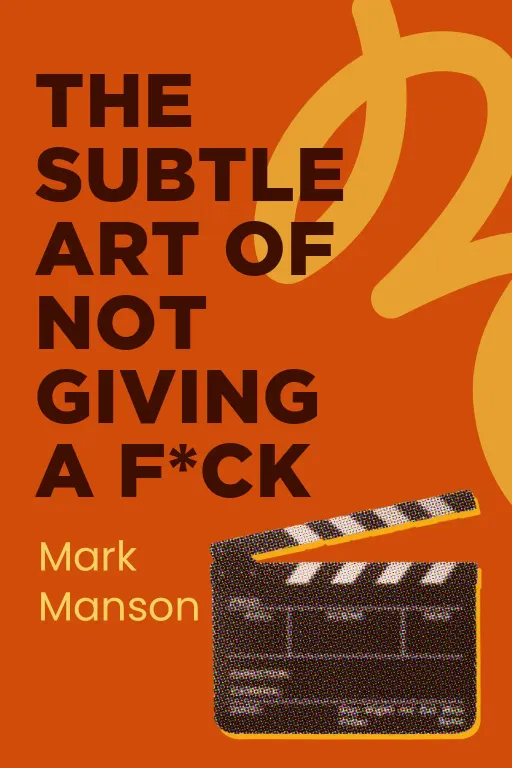
The Trader's Edge: Why Not Giving a F*ck is the Ultimate Market Strategy
Golden Hook & Introduction
SECTION
Socrates: John, you're a trader. You're staring at your screen, and a position you were confident in is bleeding red. That knot in your stomach tightens. You start thinking, 'I'm an idiot.' Then you get angry at yourself for feeling anxious, which only makes you more anxious. You've just fallen into what author Mark Manson calls 'The Feedback Loop from Hell,' a psychological trap that destroys more trading accounts than any bear market.
John: It's a painfully familiar feeling, Socrates. That's the moment where logic can just fly out the window. It feels personal.
Socrates: Exactly. And breaking free from that trap is what we're exploring today, through the lens of Manson's brilliant book, ck*. Now, the title is provocative, but the book isn't about being indifferent. It's about being strategic with what you care about. Today we'll dive deep into this from two critical perspectives for any decision-maker. First, we'll explore that psychological trap, the 'Feedback Loop from Hell,' and how it derails us.
John: And I assume how to get out of it.
Socrates: Precisely. Then, we'll discuss the game-changing concept of taking responsibility without taking the blame, and how failure—or what looks like failure—is actually the most direct path forward.
Deep Dive into Core Topic 1: The Trader's Downward Spiral
SECTION
Socrates: So let's start there, John, with that 'painfully familiar feeling.' Manson argues that the desire for more positive experience is, itself, a negative experience. How does that land with you in a world driven entirely by the pursuit of profit?
John: It sounds completely backward, but it's the core truth of trading psychology. The desperate to win, the craving for that dopamine hit of a green P&L, is what leads to the biggest mistakes. You start chasing. You abandon your strategy. You see a stock that's already run up 20% and you jump in, fearing you'll miss out more, and of course, that's usually the exact top. The desire for the positive feeling of a win leads directly to the negative action of a bad entry.
Socrates: That's the Feedback Loop in action. You feel bad about a loss, which makes you anxious. Then you feel anxious about feeling anxious, and suddenly you're in a spiral. Manson has this wonderful, absurd metaphor for this: the Disappointment Panda.
John: Disappointment Panda? I'm intrigued.
Socrates: Imagine a superhero, but instead of a cape, he's a giant, fluffy panda. And instead of saving you from a burning building, he just shows up at your door to tell you harsh truths. He'd tell the person obsessed with wealth that their kids won't love them more if they buy a yacht. He'd tell the person chasing happiness that the very act of chasing it is what's making them miserable. For a trader, the Disappointment Panda would waddle up to your desk, look at your screen, and say, "You know, desperately wanting this trade to be a winner is the very reason it's going to fail."
John: Wow. I need to hire this panda. Because that's it, right there. That's what we call 'revenge trading.' You take a loss, you feel stupid and angry, and you immediately jump into another, probably riskier, trade to 'get your money back' and, more importantly, to make yourself feel smart again. You're trying to kill the bad feeling, but you're just feeding the loop.
Socrates: So if chasing wins is the problem, what's the solution? Manson's advice is to 'Choose Your Struggle.' He says we all want the prize, but we're not willing to endure the process. We want the rockstar life without the years of practicing in a smelly garage. So, what struggle should a trader choose, if not the struggle for profit?
John: That's the million-dollar question, and the answer is what separates professionals from gamblers. You have to choose the struggle of the. The struggle of doing hours of research for a trade that you might not even take. The struggle of meticulously logging every win and every loss. The struggle of having the discipline to stick to your stop-loss even when your gut is screaming, 'It's gonna turn around!'
Socrates: So you're saying you have to give a fuck about the process.
John: You give a fuck about your execution, not the outcome of any single trade. The outcome is, to a large degree, random. Your execution is not. If you choose the struggle of perfecting your process, the profits become a byproduct. They're the effect, not the cause you're chasing.
Deep Dive into Core Topic 2: The Power of a 'Good Loss'
SECTION
Socrates: I love that. 'Give a fuck about your execution, not the outcome.' That's a perfect bridge to our second big idea, which completely reframes the concept of failure. Manson makes a brilliant distinction between fault and responsibility.
John: Go on. This sounds relevant.
Socrates: He argues that many things that happen to us are not our, but they are our. It's not your fault you were born with a certain genetic predisposition, but it's your responsibility to manage your health. In your world, it's not your that the Fed chairman made a surprise announcement that tanked the market. That's an external event. But it is 100% your how you prepared for that risk and how you react to it now.
John: Right. Did I have a stop-loss in place? Was my position size appropriate for my account? That's the responsibility part. Blaming the Fed is the amateur move.
Socrates: Exactly. And this ties into his idea that 'Failure Is the Way Forward.' He tells the story of Dave Mustaine, the guitarist who was kicked out of Metallica right before they became the biggest band in the world. It was a brutal, public failure.
John: I can't even imagine.
Socrates: So what does he do? He gets angry, he gets motivated, and he forms his own band, Megadeth. They become a massive, multi-platinum-selling heavy metal act. A huge success by any objective measure. But in a 2003 interview, decades later, he was still miserable. He confessed that he considered himself a failure. Why? Because his internal metric for success was still 'be bigger than Metallica.'
John: Oh, that's brutal. And so relatable. That's the trader who has a fantastic year, makes 50%, but is miserable because his buddy at another firm made 55%. The metric is broken. He's measuring against something external and uncontrollable, just like Mustaine.
Socrates: He was taking responsibility for his new band, but he was still stuck on the 'fault' of being kicked out. He never changed his values. So, let's apply this. How do you take a losing trade, an event that feels like a failure, and turn it into a 'good loss' using this responsibility/fault framework?
John: It's simple, but it's not easy. A 'bad loss' is one where you broke your rules. You didn't honor your stop-loss, you got greedy, you revenge-traded. That is your fault your responsibility. You own it, you feel the sting, and you learn from it.
Socrates: And a 'good loss'?
John: A 'good loss' is the cornerstone of a professional career. It's a trade where you followed your system perfectly. Your research was solid, your entry was precise, your risk was defined... and the market just did something else. The trade didn't work out. That is. The market is a force of nature. But your responsibility is what you do next.
Socrates: Which is?
John: You don't get angry. You don't blame anyone. You calmly close the position, and you log it. You write down why you took the trade, why it didn't work, and you move on. That failure, that 'good loss,' is just data. It's feedback. It's the way forward to refining your system over hundreds or thousands of trades. It's the most valuable thing you can get from the market, more valuable than a lucky win.
Synthesis & Takeaways
SECTION
Socrates: That's incredibly powerful. So, it seems the 'subtle art' for a trader, or really any decision-maker, is twofold. First, escape the Feedback Loop from Hell by choosing to care about your, not your fluctuating P&L.
John: Your inputs, not your outputs.
Socrates: Yes! And second, embrace failure by separating fault from responsibility. Take absolute ownership of your process, even when the world—or the market—proves you wrong, because that's the only path to getting better.
John: Exactly. It's about building a system and a mindset so robust that your day-to-day emotions become irrelevant. You're not giving a fuck because you're apathetic or checked out. You're not giving a fuck about the noise because you've already given all your fucks to building and trusting your process. That's where the real freedom is.
Socrates: A perfect summary. So for everyone listening, whether you're trading stocks or just navigating the tough decisions of life, here's the challenge from today's conversation: What is one outcome-based metric you're using that's causing you pain? Maybe it's the number on the scale, or a sales quota, or your kid's report card.
John: Or the daily value of your 401k.
Socrates: Yes. And what is a process-based metric you could replace it with? Don't just think about the result you want. As Mark Manson would say, think about the struggle you're willing to choose. That choice, it seems, is everything.









