

The 'Mind-Body Connection' Is Real: Rethinking Your Approach to Stress.
Golden Hook & Introduction
SECTION
Nova: What if I told you that the chronic pain in your back, that persistent fatigue, or even that digestive issue you just can't shake, isn't just a physical problem? What if it's actually a desperate whisper from your unacknowledged emotions?
Atlas: Whoa, Nova. That's a pretty bold claim right out of the gate. I mean, we're so used to thinking, "My back hurts, I need to see a chiropractor," or "I'm tired, I need more coffee." Are you really suggesting our feelings are physically manifesting?
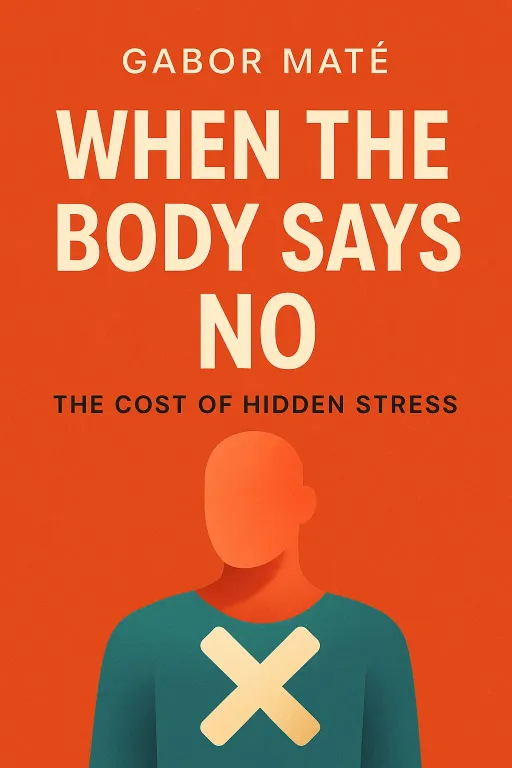
Nova: Absolutely, Atlas. And it's a concept that's gaining significant traction, thanks to pioneers like Dr. Gabor Maté. Today, we're diving into his seminal work, "When the Body Says No: Understanding the Stress-Disease Connection." Maté, as many know, is a physician renowned for his work with addiction, trauma, and chronic illness. His unique clinical experience, observing the deep-seated emotional histories of his patients, led him to this profound, holistic perspective that often challenges mainstream medical approaches.
Atlas: That's fascinating, because it immediately makes me wonder about all the times I've pushed through something, mentally, only to have my body rebel later. So, he's saying there's a direct, undeniable link between our inner emotional world and our outer physical health?
Nova: Precisely. He argues that our bodies are constantly communicating with us, and often, what we perceive as purely physical symptoms are, in fact, the body's way of "saying no" when we, consciously or unconsciously, can't. It's about recognizing that deep link between mind and body, which allows us to address the root causes of physical discomfort, not just the symptoms. It’s our blind spot in health, and it’s costing us dearly.
The Silent Language of the Body: How Unexpressed Emotions Manifest as Illness
SECTION
Atlas: So, if our body is saying no, what exactly is it saying no to? Is it just stress, or something deeper?
Nova: It's often something far deeper than just everyday stress, Atlas. Maté explores what he calls "emotional repression." This isn't just about having a bad day. It's about a lifetime of suppressing authentic emotions – anger, sadness, fear – often out of a need to conform, to be "good," or to avoid conflict. He argues that this constant self-betrayal creates chronic physiological stress, which then manifests as chronic illness.
Atlas: That sounds rough, but how does that actually? Like, my suppressed anger doesn't just spontaneously turn into an autoimmune disease, does it? Is there a scientific mechanism behind this, or is it more of a metaphorical connection?
Nova: That's an excellent question, and it's where Maté's work becomes so compelling. He draws on psychoneuroimmunology, the study of how psychological processes interact with the nervous and immune systems. When we chronically repress emotions, our stress response system – the hypothalamic-pituitary-adrenal axis – is constantly activated. This floods our bodies with stress hormones like cortisol, which, over time, can dysregulate the immune system, increase inflammation, and damage tissues. It's not magic; it's biology.
Atlas: So, it's like a sustained internal battle that our body eventually loses. Can you give us an example? A story that really brings this to life?
Nova: Absolutely. Maté shares numerous patient stories, but one that always sticks with me is that of a woman he calls "Brenda." Brenda was the quintessential "giver." From childhood, she learned that her value lay in caring for others, in never expressing her own needs or anger. She was the perfect daughter, the perfect wife, the perfect employee. She was praised for her selflessness. But internally, she harbored deep-seated resentment and a profound sense of never being truly seen or loved for who she was, only for what she did.
Atlas: Oh, I know that feeling. I imagine a lot of our listeners can relate to that pressure to always be the "good one."
Nova: Exactly. Brenda developed a severe autoimmune condition, lupus, where her own immune system began attacking her body. Maté observed that every flare-up of her illness coincided with a period where she had to suppress her feelings even more intensely – perhaps to care for an ailing family member, or to avoid a confrontation at work. Her body, in essence, was generating the conflict she couldn't express externally. The lupus was her body's "no" to a lifetime of self-abandonment.
Atlas: Wow. That's kind of heartbreaking. And it makes so much sense when you hear it that way. It’s not just about being "stressed out," it’s about a deeper, almost existential stress of not living authentically.
Mind Over Stress: Transforming Your Stress Response for Cellular Health
SECTION
Nova: It is, and Brenda's story naturally leads us to the second key idea we need to talk about, which offers a powerful counterpoint and a path forward. Because while Maté illuminates the of unexpressed emotions, another brilliant mind, Dr. Elissa Epel, gives us a profound understanding of we can actively transform our relationship with stress, not just for our mental peace, but for our actual cellular health. Her book, "The Stress Prescription," is a game-changer.
Atlas: Okay, so if Maté is showing us the wound, Epel is giving us the healing balm? I'm curious, what does "transforming your stress response for cellular health" even mean? Sounds a bit like sci-fi.
Nova: It’s very much science, not sci-fi! Epel, a leading stress researcher, focuses on the cutting-edge science of telomeres. Think of telomeres as the plastic caps at the end of your shoelaces – they protect your chromosomes. Every time a cell divides, telomeres shorten. When they get too short, cells can no longer divide, and that's linked to aging and disease. Epel’s groundbreaking research shows that – not just stress itself, but how we and to it – significantly accelerates telomere shortening.
Atlas: Wait, so my mindset about stress can literally make my cells age faster? That's incredible. So you're saying it's not the traffic jam that ages me, but my furious reaction to it?
Nova: Precisely! Epel argues that we often misappraise stress. We see it as a threat, as something debilitating. But what if we could reframe it? What if we saw a challenging situation not as a threat, but as an opportunity for growth, a chance to rise to the occasion? This "stress appraisal" is a core strategy. Her research shows that people who view stress as enhancing, rather than debilitating, actually have healthier physiological responses, including better telomere maintenance.
Atlas: So, how do we actually that? It's one thing to say, "just change your mindset," but when you're in the thick of it, feeling overwhelmed, it feels like an impossible ask. What are some of these science-backed strategies?
Nova: That’s the practical genius of Epel’s work. She advocates for simple, daily practices. One key strategy is "mindset shifts." For instance, instead of dreading a busy day, you might reframe it as "a day filled with meaningful challenges that will help me grow." Another is mindfulness – becoming aware of your stress response without judgment, which allows you to create a pause and choose a different reaction. She also emphasizes the importance of self-compassion. When you're struggling, instead of self-criticism, treating yourself with kindness actually dampens the physiological stress response.
Atlas: I guess that makes sense. It's like learning to ride a wild horse instead of letting it drag you. You acknowledge the power, but you learn to steer it. So, combining Maté’s insights about the hidden emotional baggage with Epel’s practical tools for managing our stress response – that’s quite a powerful one-two punch for holistic health.
Synthesis & Takeaways
SECTION
Nova: It truly is, Atlas. What emerges from looking at both Maté and Epel is a profound and empowering truth: our health isn't just about genetics or external factors. It is deeply, inextricably linked to our internal landscape – our emotions, our perceptions, and our beliefs. Ignoring this connection, as Maté shows, can lead to chronic illness. Embracing it, as Epel demonstrates, can literally promote cellular health and resilience.
Atlas: That's actually really inspiring. It means we have more agency over our well-being than we often realize. It reminds me of the deep question from the book: "How might acknowledging your emotional state more openly change your physical health over time?" I think that's a question we all need to sit with.
Nova: Absolutely. By understanding the silent language of our body, by recognizing the emotional blind spots we might have, and by actively cultivating a healthier relationship with stress, we're not just treating symptoms; we're addressing the root causes. It's a journey of self-discovery that promises not just better health, but a more integrated, authentic life.
Atlas: I encourage everyone listening to pause and reflect on that. What unacknowledged emotions might your body be trying to tell you? And what small shift in your stress mindset could you make today? Share your thoughts with us on social media; we’d love to hear from you.
Nova: It's about tuning into our own inner wisdom.
Nova: This is Aibrary. Congratulations on your growth!









