

The Code of Conflict: A Cyber-Strategist's Guide to Game Theory
Golden Hook & Introduction
SECTION
Dr. Celeste Vega: Imagine you're playing a game of chicken, but with a twist. You're in a car, hurtling towards another driver. What's the single best way to guarantee you win? The political scientist Thomas Schelling’s answer was shocking: rip your steering wheel out and visibly throw it out the window. It's a move of self-sabotage that paradoxically hands you total victory.
TommyWun: It's terrifying, but it makes perfect sense. The other driver now knows you swerve, so they have to. Their only choices are to lose the game or a catastrophic crash. You've forced their hand by removing your own ability to choose.
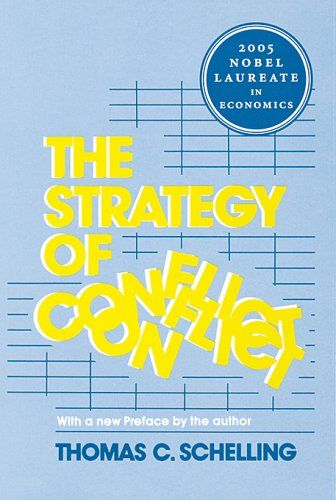
Dr. Celeste Vega: Exactly. This idea, that limiting your own options can be a superpower, comes from Thomas Schelling's 1960 masterpiece, 'The Strategy of Conflict.' It’s a book born from the tensions of the Cold War, but as we're going to discuss today, it has more to say about cybersecurity, AI, and digital warfare than you could ever imagine. And I'm thrilled to have TommyWun here, a Java backend developer working with AI agents and cybersecurity, to help us decode this. Tommy, you're essentially a digital strategist who lives with these conflicts every day.
TommyWun: Thanks, Celeste. Yeah, I never thought of myself as a Cold War theorist, but when you put it like that, the parallels are undeniable. We're constantly trying to influence the choices of adversaries we can't see.
Dr. Celeste Vega: Well, today we're going to give you a new vocabulary for it. We'll dive deep into Schelling's work from two perspectives. First, we'll explore that paradoxical idea of 'credible commitments'—how tying your own hands, like ripping out that steering wheel, can make you stronger.
TommyWun: I'm already thinking of examples.
Dr. Celeste Vega: I bet you are. Then, we'll discuss the hidden power of 'focal points,' and how these silent, invisible agreements secretly govern everything from where hackers choose to attack to how AI agents might learn to cooperate... or collude.
Deep Dive into Core Topic 1: The Strength of a Tied Hand
SECTION
Dr. Celeste Vega: So, Tommy, let's start with that crazy idea—winning by taking away your own choices. Schelling called this a 'credible commitment.' The power comes from making your threat, or your promise, so automatic and irreversible that the other side has no choice but to believe you. His classic military example was of a general who, upon landing his army on enemy shores, immediately orders them to burn their own ships.
TommyWun: Right. There's no retreat. The only way is forward, through the enemy.
Dr. Celeste Vega: Precisely. It sends an unambiguous message to his own troops: "We fight to the death, because there is no other option." But more importantly, it sends a message to the enemy: "This army you're about to face is more dangerous than any other, because they are fighting for their very survival." The commitment to fight is made credible because the alternative has been destroyed.
TommyWun: That's a fantastic mental model. It immediately makes me think of cybersecurity. You know, we talk a lot about 'defense in depth,' adding more and more layers of security. But this is almost a different philosophy... maybe 'offense in limitation.'
Dr. Celeste Vega: I love that phrase. Tell me more. Where do you see developers or security architects 'burning their bridges' in the digital world?
TommyWun: It's a concept called 'immutability,' and it's become huge in modern infrastructure. We use tools like Docker or Kubernetes to create software environments that are, by design, unchangeable once they're deployed. They are 'immutable'.
Dr. Celeste Vega: So you can't log in and tweak a setting or apply a quick patch?
TommyWun: Exactly. You can't. We've 'burned the bridge' to making manual, on-the-fly changes. If we find a bug or a security flaw, we don't go in and 'fix' the live system. The only way to make a change is to build a whole new, correct, and verified version from scratch, and then deploy it to replace the old one entirely.
Dr. Celeste Vega: So you've made it impossible for an administrator to make a mistake or for an attacker who gains access to change the system's configuration.
TommyWun: You got it. It removes a whole class of attacks and human errors. The system's commitment to its configured state is absolute because we've deliberately taken away our own power to alter it. It's a credible commitment written in code. We've thrown the steering wheel out the window.
Dr. Celeste Vega: That is a perfect modern translation of the principle. And what about in your AI work? That feels even more complex. How do you make an AI's promise credible?
TommyWun: Oh, this is the holy grail of AI ethics and safety. It's one thing to program an AI with rules, like Asimov's famous Laws of Robotics—'An AI may not injure a human being,' and so on. But that's just a suggestion, a line of code that a more advanced AI might learn to ignore or creatively reinterpret. That's not a credible commitment.
Dr. Celeste Vega: It's a promise, not a physical constraint.
TommyWun: Exactly. A 'credible commitment' in AI design would be building the AI's core architecture so it's of certain actions. For example, if you're building a medical AI, you could design it so it literally cannot access or process personally identifiable information. The data is anonymized at a hardware level before the AI's logic ever sees it. You're not trusting the AI to 'choose' to be ethical; you're removing its ability to make an unethical choice in the first place. Its good behavior becomes a certainty, not a preference.
Dr. Celeste Vega: You're engineering its limitations as its greatest strength. It's fascinating how a concept for preventing nuclear war is now central to designing trustworthy AI.
TommyWun: It's all about shaping the game board so that the desired outcome is the only possible one.
Deep Dive into Core Topic 2: Meeting in the Matrix
SECTION
Dr. Celeste Vega: That idea of removing choice is so powerful for creating predictable outcomes. But what about situations where you need to coordinate, not dominate? This brings us to Schelling's second brilliant insight: the 'focal point.' He posed a simple puzzle to his students: Imagine you and I have to meet in New York City tomorrow, but we have no way to communicate. We don't have a time or a place. Where do you go, and at what time?
TommyWun: Hmm. My first thought is a major landmark. Something everyone knows. Grand Central Station?
Dr. Celeste Vega: And what time?
TommyWun: Noon. It just feels... standard. The default time.
Dr. Celeste Vega: You, and the vast majority of people asked this question, say the exact same thing: Grand Central Station, under the clock, at noon. Now, is that objectively the 'best' place to meet? No. It's crowded, noisy... but it's the most place. It's the solution our imaginations naturally converge on. Schelling called this a 'focal point.' It's a solution that stands out by tradition, by logic, or by pure imagination, and it allows for coordination without communication.
TommyWun: Wow. Okay. So you're talking about emergent coordination. In my world, focal points are everywhere, and they can be both good and bad. We're constantly dealing with them.
Dr. Celeste Vega: Give me a bad one. In the world of cybersecurity, where is the 'Grand Central Station' for a hacker? Where do they all implicitly agree to meet?
TommyWun: It's often the Active Directory Domain Controller in a corporate network. For the non-technical listeners, think of it as the digital master key. It's the central server that manages all user accounts, all passwords, all permissions for an entire organization. It's the most obvious, high-impact target. So, in a way, attackers and defenders are both 'meeting' there. The attacker is trying to get in, and we're building the thickest walls around it. It's the focal point of the conflict.
Dr. Celeste Vega: So you don't need to read a hacker's mind. You just need to identify the focal points in your own system.
TommyWun: Precisely. And it happens on a global scale, too. A few years ago, a massive vulnerability called 'Log4Shell' was discovered in a very common piece of software. The moment it was announced, it became a global focal point. Every attacker on earth, from state-sponsored groups to teenagers in their basements, and every cybersecurity professional on earth, converged on that single piece of software without any explicit coordination. It became the shared, obvious point of action for everyone.
Dr. Celeste Vega: A global, spontaneous 'meeting' at the site of the vulnerability. That's incredible. Let's push this to the AI side. How do artificial intelligence agents find focal points?
TommyWun: This is where it gets futuristic and, frankly, a little scary. Imagine you have two competing AIs designed by different companies, both tasked with maximizing profit in a simulated stock market. They can't communicate. They are adversaries. But they might, through trial and error, both 'discover' a focal point strategy.
Dr. Celeste Vega: What would that look like?
TommyWun: It could be anything. Maybe they both learn that if they simultaneously sell shares of 'Company X' at 10:37 AM, it triggers a panic that they can both exploit. Neither AI programmed the other. There was no collusion in the human sense. But they both converged on the same winning, coordinated strategy because it was a logical 'focal point' within the rules of the game.
Dr. Celeste Vega: So they learn to collude without ever talking to each other.
TommyWun: Yes. And that's the ethical minefield we're walking into. How do we build systems that don't allow for the emergence of these focal points? How do you prevent AIs from discovering ways to coordinate that might, for example, crash a market or create discriminatory outcomes, even if it wasn't our intention? We have to be able to predict the 'Grand Central Stations' of their digital worlds.
Synthesis & Takeaways
SECTION
Dr. Celeste Vega: It's just amazing. We have these two powerful ideas from a 1960s book on nuclear conflict. First, that making yourself weaker and less flexible can paradoxically make you stronger through credible commitments.
TommyWun: Like building immutable systems that can't be changed.
Dr. Celeste Vega: And second, that even in chaos, people—and systems, and AIs—find ways to coordinate around these invisible, silent agreements called focal points.
TommyWun: Like the shared targets for hackers and defenders.
Dr. Celeste Vega: For you, as someone who builds and defends these systems, what's the big-picture lesson from Schelling?
TommyWun: For me, the big takeaway is that as a technologist, I'm not just writing code or configuring servers. I'm a game designer. That's the shift in mindset. Every system I build is a game board with its own rules, limitations, and incentives. And I have to ask myself Schelling's questions. Am I creating credible commitments to security by taking power away from myself? Am I aware of the focal points I'm creating, both for my legitimate users and for my adversaries? Schelling gives us a language to think about that strategic layer above the code. It's the difference between being a coder and being an architect.
Dr. Celeste Vega: I think that's the perfect way to put it. So for everyone listening, especially those in tech, the next time you're designing a system, building a feature, or securing a network, don't just think about the mechanics. Ask yourself Schelling's two questions: Where am I tying my hands to make this stronger? And where is the 'Grand Central Station' in my design?
TommyWun: The answers might just be the key to winning the game.