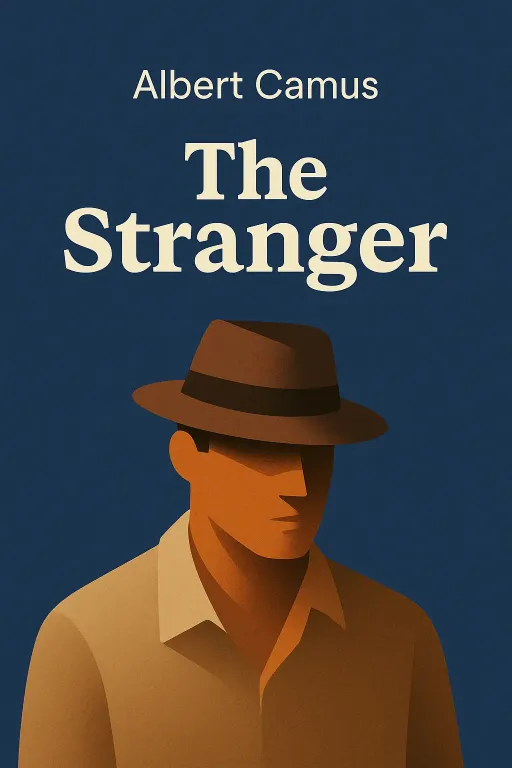
The Narrative Trap: Deconstructing Camus's 'The Stranger' with Rai Qadir
Golden Hook & Introduction
SECTION
Nova: Imagine standing trial for murder, but instead of analyzing the forensics, the prosecutor spends hours grilling you about why you drank a cup of coffee and smoked a cigarette next to your mother's coffin. That is the bizarre, chilling reality of Albert Camus's classic, The Stranger. Today, we're diving into this existential masterpiece with analytical thinker Rai Qadir to unpack why society is terrified of anyone who refuses to play by its emotional rules. We are so glad to have you here, Rai!
Rai Qadir: Thanks, Nova. It is great to be here. The Stranger is such a fascinating book because it acts like a mirror. When we look at Meursault, the protagonist, we are not just looking at a detached man; we are looking at how our social systems desperately try to force logic, morality, and narrative onto a universe that often has none of those things.
Nova: Oh, absolutely! It is like we are all actors in a play, and Meursault is the guy who forgot his script but refused to ad-lib. Today, we're going to tackle this book from three different angles. First, we'll explore the tyranny of social scripts and why society fears emotional non-conformity. Then, we'll analyze the sensory mechanics behind Meursault's fateful day on the beach. And finally, we'll focus on the radical, liberating power of accepting an indifferent universe. Ready to jump in, Rai?
Rai Qadir: Let's do it. I think that first point about social scripts is the perfect place to start because it sets up the entire conflict of the novel.
Deep Dive into Core Topic 1
SECTION
Nova: Yes! Let's talk about those social scripts. The book starts with one of the most famous lines in literature: Mother died today. Or maybe yesterday, I don't know. Right off the bat, Camus hits us with Meursault's complete detachment. He goes to the funeral in Marengo, but instead of weeping, he complains about the heat, falls asleep during the vigil, drinks café au lait, and smokes a cigarette. To the people around him, this is deeply unsettling. Why do you think we, as a society, get so uncomfortable when someone doesn't perform grief the way we expect them to?
Rai Qadir: It comes down to cognitive shorthand and social cohesion. As humans, we rely on predictable emotional signals to assess whether someone is safe, cooperative, and part of the tribe. When Meursault doesn't cry, he violates the social contract. We assume that if someone doesn't feel grief, they lack empathy, and if they lack empathy, they are dangerous. But what is brilliant about Camus's writing is that Meursault isn't malicious; he is just brutally honest. He doesn't believe in performing emotions he doesn't actively feel in that exact moment.
Nova: Right! He is almost pathologically honest. Like when his girlfriend, Marie, asks him if he loves her. A normal person might lie or soften the blow, but Meursault just says that sort of question has no meaning, but he supposes he doesn't. It is hilarious in a dark way, but also so jarring!
Rai Qadir: Exactly. He refuses to play the game. In social psychology, we talk about emotional labor—the effort it takes to align our outward expressions with societal expectations. Meursault performs zero emotional labor. And this becomes his downfall. When he is put on trial later for killing the Arab on the beach, the prosecution doesn't focus on the self-defense angle or the chaotic nature of the fight. Instead, they call witnesses to testify about his behavior at the funeral. The doorkeeper testifies that Meursault smoked and drank coffee. The warden notes he didn't shed a single tear.
Nova: It is wild! The trial literally becomes a theater of moral outrage. The prosecutor basically argues that because Meursault didn't weep at his mother's funeral, he is intellectually guilty of parricide. They construct this elaborate narrative that he is a heartless monster, a moral void. It is like they are saying, if you don't cry at the funeral, you might as well have pulled the trigger yourself.
Rai Qadir: Yes, and that is the narrative trap. The legal system, which is supposed to be objective, cannot handle pure randomness or raw, unvarnished truth. It needs a story. It needs a sequence of cause and effect that makes sense of the tragedy. If Meursault is just a monster, then the world makes sense again. But if Meursault is just a regular guy who made a terrible, impulsive decision under extreme physical distress, then the world is chaotic and unpredictable. And that is a terrifying thought for most people.
Nova: Oh, that is such a powerful way to look at it, Rai. We build these systems to protect ourselves from the chaos, and when someone like Meursault exposes the cracks in those systems just by being himself, we try to destroy them. It is like society is saying, play the part, or we will write you out of the script entirely.
Deep Dive into Core Topic 2
SECTION
Rai Qadir: That is exactly what happens. And this brings us to our second topic: how physical sensations and sensory overload actually drive Meursault's actions, rather than some deep, calculated malice. If we look closely at the climax of Part One—the beach scene—it is not a story of a calculated murder. It is a story of a man completely overwhelmed by his environment.
Nova: Oh, the beach scene is so intense! Camus's description of the heat and the light is almost suffocating. Let's set the scene for our listeners. Meursault, Marie, and his neighbor Raymond are at a beach house. Raymond has been having this violent feud with a group of Arab men, including the brother of his mistress. They have a confrontation on the beach, and Raymond gets slashed with a knife. Later, Meursault goes back down to the beach alone. He is carrying Raymond's gun, which he took earlier to keep Raymond from doing something stupid. And then, he encounters one of the Arab men near a cool spring.
Rai Qadir: Right. And pay attention to how Camus describes Meursault's internal state here. He is not thinking about revenge. He is not thinking about Raymond. He is thinking about the sun. The heat is described as a physical weight, pressing down on him. The light is reflecting off the sand and the water like a blade. When the Arab draws his knife, the sunlight hits the steel, and Camus writes that it was like a long flashing sword lunging at his forehead.
Nova: Yes! It is a sensory assault. Meursault says the light was the same as the day of his mother's funeral, and his whole forehead was throbbing. He takes a step forward, the trigger gives, and he shoots. And then he shoots four more times into the inert body. When asked why he did it during the trial, his only defense is, it was because of the sun. Of course, the courtroom laughs at him. It sounds like a ridiculous excuse. But cognitively, Rai, what is actually happening there?
Rai Qadir: It is a classic case of sensory overload overriding executive function. When our brains are subjected to extreme physical stress—like intense heat, blinding light, and dehydration—our ability to process complex moral decisions or anticipate future consequences completely breaks down. Meursault's focus is entirely immediate and physical. The boundary between his internal state and the external environment dissolves. He doesn't shoot because of a conscious decision; he shoots because the physical tension of the moment became unbearable, and pulling the trigger was the only way to shatter that tension.
Nova: Wow. So the gun going off was almost like a reflex, like blinking when a bright light is shone in your eyes. It is the ultimate tragedy of physical existence. We like to think we are these highly rational beings guided by lofty morals, but sometimes, we are just biological machines reacting to a hot day.
Rai Qadir: Exactly. And Camus uses this to highlight the absurdity of human existence. We overlay these complex moral narratives onto actions that are often just the result of physical circumstance. To emphasize this, Camus includes a fascinating subplot while Meursault is in prison. Meursault finds a scrap of an old newspaper stuck to his mattress. It tells the story of a Czech villager who left his home, made a fortune, and returned after twenty-five years incognito to surprise his mother and sister, who ran a hotel. He checked in under an assumed name, showing off his wealth. That night, his mother and sister murdered him for his money, not knowing who he was. When his wife arrived the next morning and revealed his identity, the mother hanged herself and the sister threw herself down a well.
Nova: Oh, that story is so dark and tragic! It is like a classic Greek tragedy, but stripped of any divine justice.
Rai Qadir: Yes, and Meursault reads this story over and over again. He concludes that, on one hand, the story was highly unlikely, but on the other, it was perfectly natural. He says the man was asking for trouble, and that you should never play tricks. This story is a perfect metaphor for the novel's theme. The Czech man tried to create a clever, artificial narrative—playing a trick, pretending to be a stranger—and the chaotic, indifferent universe punished him for it. When we try to play games with reality, reality has a way of snapping back in the most brutal way.
Nova: That is a brilliant connection, Rai! The Czech man tried to script his life for a dramatic reveal, and it ended in a double suicide and murder. Meursault, on the other hand, refuses to play tricks. He is completely transparent, yet he ends up condemned anyway. It seems like whether you play the game or refuse to play, the universe doesn't care. The house always wins.
Deep Dive into Core Topic 3
SECTION
Rai Qadir: Exactly. The universe is entirely indifferent. And that realization is what leads us to our final topic: the transition from passive detachment to active, liberating acceptance. This happens in the final chapters of the book, where Meursault is in his cell, awaiting his execution.
Nova: This is where the book gets incredibly raw and emotional. Up until this point, Meursault has been so passive. He just lets things happen to him. He goes to prison, he goes to trial, he listens to people talk about him in the third person like he isn't even in the room. But then, the prison chaplain comes to visit him. The chaplain refuses to accept that Meursault doesn't believe in God or an afterlife. He keeps pressing him, trying to get him to repent, to seek forgiveness, to find meaning in his suffering. And Meursault just snaps.
Rai Qadir: It is the only time in the entire novel where Meursault shows real, explosive passion. He grabs the chaplain by the collar and screams at him. He rejects all the chaplain's comforting illusions—God, heaven, sin, redemption. He says that none of it matters because everyone is condemned to death anyway. He realizes that the chaplain is living like a dead man because he is so focused on a future that doesn't exist, whereas Meursault, even though he is about to be executed, is fully alive because he is rooted in the present reality.
Nova: It is such a cathartic moment! It is like all the passive indifference he felt throughout the book suddenly crystallizes into this fierce, defiant joy. He realizes that the chaplain's beliefs are just another artificial script designed to hide the terrifying truth of our mortality. By screaming at the chaplain, Meursault is finally claiming his own voice.
Rai Qadir: Yes, he is claiming his existential freedom. After the chaplain leaves, Meursault calms down. He looks out at the night sky, smells the summer air, and says he feels a deep peace. He writes, I laid my heart open to the benign indifference of the universe. To feel it so like myself, indeed, so brotherly, made me realize that I'd been happy, and that I was happy still.
Nova: That line always gives me chills. The benign indifference of the universe. It sounds like a contradiction. How can indifference be benign, or kind?
Rai Qadir: Because if the universe is indifferent, it means there is no grand, cosmic judge keeping score. There is no inherent meaning we have to live up to, no divine script we have to follow. We are completely free. The indifference of the universe is liberating because it relieves us of the burden of trying to find a hidden purpose in everything. The meaning of life isn't something we discover; it is something we create in the present moment through our own experiences and choices. Meursault realizes that his simple, sensory life—the swim in the ocean, the warmth of the sun, the laugh of a woman—was enough. It didn't need to justify itself to anyone.
Nova: That is so beautiful, Rai. It is like he moves from a state of passive nihilism—where nothing matters, so why care?—to active absurdism—where nothing matters, so let's fully enjoy the life we have right now. It is a complete shift in perspective.
Rai Qadir: Exactly. And that is why his final wish is so fascinating. He says, for all to be accomplished, for me to feel less lonely, all that remained to hope was that on the day of my execution there should be a huge crowd of spectators and that they should greet me with howls of execration.
Nova: He wants them to hate him! Why would he want that?
Rai Qadir: Because their hatred is the ultimate confirmation of his truth. If they hate him, it means they recognize him as someone who refused to lie, someone who refused to play their game. He wants to be a conscious actor in his final moment, fully present, refusing to offer them the satisfaction of a repentant tear. He dies as he lived: on his own terms, authentic to the very end.
Synthesis & Takeaways
SECTION
Nova: Wow. What an incredible journey through one of the most challenging books of the twentieth century. We've covered so much ground today, Rai. We talked about how society demands we perform these emotional scripts, how physical sensations can override our rational minds, and finally, how accepting the absolute indifference of the universe can actually set us free to live authentically.
Rai Qadir: It really is a call to authenticity. The Stranger challenges us to look at our own lives and ask: how much of what we do, say, and feel is just a performance to satisfy other people's expectations? Are we living our lives, or are we just reading from a script that someone else wrote for us?
Nova: Oh, that is the million-dollar question, isn't it? It is so easy to fall into the trap of performative living, especially in our modern world of social media where everything is curated and packaged for public consumption. Camus reminds us that there is a quiet, radical joy in just being present in our own skin, experiencing the world directly without needing to justify it or turn it into a story.
Rai Qadir: Absolutely. The takeaway here isn't to become cold or detached like Meursault, but to cultivate his honesty. To love when we love, to grieve when we grieve, but to do it genuinely, not because we are expected to. To embrace the chaos of life and find our own meaning in the simple, physical reality of being alive.
Nova: I love that so much. Well, listeners, we want to leave you with a question to ponder as you go about your day: What is one social script you are playing right now that you would secretly love to tear up? Think about it, and remember to enjoy the sunshine—just maybe not too much of it! Thank you so much for joining us, Rai, and thank you to everyone listening. Until next time, keep it real, and keep exploring!
Rai Qadir: Thanks, Nova. It was a pleasure. Bye, everyone!