The Body's Blueprint: An Evolutionary Rx for Modern Disease
Golden Hook & Introduction
SECTION
Dr. Celeste Vega: Mohamed, in medical school, you spend years learning how to treat diseases. But what if the most powerful medicine isn't a drug or a procedure, but an answer to a simple question: Why do we get sick in the first place?
Mohamed Atef: That’s the fundamental question, isn't it? We spend so much time on the 'how'—the pathophysiology, the molecular pathways—but the 'why' often gets less attention.
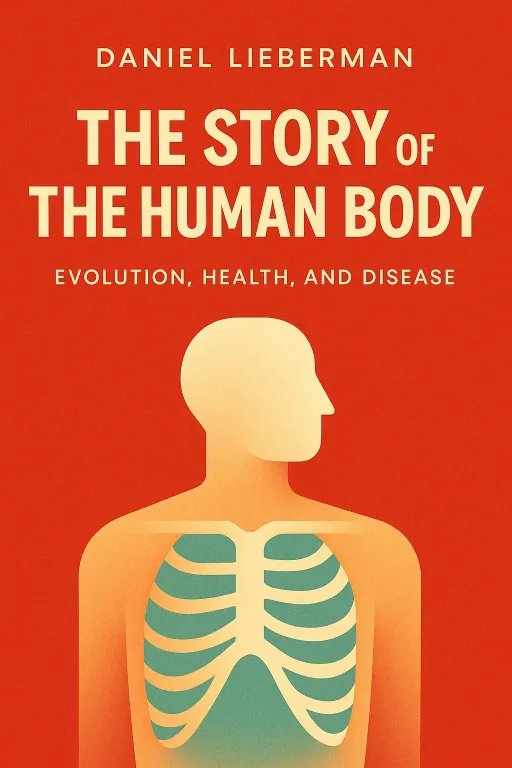
Dr. Celeste Vega: Exactly. And it’s a huge paradox. We’re living longer than any humans in history, yet we're facing an epidemic of chronic illnesses—diabetes, heart disease, obesity, certain cancers. The book we're diving into today, Daniel Lieberman's "The Story of the Human Body," argues it's because we're running Stone Age software in a space-age world. This isn't just an academic idea; I think it's a fundamental challenge to how we practice medicine.
Mohamed Atef: I agree. It suggests that the environment we've built for ourselves, the very symbol of our progress, might be the primary pathogen.
Dr. Celeste Vega: Perfectly put. And that’s why I’m so excited to have you here, Mohamed. As a medical student with a keen interest in surgery, neuroscience, and the future of AI in healthcare, you're at the perfect intersection to explore this. Today we'll dive deep into this from two powerful perspectives. First, we'll explore the paradox of progress—how diseases of excess, like Type 2 Diabetes, are a direct result of our evolutionary success.
Mohamed Atef: And then?
Dr. Celeste Vega: Then, we'll uncover the hidden dangers of the comfort trap, looking at diseases of disuse and how our bodies are literally losing function by not being used as they were designed to be.
Deep Dive into Core Topic 1: The Paradox of Progress
SECTION
Dr. Celeste Vega: So let's start with that first idea, Mohamed: diseases of excess. The book presents this powerful concept of 'mismatch diseases.' From a clinical standpoint, what does that term spark for you?
Mohamed Atef: It immediately makes me think of the gap between our genetics and our lifestyle. In medicine, we talk a lot about gene-environment interaction. A mismatch disease sounds like the ultimate, species-level example of that interaction going wrong.
Dr. Celeste Vega: That's the perfect way to frame it. Lieberman explains that for millions of years, our ancestors lived in environments where calories were scarce and hard to get. Natural selection favored what he calls a 'thrifty genotype'—genes that made us incredibly efficient at craving high-energy foods, eating as much as possible when we found them, and storing any excess energy as fat. That fat was our savings account for lean times.
Mohamed Atef: A survival mechanism, essentially. The ability to store energy was a massive evolutionary advantage.
Dr. Celeste Vega: A life-saving one! But here's the mismatch: what happens when you take a body that is exquisitely adapted for scarcity and drop it into a modern environment of overwhelming abundance? An environment with a supermarket on every corner and a fast-food restaurant next to that.
Mohamed Atef: The survival mechanism becomes a liability. The system gets overloaded.
Dr. Celeste Vega: Precisely. And there's no more dramatic example of this than the story of the Pima people. Imagine two groups of people, genetically almost identical. One group lives a traditional life in the remote mountains of Mexico. They are subsistence farmers, they forage, and their life is physically demanding. The other group lives just across the border in Arizona, with full access to the modern American lifestyle—processed foods, sugary drinks, and far less physical activity.
Mohamed Atef: Okay, so you have a perfect natural experiment. Same genetic blueprint, two radically different environments.
Dr. Celeste Vega: Exactly. And the results are staggering. In the Mexican Pima community, the rate of Type 2 Diabetes is about 6%. It's not zero, but it's relatively low. Now, guess the rate for the Pima in Arizona.
Mohamed Atef: I know it's high, but I'm guessing... 30%?
Dr. Celeste Vega: It's 50%. Five-zero. One of the highest rates in the entire world. Their 'thrifty' genes, which were once a blessing, become a curse when flooded with constant, easily accessible calories. That, right there, is a mismatch disease in action.
Mohamed Atef: That's incredible. It reframes the disease entirely. We're taught to see it as a personal health issue, often linked to individual choices. But this shows it as a predictable, biological response to an unnatural environment. It's not a failure of willpower; it's a success of our ancient survival programming in the wrong context.
Dr. Celeste Vega: And this leads to another chilling concept from the book: 'dysevolution.' This is the vicious feedback loop. We see someone with Type 2 Diabetes, and what do we do? We treat the symptom—the high blood sugar—with medication like insulin. This is life-saving, of course. But by only treating the symptom, we do nothing to change the root environmental cause.
Mohamed Atef: Right. The treatment allows the person to continue living in the very environment that caused the disease. So, the underlying mismatch persists, and the disease becomes more common in the population over time. We're essentially using modern medicine to adapt ourselves to a toxic environment, rather than changing the environment itself. It's a profound thought.
Dr. Celeste Vega: It is. We're managing the crisis, but we're not preventing it. And that's a perfect pivot to our second topic. Because the problem isn't just what we have too much of.
Deep Dive into Core Topic 2: The Comfort Trap
SECTION
Dr. Celeste Vega: It's also what we have too little of. And that's the second kind of mismatch disease: diseases of disuse. Our modern world isn't just a world of excess; it's a world of profound comfort. And that comfort can be dangerous.
Mohamed Atef: You mean the 'use it or lose it' principle, but applied to our entire body.
Dr. Celeste Vega: Exactly. Our bodies are designed to respond to stress. Not emotional stress, but physical, mechanical stress. Think about bones. You know from your studies that bones are living tissue. They remodel themselves constantly based on the loads they experience. For our hunter-gatherer ancestors, who walked and ran miles every day, their bones were constantly getting the signal to stay strong and dense.
Mohamed Atef: And in our sedentary lives, sitting in cars and at desks, our bones don't get that signal. The body, being efficient, decides it doesn't need to invest resources in maintaining bone density that isn't being used. And that leads to osteoporosis.
Dr. Celeste Vega: A classic disease of disuse. But Lieberman gives an even more surprising and, I think, brilliant example. It's something you, as a future surgeon, will definitely encounter. Impacted wisdom teeth.
Mohamed Atef: Of course. It's one of the most common oral surgery procedures. We just see it as a normal anatomical variation, a quirk of development.
Dr. Celeste Vega: But what if it's not a quirk? What if it's a disease? Lieberman tells this story about an experiment with hyraxes, which are small mammals with human-like chewing. They raised two groups on nutritionally identical food. One group got hard, tough pellets, and the other got soft, mushy food. The hyraxes that had to chew hard food developed jaws that were significantly longer, thicker, and wider.
Mohamed Atef: They got the mechanical stress they needed. Their jaws grew to their full genetic potential.
Dr. Celeste Vega: Exactly! Now apply that to us. For millions of years, our ancestors chewed tough, fibrous plants, and uncooked or lightly cooked meat. Their jaws got a serious workout from a very young age. Today, we wean babies onto soft purees and raise children on bread, pasta, and processed foods. Our jaws rarely experience significant mechanical stress.
Mohamed Atef: So... our jaws don't grow large enough to accommodate all 32 of our teeth. And the last ones to come in, the wisdom teeth, have nowhere to go. They get stuck, or 'impacted.'
Dr. Celeste Vega: That's the theory. Impacted wisdom teeth aren't a design flaw in our bodies. They are a modern disease of disuse, caused by the comfort of a soft diet.
Mohamed Atef: That is a complete paradigm shift. I've never heard it framed that way. We see it as a routine problem to be solved with a scalpel and forceps. But you're saying the surgery is just another example of treating the symptom of a mismatch. The root cause is a lifetime of insufficient chewing. It makes me wonder what other 'normal' aches, pains, and procedures are actually just symptoms of our comfortable lives.
Dr. Celeste Vega: Flat feet from supportive shoes, lower back pain from sitting in chairs... the list goes on. We've created a world that is so comfortable, it's preventing our bodies from developing and functioning as they were meant to.
Synthesis & Takeaways
SECTION
Dr. Celeste Vega: So when you put it all together, it's this powerful, two-pronged assault on our ancient bodies. On one hand, we have diseases of excess, driven by too much energy. On the other, we have diseases of disuse, driven by too little physical stress.
Mohamed Atef: And both are perpetuated by what Lieberman calls dysevolution. We have a medical system that is absolutely brilliant at treating the acute symptoms—managing blood sugar, removing impacted teeth, replacing worn-out joints. But it's a system that, by its very nature, focuses less on the evolutionary root cause.
Dr. Celeste Vega: Which brings us to the future, and to your interests. So, Mohamed, as a future doctor who is passionate about artificial intelligence, how can this evolutionary lens shape the technology you want to build? How do we use our most advanced tools to solve our most ancient problems?
Mohamed Atef: That's the billion-dollar question. I think the future isn't just about using AI for faster diagnosis or more precise robotic surgery, as exciting as that is. The real revolution will be using AI to create personalized 'environmental prescriptions.'
Dr. Celeste Vega: Unpack that. What does that look like?
Mohamed Atef: Imagine an AI that integrates your genetic data, your microbiome, your daily activity levels from your watch, and your dietary habits. It understands your specific, individual risk for certain mismatch diseases. It knows you have the 'thrifty' genes. So, instead of just telling you to 'eat healthy,' it gives you a nudge: "Your body processes sugar rapidly in the afternoon. A 15-minute walk after lunch will make a huge difference." It could help you find the right 'dose' of physical stress your bones need, or even suggest foods that provide the chewing resistance your jaw is missing.
Dr. Celeste Vega: So you're talking about using our most modern technology to help us live more in sync with our ancient biology.
Mohamed Atef: Exactly. It's about moving from a one-size-fits-all model of medicine to a deeply personalized, preventative approach guided by our own evolutionary story. It's not about rejecting progress. It's about using progress wisely, to build an environment that works our biology, not against it. That, to me, is the most exciting future for healthcare.
Dr. Celeste Vega: A powerful and hopeful vision. Mohamed Atef, thank you so much for bringing your clinical and future-focused perspective to this. It’s been fascinating.
Mohamed Atef: The pleasure was all mine. It's given me a lot to think about.