

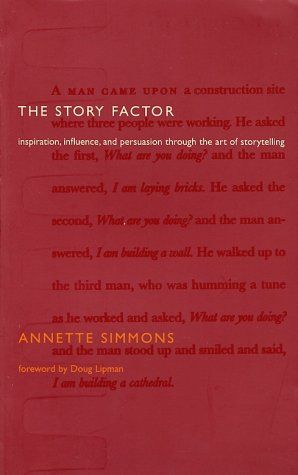
The Story Factor
Inspiration, Influence, and Persuasion Through the Art of Storytelling
Introduction: The Tyranny of the Bullet Point
Introduction: The Tyranny of the Bullet Point
Nova: Welcome to 'The Narrative Edge,' the podcast where we dissect the tools that truly move people. Today, we're diving into a book that argues the most powerful asset in any boardroom, sales pitch, or leadership meeting isn't a spreadsheet, but a story. We're talking about Annette Simmons' seminal work, The Story Factor.
Nova: Exactly! It's the tyranny of the bullet point. Simmons, who is a renowned consultant, looked at this problem and realized that facts inform, but stories transform. She argues that if you want to persuade, motivate, or inspire real change, you need to tap into emotion, and emotion lives in narrative.
Nova: The big claim is that you don't need to be a natural orator or a novelist. You just need to master a specific, finite toolkit. Simmons boiled down the essence of persuasive communication into exactly six essential stories. Six! That's manageable. That's actionable. That's what we're unpacking today: what those six stories are and how they work their magic.
Nova: We begin with the foundation of all influence: establishing who you are. Let's jump into Chapter One.
Key Insight 1: The Six Essential Stories
The Foundation: Establishing Credibility and Purpose
Nova: Chapter One of The Story Factor is titled 'The Six Stories You Need to Know How to Tell.' This is the core architecture of the book. Simmons insists that these six archetypes cover nearly every necessary communication scenario in business and life. They are designed to move hearts and minds simultaneously.
Nova: Absolutely. The 'Who I Am' story is the bedrock. It’s not your resume; it’s the narrative that reveals your character, your background, and the experiences that shaped your perspective. Simmons notes that this story is crucial for building immediate trust. Think about it: when you meet someone new, you don't trust their quarterly report; you trust the person delivering it.
Nova: Precisely. And the research backs this up. Stories about personal struggle and overcoming obstacles create a powerful emotional resonance that a list of skills simply cannot replicate. It makes you three-dimensional, as one summary put it, adding life to what might otherwise be a flat corporate profile.
Nova: That leads directly to the second essential story: 'Why I'm Here.' This story addresses the audience's inherent skepticism about your motives. Simmons emphasizes that this story must be authentic and reveal your self-serving objectives in a positive light, or better yet, frame them around a shared goal.
Nova: That’s the spirit. It’s about connecting your personal stake to the audience’s benefit. It’s the difference between saying, 'I need this budget to hit my targets,' and saying, 'I need this budget because I saw a critical gap that, once filled, will secure our team's success for the next five years.' It shifts the focus from personal gain to shared victory.
Nova: The next layer is about painting the future, which is where we move from establishing the self to inspiring the collective. That brings us to the stories about vision and values.
Key Insight 2: Painting the Future
Inspiring Movement: Vision and Values in Action
Nova: Once the audience trusts you and understands your immediate intent, you have to give them a destination. This is where 'The Vision' story comes in. This story is pure aspiration. It’s about painting a picture of the world after your proposed change has been implemented.
Nova: Simmons offers a brilliant countermeasure: anchor the vision in a tangible, relatable scenario. Don't just say, 'We will be the industry leader.' Tell the story of the first customer who calls you, ecstatic because your new system saved their business from collapse. Use sensory details. Make the future feel real, lived-in, and desirable.
Nova: It’s the moral compass of the entire set. The 'Values in Action' story is the proof that your stated values aren't just words on a plaque. It’s a story where you, or someone you admire, made a difficult choice—a choice that prioritized a core value over an easy win or short-term profit.
Nova: Imagine a sales executive who discovers a minor flaw in a product just before a massive shipment goes out. The easy path is to ship it, fix it later, and hit the quarterly number. The 'Values in Action' story is about the executive stopping the shipment, taking the short-term revenue hit, and explaining to the board why protecting the customer's trust was non-negotiable. That single story demonstrates integrity more effectively than a hundred-page ethics manual.
Nova: We have the stories that deal with the immediate friction point: doubt and learning. These are crucial for overcoming resistance and ensuring the message sticks. We're moving from inspiration to practical application and empathy.
Key Insight 3: Addressing Doubt and Teaching
Bridging the Gap: Empathy and Instruction
Nova: The fourth and fifth stories are about connection and instruction. First up is the 'I Know What You're Thinking' story. This is pure empathy in narrative form. It’s designed to disarm the audience by voicing their unspoken objections or fears before they even have a chance to fully form them.
Nova: Not if you frame it correctly. Simmons advises you to voice the objection, validate it as reasonable, and then immediately pivot to how your previous stories—your 'Who I Am' and 'Values' stories—address that exact concern. For example: 'I know what you're thinking: This sounds expensive. But remember the story about the shipment I stopped last year? That short-term cost prevented a long-term reputational disaster. That's the mindset we're bringing to this investment.'
Nova: It is. It shows you respect their intelligence. Now, let’s talk about the 'Teaching' story. This is where you impart a specific lesson or skill. This is often used in training or mentoring, but it's vital for any leader trying to transfer knowledge.
Nova: A memo is inert. A teaching story is alive. Instead of listing the three steps to effective negotiation, you tell the story of the time you completely botched a negotiation by following those three steps, the painful lesson you learned, and the subsequent success when you applied the corrected method. The lesson is embedded in the consequence.
Nova: Exactly. And this brings us to the final, and perhaps most powerful, story in the set, the one that ties everything together and ensures longevity: the story that shows how to move from a one-dimensional view to a three-dimensional understanding of a situation. It’s about depth and complexity.
Key Insight 4: The Power of the Full Set
The Synthesis: Making Stories Stick
Nova: We've explored 'Who I Am,' 'Why I'm Here,' 'The Vision,' 'Values in Action,' and 'I Know What You're Thinking,' plus the 'Teaching' story. The real power, Alex, according to Simmons, isn't using just one, but understanding how they interlock. They are a system, not a collection of random anecdotes.
Nova: Precisely. The book showcases examples where leaders used these stories to navigate massive organizational change. One case study mentioned involved a merger where the facts and figures for the merger were sound, but employee morale was collapsing because people feared losing their identity. They needed the 'Who I Am' story reframed for the new entity, and the 'Vision' story to show what the combined future looked like.
Nova: They do. And the key takeaway for our listeners who want to apply this immediately is preparation. Simmons stresses that you must have these stories ready to deploy. They shouldn't be improvised under pressure. You need to workshop your 'Who I Am' story until it’s sharp, concise, and under three minutes, ready for that unexpected networking moment.
Nova: It is. And the payoff is immense. When you use facts, you engage the logical part of the brain. When you use story, you engage the emotional centers, the parts that drive memory and action. Facts might get you an audience; stories get you commitment. We’re talking about moving people from passive agreement to active advocacy.
Nova: A perfect analogy. Let's bring this all home in our final thoughts.
Conclusion: Your Narrative Edge
Conclusion: Your Narrative Edge
Nova: We’ve spent this time exploring Annette Simmons' blueprint for influence: The Story Factor. The core message is clear: stop presenting data and start sharing meaning.
Nova: The actionable takeaway today is to choose one of those six—perhaps the 'Who I Am' story—and spend the next week refining it. Make it vivid, make it brief, and practice deploying it naturally. See how the dynamic shifts when you lead with narrative instead of just statistics.
Nova: Absolutely. The world is saturated with information, but starved for meaning. Go out there and provide that meaning through your stories. This has been a deep dive into persuasion.