

The State is Obsolete
Introduction
Narrator: Imagine a world where taxpayers, long treated like cows in a field to be milked by the state, suddenly grow wings. This is not a fantasy, but a powerful metaphor for a seismic shift in power. For centuries, governments have held a monopoly on coercion, their power rooted in their ability to control territory and, by extension, the people and assets within it. But what if technology created a new realm, a digital frontier where wealth could be generated, stored, and moved beyond the reach of any single government? What if the most productive individuals could simply opt out of the social contract, becoming immune to taxation and political compulsion?
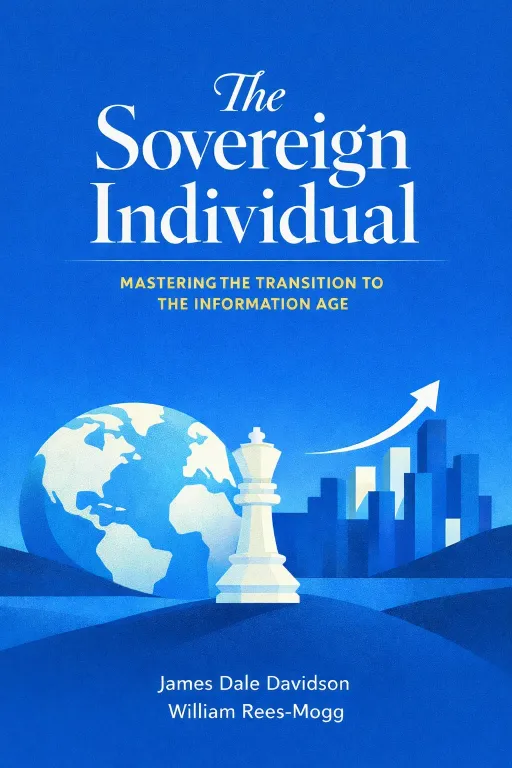
This is the provocative and prescient world laid out in The Sovereign Individual: Mastering the Transition to the Information Age by James Dale Davidson and Lord William Rees-Mogg. Written in 1997, the book argues that the Information Revolution is not just another technological advancement but a "megapolitical" force so powerful it will dismantle the nation-state and give rise to a new elite class of autonomous, denationalized individuals.
The End of an Era: Why the Nation-State Is Obsolete
Key Insight 1
Narrator: The book's central argument is that the nation-state, the dominant political structure of the last 500 years, is dying. To understand this radical claim, the authors draw a powerful historical parallel to the decline of another monolithic institution: the medieval Church.
In the 15th century, the Church was the central organizing force of society. It was a universal institution that, for a time, played a vital role in preserving knowledge and fostering economic recovery. But by the late 1400s, it had become, in the authors' words, "senile and counterproductive." Widespread corruption was rampant, with clergy held in public contempt for their worldliness and greed. This moral decay was a symptom of a deeper megapolitical shift. The Gunpowder Revolution had fundamentally altered the logic of violence. The armored knight, once the pinnacle of military power, was rendered obsolete by cannons and firearms that could be wielded by commoners. This new technology favored large, centralized states that could afford massive armies, making the fragmented feudal system, upheld by the Church, an anachronism.
Davidson and Rees-Mogg argue that the Information Revolution is the gunpowder of our time. Microprocessing is dismantling the logic that favored the large-scale, centralized nation-state. Just as gunpowder and the printing press broke the Church's monopoly on power and information, cyberspace and encryption are breaking the nation-state's monopoly on violence and taxation. The institution that defined the Modern Age is becoming a relic, too slow and inefficient for a new world.
Megapolitics: The Hidden Logic of Violence
Key Insight 2
Narrator: To explain these grand historical shifts, the authors introduce their core analytical framework: "megapolitics." This is a way of looking at history that ignores political speeches and popular opinion, focusing instead on the hidden factors that alter the costs and rewards of violence. These factors are topography, climate, microbes, and, most importantly, technology.
The logic is simple: the way societies organize themselves is fundamentally determined by who can project power and how. For example, the authors explain that the unique topography of ancient Greece, with its jagged coastline, allowed farmers to grow high-value crops like olives and grapes and easily ship them by sea. This made them wealthy enough to afford their own armor, creating a formidable class of citizen-soldiers, or hoplites. Because the common man was militarily powerful, democracy flourished. This contrasts sharply with the Middle Ages, where the technology of warfare—the armored knight on his warhorse—was so expensive that only a tiny elite could afford it, leading to a highly unequal feudal society.
In the 20th century, the technology of warfare favored massive, industrial-scale armies, which in turn required massive, industrial-scale states to fund them. Now, the authors argue, technology is again changing the equation. Smart weapons, cyber warfare, and decentralized communication empower small groups and individuals, making the massive nation-state and its conscript armies less relevant. Understanding this shifting logic of violence is the key to understanding why our world is being remade.
The Rise of the Cybereconomy and the Sovereign Individual
Key Insight 3
Narrator: As the nation-state wanes, a new frontier is opening: cyberspace. The authors describe this not as a highway between places, but as a destination in itself—the "ultimate offshore jurisdiction." It is a realm without physical territory, where a government's threats of violence are meaningless. In this new economy, wealth is generated from ideas and information, assets that can be moved across the globe at the speed of light.
This new reality gives rise to the "Sovereign Individual." These are the cognitive elite, the high-skilled creators and entrepreneurs who can operate globally. They are no longer bound by the "tyranny of place." A brilliant programmer in Bangalore can compete for the same work as one in Silicon Valley. A financial trader can live in a low-tax jurisdiction while managing assets held in a dozen others.
To illustrate this, the book paints a picture of a "cyberdoctor." Imagine a world-class surgeon living in a tax-free haven like Bermuda. Using robotic instruments and high-resolution imaging, she can perform complex surgery on a patient in New York, a procedure that is less invasive, more precise, and contracted under a legal framework drafted by a digital lawyer in yet another country. Her income is earned in a placeless digital realm, beyond the reach of any single tax authority. This individual, operating like a "god of myth," politically separate from the ordinary citizens around her, is the archetype of the new era.
The Revenge of the Nation-State: A Neo-Luddite Backlash
Key Insight 4
Narrator: This transition will not be peaceful. As governments see their tax base—the "cows with wings"—fly away, they will not surrender power gracefully. The authors predict they will become increasingly desperate and ruthless. They will resort to what they call the "revenge of nations."
We see early signs of this in policies like the "exit tax," which the authors describe as a "Berlin Wall for capital," designed to punish wealthy citizens for renouncing their citizenship. Governments will increase surveillance, attempt to control encryption, and use any means necessary to prevent wealth from escaping their grasp.
This governmental desperation will be mirrored by a furious social backlash. The Information Age creates stark inequalities. While the cognitive elite thrive, many people with skills suited for the Industrial Age will find themselves left behind, their jobs automated or outsourced. This will fuel a "neo-Luddite" reaction, a violent opposition to the technologies and the people seen as responsible for their declining status. This backlash will be characterized by angry nationalism, anti-immigrant sentiment, and a hatred of the global elite, creating a period of intense social and political turmoil.
The Commercialization of Sovereignty: From Citizen to Customer
Key Insight 5
Narrator: The ultimate outcome of this great transformation is what the authors call the "commercialization of sovereignty." As the nation-state's monopoly on power dissolves, it will be forced to change its business model. Governments will no longer be able to treat their populations as captive subjects but will have to compete for them as customers.
The book uses the historical example of Andorra, a tiny principality nestled between France and Spain. For over 700 years, its sovereignty was shared by two competing feudal lords. Because neither could afford to alienate the residents and drive them into the arms of the other, Andorrans paid almost no taxes and lived with minimal government. This, the authors argue, is a model for the future.
In the Information Age, Sovereign Individuals will "shop" for jurisdictions, choosing to live and invest where they receive the best services—protection of life and property—for the lowest price, or tax rate. Governments will be forced to become more like competitive service providers, offering different "packages" of laws, security, and amenities to attract the mobile capital and talent of the world's most productive people. The relationship will shift from one of involuntary allegiance to one of voluntary contract. Politics as we know it will die, replaced by a marketplace for governance.
Conclusion
Narrator: The single most important takeaway from The Sovereign Individual is that technology is fundamentally decentralizing power, shifting it away from the state and into the hands of the individual. The megapolitical forces of the Information Age are making the individual the master of their own destiny in a way that was never before possible. The book argues that the coercive, territorial nation-state is an artifact of the Industrial Age, and its decline is not a matter of if, but when.
The book's vision is both liberating and terrifying. It challenges us to reconsider our most basic assumptions about society, loyalty, and progress. It asks a profound question: Are you prepared for a world where the protections and burdens of citizenship are no longer a given? A world where you are not a citizen, but a customer of governance, with all the freedom—and all the responsibility—that choice entails.