

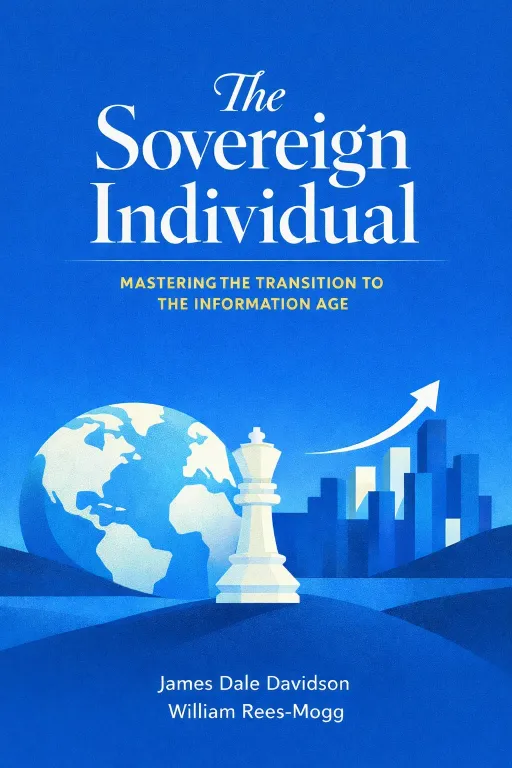
Unplugging the State
Golden Hook & Introduction
SECTION
Joe: Most of us think of our citizenship as a core part of our identity, a source of rights and belonging. But what if it's actually your biggest financial liability? A subscription service with a terrible cancellation policy that's about to go bankrupt. Lewis: Whoa. That is a spicy take. You’re saying my passport is basically a ball and chain? Joe: That's the brutal premise at the heart of The Sovereign Individual by James Dale Davidson and Lord William Rees-Mogg. Lewis: Ah, the legendary one. Written way back in the late 90s, right? It's become this almost prophetic text in tech and finance circles. People talk about it in hushed tones. Joe: Exactly. And what's wild is that the authors weren't just academics; they were investment strategists. They were looking at history not for moral lessons, but for what they call 'megapolitical' patterns to predict where money and power would flow next. And their predictions have been eerily, almost frighteningly, accurate. Lewis: Okay, so they're not just philosophers, they're putting their money where their mouth is. That definitely gets my attention. So what's the big idea that has everyone so spooked and fascinated? Joe: Their biggest, most controversial prediction is that the nation-state itself—the entire system of countries, borders, and governments we've known for 500 years—is on its deathbed.
The End of an Era: Why the Nation-State is Becoming Obsolete
SECTION
Lewis: On its deathbed? That sounds a little dramatic. I mean, governments seem pretty powerful to me. They have armies, they collect taxes... they're not just going to disappear. Joe: They don't think it will be a quiet disappearance. But they draw this incredible parallel. They say the modern nation-state today is in the exact same position as the Catholic Church in the late 15th century. Lewis: The Catholic Church? How does that work? Joe: Well, think about it. For a thousand years, the Church was the organizing principle of society. It wasn't just about religion; it provided social services, it legitimized rulers, it was the bedrock of law and order. It was, for all intents and purposes, the central institution of the Western world. Lewis: Right, it was everything. Joe: But by the 1490s, it had become, in their words, "senile and counterproductive." It was corrupt. Popes had illegitimate children, clergy were selling indulgences to get people out of purgatory. The institution was seen as a massive drag on the economy, and there was this widespread, simmering contempt for it. The moral outrage was everywhere, long before Martin Luther ever nailed his theses to the church door. Lewis: Okay, I can see the corruption parallel. People definitely don't have a high opinion of politicians these days. The book mentions a global wave of scandals from the US to Japan, and that was in the 90s. It’s only gotten more intense. Joe: Exactly. But the core of the argument is technology. What really brought down the Church's monopoly wasn't just moral decay; it was the Gunpowder Revolution. Suddenly, the old military system of knights in shining armor, loyal to the Church and feudal lords, was obsolete. A peasant with a gun could take down a knight. It completely changed the 'logic of violence.' Lewis: And the printing press spread heretical ideas that the Church couldn't suppress. Joe: Precisely. New technology made the old system untenable. And the authors' argument is that the Information Revolution—microprocessing, encryption, the internet—is the new gunpowder. It's making the nation-state, with its mass armies and geographic monopolies, just as obsolete as the armored knight. Lewis: So we're living through the decline, but we might not even realize it. The book talks about this idea of 'persistent make-believe,' right? Joe: Yes! It's one of their most brilliant points. They use the fall of the Roman Empire as the prime example. When the last Western Roman Emperor was deposed in 476 AD, nobody ran a headline saying "ROME HAS FALLEN." The new barbarian king, Odoacer, was clever. He didn't declare himself emperor; he just said he was ruling on behalf of the other emperor in the East. The Senate still met. The old offices still existed. They kept up the fiction of the empire for generations, even as the reality on the ground was chaos and decay. Lewis: Wow. So we could be doing the same thing now—pretending our political systems are working, even as they're being hollowed out from the inside by these new technological forces. That is a chilling thought. But what exactly is this force? What's the engine driving this collapse?
Megapolitics: The Secret Engine of History is Violence
SECTION
Joe: This is where we get to their secret weapon, their analytical framework, which they call 'megapolitics.' Lewis: Megapolitics. Sounds grand. What is it? Joe: It's a way of looking at history that ignores the noise—the political speeches, the ideologies, the headlines. Instead, it focuses on the deep, underlying factors that change the fundamental rules of power. They identify four: topography, climate, microbes, and, most importantly, technology. Lewis: Okay, so how do those things connect to the fall of governments? Joe: Because they all change the answer to one simple, brutal question: does violence pay? And if so, what kind of violence? They have this quote that's central to their whole worldview: "The reason that people resort to violence is that it often pays." An army seizing an oil field is doing the same thing as a thug stealing a wallet. They're taking something because it's easier than earning it. Lewis: That is a deeply cynical, but probably true, view of the world. So history is just a story of who has the better stick and how they use it. Joe: In a way, yes. And technology is constantly changing the stick. For centuries, after gunpowder, the advantage went to scale. Bigger states with bigger armies and bigger tax bases won. That's why the nation-state became dominant. It was the most effective vehicle for organizing large-scale violence. But the authors argue that microprocessing reverses this. It favors efficiency over scale. Lewis: How so? Joe: Think about it. A small group of hackers can now do more damage to a country's infrastructure than a battalion of soldiers. Encrypted communication allows individuals and groups to organize and move capital completely outside of state control. The state's ability to project force and to tax—its two core functions—is being technologically undermined. The 'returns to violence' are diminishing for large-scale actors. Lewis: And they've used this framework to make predictions before? Joe: This is the crazy part. In their previous books, they used this exact logic to predict things everyone thought was impossible. In the early 80s, they predicted the collapse of the Soviet Union when the CIA was saying it was stronger than ever. They predicted the 1987 stock market crash. They predicted the long-term decline of blue-collar wages. They were laughed at, but they were right, because they weren't looking at politics; they were looking at the changing logic of power. Lewis: Okay, that's a pretty solid track record. It lends a lot of weight to their argument. It’s not just a wild theory; it’s a predictive model that has worked. So if the nation-state is the dying institution, what comes next? Who are the winners in this new world?
The Sovereign Individual: Gods, Anarchy, and 'Cows with Wings'
SECTION
Joe: This is where it gets really wild. The book argues that as the nation-state crumbles, a new actor emerges on the world stage: the 'Sovereign Individual.' Lewis: The Sovereign Individual. It sounds like a character from a superhero movie. Joe: The description is not far off. They write that the new Sovereign Individual will "operate like the gods of myth in the same physical environment as the ordinary, subject citizen, but in a separate realm politically." Lewis: What does that even mean, a separate realm politically? Joe: It means they are no longer bound by the laws and taxes of any single nation-state. They are the 'cognitive elite'—the programmers, the investors, the creators—whose skills are so valuable and so portable that they can live anywhere, work anywhere, and keep their wealth anywhere. They become customers of governance, not subjects. They shop for the best deal. Lewis: And this is where the famous 'cows with wings' metaphor comes in. Joe: Exactly. The authors say that for centuries, the state has treated its taxpayers like a farmer treats his cows: keeping them in a field to be milked. But now, thanks to technology, "the cows will have wings." Wealth is no longer tied to land or factories. It's information. It's digital. It can be moved to the "ultimate offshore jurisdiction," as they call it: cyberspace. Lewis: "Bermuda in the sky with diamonds." I love that line. It’s so evocative. It paints a picture of a completely new economic reality, one with no taxes, no government, no borders. Joe: And that's where the book gets really controversial and, for many readers, quite dark. Because this future is not for everyone. Lewis: Right. This is the elitism critique. It sounds fantastic if you're one of the 'cognitive elite' with a billion dollars in cybercash. But what about the rest of us? The people who can't just 'pack up their laptop and fly away'? Are we just left behind to fight for the scraps in these collapsing, bankrupt nation-states? Joe: The book is unflinching on this point. They predict a massive rise in income inequality, far greater than what we see today. They foresee a 'neo-Luddite' reaction—a violent backlash from those who lose status, income, and security in this transition. They predict rising crime, social decay, and a world that is much more fragmented and dangerous for the average person who is still tied to a specific place. Lewis: So it's a techno-utopia for the few and a dystopia for the many. That's a tough pill to swallow. It feels like it ignores the fact that states can adapt, that people might choose community over pure, rational self-interest. It’s a very cold, deterministic view. Joe: It is. Their argument is that these are megapolitical forces, as unstoppable as an earthquake. You can't vote against them. You can't wish them away. You can only understand them and adapt. And for the individual, that adaptation is radical. It means rethinking everything you thought you knew about loyalty, identity, and security.
Synthesis & Takeaways
SECTION
Lewis: So, we're living through this massive, tectonic shift. The very ground beneath our political and economic world is breaking apart, all driven by a fundamental change in the profitability of violence. And the result is a future that's both incredibly liberating for a select few and potentially terrifying for the vast majority. Joe: Exactly. The book really forces you to ask a fundamental question: Are you prepared to be a 'customer' of governance? Because the old model of being a 'citizen'—with its rights, but also its non-negotiable obligations—is expiring. The authors argue that understanding this shift isn't just an intellectual exercise; it's a survival strategy. Lewis: It makes you look at your passport differently. Is this a document that grants you freedom, or is it a chain that ties you to a sinking ship? It’s a heavy but fascinating idea. We'd love to know what you all think. Does this sound like a dystopian nightmare or a libertarian dream? Let us know your thoughts. Joe: This is Aibrary, signing off.