

The Rise and Fall of Economic Prosperity
Golden Hook & Introduction
SECTION
Nova: The most dangerous assumption you can make about your career is that the economic system you were born into is the one that will support you until you retire. History shows us that economic climates shift with the frequency of the tides, and yet most of us build our financial foundations on sand, assuming the ground beneath us is bedrock.
Atlas: That hits hard. Especially for those of us who spend our days building systems or writing code. We look for stability in our architecture, but we often forget that the macro-economic architecture is essentially a temporary structure. It gets renovated, sometimes demolished, and occasionally replaced entirely.
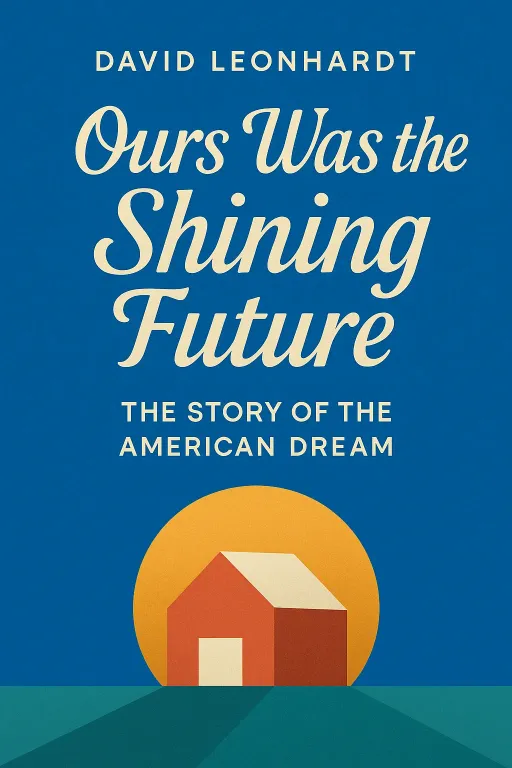
Nova: Exactly. And that is why we are looking at two very different blueprints today. We are exploring the tension between David Leonhardt’s argument in his book, Ours was the shining future, and the radical, almost prophetic vision laid out in The Sovereign Individual by James Dale Davidson and William Rees-Mogg.
Atlas: Two completely different ways to view the world. One looks at the power of the collective, and the other bets everything on the power of the individual. For someone who likes to engineer their own path, this is a fascinating conflict to resolve.
Nova: David Leonhardt, a veteran journalist, makes a compelling case that the prosperity we associate with the mid-twentieth century was not an accident. It was the result of deliberate public investment, strong labor movements, and, most importantly, democratic guardrails. He argues that when we prioritize shared growth, the entire economic engine functions better.
Atlas: And then you have The Sovereign Individual, which feels like it was written from a completely different planet. It is a cult classic that emerged in the late nineties, right as the internet was starting to really catch fire. The authors predicted that digital technology would eventually dismantle the state’s monopoly on power. They argue that we are moving toward a world where individuals can protect their wealth and operate as independent economic sovereigns, regardless of where they happen to be standing on a map.
Nova: It is the ultimate debate: Do we fix the system we are in, or do we build a way to exit it?
The Case for the Collective
SECTION
Atlas: Let’s start with Leonhardt’s vision. I think a lot of people feel a sense of nostalgia for that era—the fifties, the sixties—where a single income could sustain a family, buy a house, and fund a retirement. He claims this was a result of specific choices. What exactly does he mean by choices?
Nova: He points to the era of shared prosperity. It was not just a lucky streak of history. It was a period where the United States made massive, intentional investments in public goods. Think of the interstate highway system, massive funding for public universities, and a tax structure that kept inequality in check. These were foundational pillars. They created a middle class that was, for lack of a better term, structurally supported.
Atlas: From an engineering perspective, that sounds like a stable load-bearing wall. If you remove the support, the structure sags.
Nova: Precisely. Leonhardt’s argument is that we stopped prioritizing those load-bearing walls. We shifted toward a model that favored deregulation and individual accumulation at the expense of public infrastructure. He makes the case that when we erode the public sector, we are actually eroding the very environment that allows private businesses to thrive. Without a strong, educated, and healthy workforce—which public investment provides—private companies eventually run out of the raw material they need to grow.
Atlas: That makes sense. It is the ecosystem argument. If you drain the swamp to build a luxury hotel, you kill the biodiversity that made the location valuable in the first place. But here is the problem I see with that view. For someone trying to navigate their career today, waiting for the public sector to rebuild that infrastructure feels like a losing strategy. It takes decades to shift national policy.
Nova: You are highlighting exactly why this is such a tense debate. Leonhardt is speaking to the systemic level. He is saying that if we want long-term stability, we have to demand these shifts. But that requires a level of political and social consensus that feels very far away right now.
Atlas: And that is where my pragmatic side kicks in. I cannot wait for a legislative overhaul to plan my financial future. I have to look at the tools I have in my hands right now. This is where the contrast with the second book becomes so stark.
The Case for the Sovereign Individual
SECTION
Nova: The Sovereign Individual takes the opposite approach. If Leonhardt is looking at the system from the top down, Davidson and Rees-Mogg are looking at it from the bottom up. They argue that the nation-state has lost its ability to control the individual because the individual has gained the ability to move their value.
Atlas: I remember reading about this. They predicted that information technology would act as a solvent, dissolving the borders that nation-states used to trap wealth.
Nova: They called it the transition to the Information Age. They argued that in the old world—the industrial age—wealth was tied to territory. You had to have a factory on a piece of land, and that land was controlled by a government. That government could tax you, regulate you, and conscript you. But in the digital age, wealth is information. And information is portable.
Atlas: This is the essence of the remote work revolution, isn’t it? If my work is purely digital, my location is a preference, not a requirement. I can choose to live in a jurisdiction that is favorable to me, or I can work for a client on the other side of the planet. I am no longer tethered to the local economic system.
Nova: That is exactly the point they were making. They envision a future where individuals become like multinational corporations. You manage your own tax liability, you choose where to deploy your capital, and you leverage technology to bypass the gatekeepers. It is a vision of radical self-reliance.
Atlas: It sounds empowering, but I have to play devil’s advocate here. Is this actually realistic for everyone? If I am a software engineer, sure, I have portability. But what about the person who builds the physical infrastructure, or the teacher, or the nurse? They cannot digitize their labor and move it to a lower-tax jurisdiction. Does this theory just create a massive divide between the digital elite and everyone else?
Nova: That is the critical question. The authors of The Sovereign Individual would argue that the divide is already here. They view this transition as inevitable, not optional. They suggest that the nation-state will have to compete for citizens by offering better services, or it will lose its best people to jurisdictions that are more efficient. It is a market-based view of governance.
Atlas: It is a brutal view, though. It treats citizenship like a subscription service. If you are not paying into the system, or if the system is not providing value, you churn.
Nova: It is jarring. And it stands in direct opposition to Leonhardt’s vision of a society where we are all invested in a common future. One view says: "Let’s fix the house we all live in." The other says: "The house is decaying, so I am building my own independent structure."
Synthesis and Practical Application
SECTION
Atlas: So, how do we synthesize this? Because if I pick Leonhardt’s path, I am betting on a political and social turnaround that is not guaranteed. If I pick the Sovereign Individual’s path, I am betting on my ability to outrun the system, which is also a risky gamble.
Nova: The answer lies in the middle. You need to be a pragmatic participant in the current system while building the capacity for sovereignty.
Atlas: That sounds like a hedge. Like having a diversified portfolio, but for your life strategy.
Nova: Exactly. Let’s break that down for our listeners. If you are an Analytical Architect, you need to build two layers of defense. Layer one is your engagement with the community. Leonhardt is right that you cannot escape the system entirely. You need a functioning society around you. You need good schools, safe roads, and a stable economy. So, you contribute to that. You participate in the local economy, you advocate for sound policy, and you build local networks.
Atlas: Okay, so that is the "Shining Future" layer. I am investing in the environment I live in. But what is the second layer?
Nova: The second layer is your "Sovereign" capacity. This is where you apply the lessons from Davidson and Rees-Mogg. You build your professional life to be as portable and digital as possible. You develop skills that are valued globally, not just locally. You manage your personal finances with the assumption that the local currency or the local economic climate might become unstable.
Atlas: I see what you are doing. You are suggesting that we build a career that is globally competitive—the Sovereign part—while maintaining a local commitment—the Collective part.
Nova: Think about it as digital emigration. You don’t have to leave your country to be an immigrant in the digital economy. You can be a local citizen who works for the global market. That gives you the best of both worlds. You are insulated from the decline of a specific local industry, but you are still rooted in a community you care about.
Atlas: That changes the way I look at my income streams. Instead of just asking, "How do I get a raise at my current job?" I should be asking, "How do I make my skills so portable that they function in any market?" And simultaneously, "How do I invest in my local community so that the place I live remains a place worth living?"
Nova: Precisely. It is about building resilience. If you are entirely dependent on one local employer or one local government, you are fragile. But if you have a base of digital skills, a portfolio of assets that are not tied to one region, and a strong local network of people you trust, you are robust.
Atlas: It is the difference between being a leaf in the wind and being a tree with deep roots but flexible branches. The branches move with the storm, but the roots hold you in place.
Nova: I love that analogy. Most people try to be the rock, which just breaks under pressure. You want to be the tree.
Synthesis & Takeaways
SECTION
Atlas: So, let’s wrap this up for the listeners. We have two powerful, competing narratives. Leonhardt gives us the responsibility of the citizen—the need to build and maintain the collective. Davidson and Rees-Mogg give us the agency of the individual—the need to build and maintain our own independence.
Nova: If you try to live by only one of these, you are going to be either frustrated by the system or isolated from it. The goal is to hold both truths simultaneously. You work to improve the collective, but you build your personal house to be independent.
Atlas: It comes back to that tiny step mentioned earlier. Analyze your income streams. If you are a hundred percent dependent on a local employer in a declining industry, you have zero sovereignty. You are at the mercy of the system.
Nova: And that is a dangerous position to be in. Start by mapping where your value comes from. Is it tied to a specific location? Is it tied to a specific government policy? If the answer is yes, start diversifying. Learn a skill that works across borders. Build a digital asset, or a remote-capable service, or a network that spans geographies.
Atlas: It is about optionality. If you have options, you are not a victim of the system. You are a participant.
Nova: And remember, the goal is not to abandon society. The goal is to be strong enough that you can choose to contribute to it, rather than being forced to endure it.
Atlas: That is a profound distinction. It is the difference between being a subject and being a citizen.
Nova: Well said. This is the challenge of our time. We are all architects of our own future, and we have to build foundations that can withstand the tectonic shifts in the global economy.
Atlas: I am ready to start mapping my own streams. This has been a masterclass in perspective.
Nova: I am glad we could walk through it. It is a big topic, but the path forward is clear once you see the architecture of the problem.
Atlas: Absolutely. And for everyone listening, remember that your trajectory is determined by the systems you build for yourself, not just the ones you are handed.
Nova: We hope this helps you build something that lasts. This is Aibrary. Congratulations on your growth!