Unmasking Modern Reality
Golden Hook & Introduction
SECTION
Nova: Imagine you are walking through a city, but instead of seeing buildings and people, you see a massive, high-definition screen projecting how those buildings and people are supposed to look. You are not living your life; you are starring in a movie about your life, directed by an invisible production crew that wants to sell you the next scene.
Atlas: That is a unsettling way to frame a Tuesday afternoon. But honestly, it is not far off. We spend half our day curating the version of ourselves that we want the world to see, and the other half consuming the curated versions of everyone else. It feels like we are all actors in a play where the script is written by an algorithm.
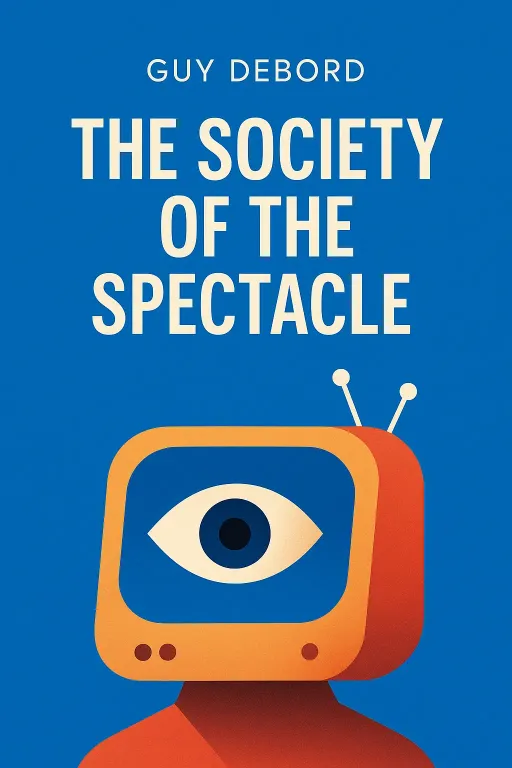
Nova: You hit the nail on the head. That feeling of performance, that sense that your daily existence is becoming a representation rather than a reality, is exactly what the French thinker Guy Debord was talking about in his seminal work, The Society of the Spectacle.
Atlas: I have heard the title thrown around in philosophy circles, but it sounds heavy. Was this written recently? It feels like it describes our current social media landscape perfectly.
Nova: That is the eerie part. Debord wrote this in 1967. He was looking at the rise of television, cinema, and mass advertising. He saw that the authentic social life we used to have was being replaced by images of life. And when you pair that with the foundational critique of capitalism from Karl Marx and Friedrich Engels in The Communist Manifesto, you get a clear picture of why our desires feel so manufactured today.
Atlas: So we are connecting a 19th-century analysis of industrial factories with a 1960s critique of television, and somehow it explains why I feel anxious when I scroll through my phone. I am ready to dive in. Let us break this down.
The Spectacle as the New Reality
SECTION
Nova: Let us start with Debord. He argued that the spectacle is not just a collection of images. It is a social relationship between people that is mediated by images. Think about the last time you went to a restaurant. Did you go just to eat, or did you go to experience the version of the meal that you could share with others?
Atlas: Oh, that hits close to home. I have definitely caught myself arranging a plate of food, adjusting the lighting, and waiting for the perfect angle before I even take a bite. The eating part almost feels secondary. It is like the event does not exist until it has been documented and broadcast.
Nova: Exactly. Debord would say that your experience has been mediated. You are no longer having a direct relationship with the food or the company; you are having a relationship with the image of that meal. The spectacle has colonized your time. It has taken the raw, unscripted, messy reality of living and replaced it with a polished, curated representation.
Atlas: It sounds like we are trading our actual lives for a highlight reel. But why do we do it? Is it just vanity? Or is there something else at play? Because it feels like a compulsion, not a choice.
Nova: That is the crucial question. Debord suggests that we do this because the spectacle is the primary way our society organizes our reality. It provides the script for what is considered a successful, happy, or desirable life. If you do not perform your life according to the script, it is as if you are not really living it. It is a feedback loop. We see the image, we want the image, we perform the image, and then we sell that image to others.
Atlas: It feels like a hall of mirrors. I see someone else’s curated life, I feel inadequate, so I curate my own to compete, and then someone else sees mine and feels inadequate. It is a race to nowhere. But wait, if Debord wrote this in the sixties, he could not have predicted the internet. Was he just lucky, or is this a fundamental human tendency?
Nova: He was identifying the trajectory of the system. He saw that as capitalism advanced, it would need to turn more and more of our private life into a commodity. He predicted that the spectacle would become more integrated, more personalized, and more inescapable. The internet just took the television screen that he was critiquing and shrank it down so we could carry it in our pockets. We are now the producers of our own spectacle, twenty-four hours a day.
The Economic Engine
SECTION
Atlas: Okay, so the spectacle is the visual layer—the shiny packaging. But to understand why this is happening, we need to look at the engine underneath. This is where Marx and Engels come in, right?
Nova: Precisely. If Debord explains the of our modern dissatisfaction, Marx and Engels explain the of the economic structure that demands it. In The Communist Manifesto, they analyze history as a series of class struggles. They argue that the capitalist structure is driven by the need to constantly expand, to turn everything into a commodity, and to keep the gears of production turning.
Atlas: I have always thought of the Manifesto as being about factories, workers in overalls, and industrial output. How does that connect to my Instagram feed?
Nova: Think of the "production" in the modern economy. It is not just about manufacturing physical goods anymore; it is about manufacturing attention and desire. Marx and Engels observed that capitalism creates a dynamic where the worker is alienated from the product of their labor. Today, we are alienated from the product of our lives. Our attention, our preferences, our data—these are the commodities being extracted. The spectacle is the mechanism that keeps us consuming, even when we do not need the things we are buying.
Atlas: That is a sharp pivot. So, the spectacle isn't just a cultural byproduct; it is a vital tool for the economic machine. It creates a state of perpetual dissatisfaction. If I am content with my life, I am not buying anything. If I am content with my authentic values, I am not a target for the next trend.
Nova: You have it exactly. The economic system requires you to feel like something is missing. It needs you to constantly look at the spectacle to see what you are lacking. Marx and Engels described the bourgeoisie as a class that constantly revolutionizes the instruments of production. Today, the instrument of production is the algorithm, and the output is our desire.
Atlas: It makes sense why we feel so exhausted. We are working two jobs: our actual job where we earn a paycheck, and our second job as a content creator for our own personal brand. And the second job is unpaid, even though it generates massive value for the platforms that host the spectacle.
Nova: And that is the brilliance of it. We are the workers and the consumers. We are the ones feeding the machine the very content that keeps us addicted to it. It is a closed circuit. The economic engine needs the spectacle to keep us engaged, and the spectacle needs the economic engine to keep producing the products we are constantly trying to show off.
Reclaiming Authenticity
SECTION
Atlas: This is starting to feel a bit hopeless. If the system is designed to make us perform, and the visual culture is designed to make us want, how do we ever step out of it? How do we find our authentic, unmediated values?
Nova: That is the central challenge. The first step is awareness. You have to recognize that the desires you feel—the urge to buy that specific jacket, the need to visit that specific travel destination, the desire to be perceived in a specific way—might not be yours. They might be imports from the spectacle.
Atlas: It is like trying to identify your own voice in a crowded room where everyone is shouting. I like the idea of auditing my desires. Asking myself, "Do I actually want this, or do I just want to be seen with this?" But practically, what does that look like?
Nova: It means reclaiming your attention. If the spectacle relies on you looking, the act of looking away becomes a radical one. It means finding spaces in your life that are not for public consumption. Do you have hobbies you never post about? Do you have conversations that you do not record or share? Those are the pockets of authentic life.
Atlas: That resonates. I started reading paper books again recently, just for the sake of reading, not to put them on a shelf for a photo. It felt strangely private, almost rebellious.
Nova: That is exactly it. That is a small act of reclamation. Debord might have called it a "situation"—a moment of life lived directly, outside the control of the spectacle. When you create something that is not meant to be a commodity, when you experience something without the need to broadcast it, you are breaking the loop.
Atlas: It is about moving from being a passive consumer of images to an active participant in reality. But I wonder, can we ever fully escape? Or do we just have to learn to live with one foot in the spectacle and one foot out?
Nova: Perhaps we don't need to escape entirely. Maybe it is about changing the balance of power. If we can become conscious of how the spectacle shapes our desires, we can start to choose which parts of it we engage with and which parts we reject. We can use the tools of the modern world without becoming the product of them.
Atlas: It reminds me of the ending of the Manifesto, where Marx and Engels talk about workers of the world uniting. Maybe the modern version is about us realizing that we are all in this same trap. We are all feeling the same pressure to perform. If we recognize that, maybe we can stop competing with each other and start connecting on a more human level.
Nova: That is a profound way to look at it. The spectacle thrives on our isolation and our competitive comparison. Authentic connection, the kind that happens when we drop the mask and admit that we are struggling, is the antithesis of the spectacle. It is the most subversive thing you can do.
Synthesis & Takeaways
SECTION
Atlas: So, we have gone from 19th-century industrial struggles to 20th-century media critiques, and landed right in the middle of our 21st-century digital lives. It is fascinating how these ideas, written decades or even centuries ago, feel like they are describing the exact notification ping I just got on my phone.
Nova: The theories change, but the fundamental struggle remains the same. It is the struggle for the ownership of our own minds and our own time. Whether it is the factory floor or the news feed, the system wants to turn your energy into its fuel.
Atlas: And the takeaway seems to be that we have to be vigilant. We have to be the ones who decide what we value, instead of letting the algorithm or the culture decide for us. It is not about throwing away the phone, but it is about knowing who is in charge when you pick it up.
Nova: Exactly. It is about moving from a state of being "watched" to a state of "seeing." When you start to see the spectacle for what it is—a construction, a mirror, a product—you lose the urge to be consumed by it. You start to reclaim your life.
Atlas: I think I am going to take that with me today. I am going to try to do one thing that is entirely for me, with no audience in mind. No photos, no updates, just the experience itself.
Nova: That is the best possible experiment. The most revolutionary act in a society of the spectacle is to live a life that is truly your own, unmediated and unperformed.
Atlas: That is a powerful note to end on. If our listeners are feeling that same pressure to perform, I hope this helps them take a breath and look at their own lives with a bit more critical distance.
Nova: It is a journey, not a destination. But it starts with that first conscious choice. Thank you for diving into this with me today, Atlas.
Atlas: Anytime. This is Aibrary. Congratulations on your growth!