Deconstructing Modern Societal Narratives
Golden Hook & Introduction
SECTION
Nova: Every morning, we wake up and immediately step onto a stage. We aren't performers by trade, yet we spend hours every day editing, filtering, and presenting a version of our lives that exists only for an audience. We are living in a theater where the audience is also the cast, and the script is written by everyone except us.
Atlas: That is a haunting way to start a Tuesday. But you are describing the modern condition perfectly. We are constantly performing for an invisible gallery, and the real danger is that we eventually start believing our own press releases.
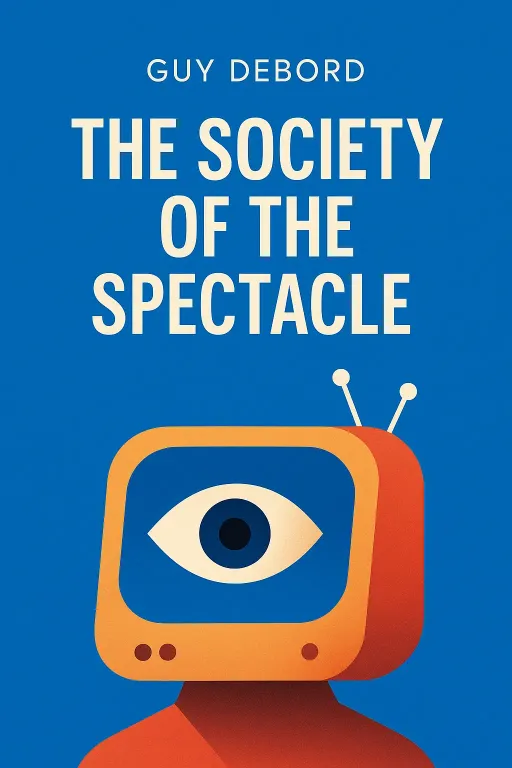
Nova: Exactly. And that is why we are diving into two brilliant, yet deeply unsettling, books today. We are looking at The Society of the Spectacle by Guy Debord, and China in Ten Words by Yu Hua.
Atlas: Two very different authors, but they share a common thread, right? They are both pulling back the curtain on how narratives are constructed.
Nova: They are. Guy Debord was a French philosopher and a founding member of the Situationist International. He wrote his masterpiece back in 1967, and he was essentially predicting the entire digital age we live in now. He argued that modern life had been replaced by a series of representations. We don't live; we view our lives.
Atlas: And then you have Yu Hua, who is one of China's most celebrated contemporary novelists. In China in Ten Words, he takes a completely different, much more visceral approach. He uses ten simple, common vocabulary words to dissect the rapid-fire economic and cultural changes in his country. He is looking at the human reality beneath the massive, state-sponsored spectacle of progress.
Nova: It is the perfect pairing. Debord gives us the philosophical framework for why we feel so disconnected, and Yu Hua gives us the concrete, human-scale reality check.
The Spectacle as a Filter
SECTION
Atlas: Let’s start with Debord. The term Spectacle gets thrown around a lot, but I want to make sure I am grasping the core of it. When he says modern life is mediated by images, does he just mean social media? Is he just a guy complaining about Instagram?
Nova: It is so much deeper than that. Debord wasn't just talking about digital screens. He was talking about the way the capitalist system turns our own lives into commodities. Think about it this way: when you go to a concert, are you experiencing the music, or are you experiencing the act of being at the concert?
Atlas: I see where you are going. It is the difference between eating a meal and taking a photo of the meal for others to see. The value shifts from the experience itself to the representation of the experience.
Nova: Precisely. Debord’s big insight was that the Spectacle is not just a collection of images. It is a social relationship between people that is mediated by images. When you look at your own professional ambitions, for example, how much of that drive is about the actual work, and how much is about the status, the title, or the external validation that the work provides?
Atlas: That hits home. For the listeners who are building their careers—the strategic architects in our audience—this is the trap. If you are chasing a promotion solely because of the title’s prestige, you are playing a game within the Spectacle. You are prioritizing the image of success over the substance of your daily life.
Nova: And here is the kicker: the Spectacle requires you to be passive. It wants you to be a spectator of your own life. It thrives when you are constantly comparing your internal reality to everyone else’s external projection.
Atlas: I have noticed this in professional environments. People will spend more time perfecting their LinkedIn presence or their internal branding than they do actually solving the hard, messy problems that move the needle. They are optimizing for the Spectacle.
Nova: It creates a feedback loop. The more you optimize for the image, the less satisfied you are with the reality. Because the image is always perfect, and reality is always flawed.
Atlas: So, if Debord is the diagnosis, how do we stop being spectators? Do we just delete everything and go live in a cabin? That does not seem like a sustainable strategy for someone trying to build wealth or influence.
Nova: That is the common trap. We think the only way out is total withdrawal. But the more effective strategy is to become a conscious participant. You have to start questioning the narrative you are being fed about what success looks like. You have to ask yourself: if no one could see my success, would I still be doing this?
Stripping Away the Gloss
SECTION
Atlas: That is a sharp pivot point. And that is exactly where Yu Hua’s work becomes so valuable. If Debord tells us we are living in a curated illusion, Yu Hua teaches us how to strip that illusion away. His book, China in Ten Words, is not a philosophical treatise. It is a series of stories.
Nova: And the power of his approach is the specificity. He picks words like Revolution, Disparity, or Bamboozle. He takes these abstract, often sanitized terms that get thrown around in news reports, and he attaches them to real, gritty, human experiences. He shows you what these words actually cost in terms of human suffering, joy, and resilience.
Atlas: I love that method. It is a masterclass in effective communication. If you want to cut through the noise of the Spectacle, you need to reclaim your own vocabulary. Most of us are walking around using words like "success," "hustle," or "productivity" without ever defining what they mean for us personally.
Nova: You are absolutely right. We let the Spectacle define our vocabulary. When we say we want to be "successful," we usually mean we want the version of success that the Spectacle has sold us. Yu Hua forces us to look at the raw data of reality. He shows us that behind every massive economic statistic, there is an individual person making a choice.
Atlas: This is vital for the Strategic Architect. When you are planning your future, you need to define your own terms. If you use the standard, media-fed definitions, you are going to end up with a standard, media-fed life.
Nova: Think about the word "Disparity," which Yu Hua explores. In the context of a booming economy, disparity is just a line on a graph. But in his stories, disparity is a family struggling to survive while the neighbor gets rich. He makes you feel the weight of that difference.
Atlas: It makes me wonder: what if we audited our own ambitions using this method? Take a word like "Productivity." Most people define it as "doing more things." But what if you used Yu Hua’s approach to define it as "doing the right things to build independence"? The whole strategy changes.
Nova: That is the breakthrough moment. When you start defining your own terms, you stop being a consumer of the Spectacle and you become the creator of your own reality. You are no longer measuring your life against a standard you did not choose.
Atlas: I can see how that shifts the entire mindset. It moves you from a state of constant, anxious comparison to a state of calm, deliberate action. You are not trying to win the game of the Spectacle; you are building your own game.
Nova: And that brings us back to the central tension. The Spectacle wants you to be a consumer of images. Authentic living requires you to be a producer of values. You have to actively choose what matters to you every single day.
Synthesis & Takeaways
SECTION
Atlas: We have covered a lot of ground here. We started with Debord’s warning about the Spectacle—this layer of representation that sits between us and our true lives. And we balanced that with Yu Hua’s technique of stripping away the gloss to find the raw, human truth.
Nova: The core of our podcast today is really an exploration of reclaiming your own agency. The Spectacle is not going away. It is getting stronger, faster, and more immersive. You cannot escape it, but you can build a filter.
Atlas: So, for the listener who wants to apply this today, here is the challenge. Take a look at your top three goals. Whether it is wealth, career, or skill-building. Ask yourself if those goals are yours, or if they are just the default goals projected by your environment.
Nova: And then, apply the Yu Hua filter. Take those words—success, growth, balance—and define them in your own terms. Not as abstract concepts, but as concrete, daily realities. What does "wealth" actually look like in your kitchen, in your commute, in your bank account, and in your stress levels?
Atlas: That is the difference between a life lived for an audience and a life lived for yourself. One is a performance; the other is a legacy.
Nova: It is the difference between being a character in someone else’s script and being the author of your own. When you stop performing, you finally have the energy to start building.
Atlas: That is a powerful place to end. We have the tools to look past the image and find the substance. I am definitely going to be auditing my own vocabulary this week.
Nova: I look forward to hearing how that shift changes your perspective. Thank you for joining us in this exploration of authenticity. This is Aibrary. Congratulations on your growth!