

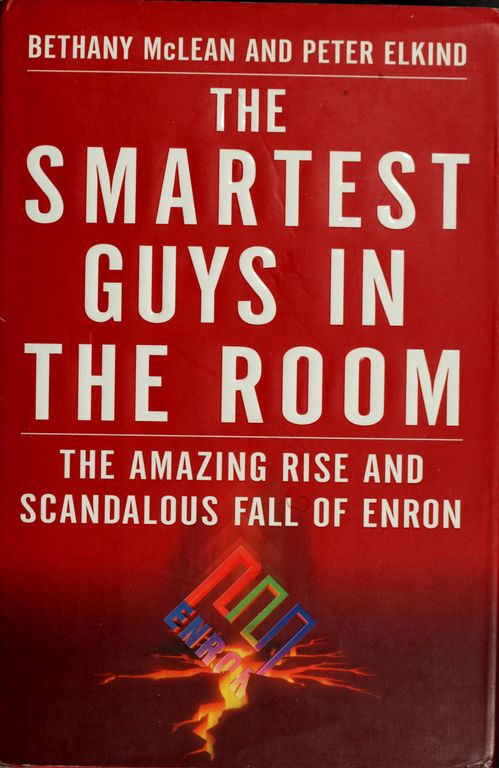
The Smartest Guys in the Room
The Irony of Genius: Introducing The Smartest Guys in the Room
The Irony of Genius: Introducing The Smartest Guys in the Room
Nova: Welcome to the show. Imagine a company so brilliant, so innovative, that it was named America's Most Admired Energy Company for six consecutive years. Now, imagine that same company collapsing into bankruptcy faster than you can say 'Special Purpose Entity,' wiping out billions in market value and the life savings of thousands of employees. That is the chilling story at the heart of Bethany McLean and Peter Elkind's definitive book, The Smartest Guys in the Room.
Nova: : That title alone is pure genius, Nova. It’s dripping with irony. They weren't just smart; they were lauded as the architects of the New Economy. What was the immediate hook for you when you first encountered the Enron story, before McLean even published her seminal work?
Nova: The sheer scale of the deception, and the fact that it was perpetrated by people who genuinely believed they were smarter than the rules, smarter than the regulators, and smarter than the journalists trying to figure them out. McLean’s research shows Enron went from the seventh largest corporation in America to dust in a matter of weeks. It wasn't just a business failure; it was a total moral and structural implosion.
Nova: : And the book makes it clear this wasn't some slow rot, right? It was a carefully constructed house of cards built on an aggressive, almost arrogant, corporate myth. Why is the book titled 'The Smartest Guys in the Room' if the ultimate outcome was so profoundly stupid?
Nova: Because that hubris was the engine of the fraud. They cultivated an environment where questioning the leadership—the 'smartest guys'—was seen as a sign of weakness or ignorance. McLean argues that the culture was the real problem, more so than any single accounting entry. It was a culture that rewarded aggressive risk-taking and punished anyone who dared to ask, 'But how are you actually making money?'
Nova: : So, we’re not just talking about a few bad numbers; we’re talking about a collective delusion fueled by ego. For our listeners who might only remember Enron as a headline, what is the single most important takeaway we need to grasp before we dive into the mechanics of the fraud?
Nova: That the fraud was fundamentally about narrative control. They sold a story of limitless growth, and as long as people believed the story, the stock price—and the executives' fortunes—kept climbing. The book is the autopsy of that narrative.
Key Insight 1: Culture as the Catalyst
The Cult of Innovation: Enron's Corporate Mythology
Nova: Let's start with the culture. McLean paints a picture of Enron as a high-octane trading floor where the mantra was 'Generate Earnings, No Matter What.' How did this culture manifest in the day-to-day operations?
Nova: : I recall reading that they had this intense performance review system, the 'rank and yank,' where the bottom 15% of employees were fired every cycle. That sounds like a recipe for internal sabotage and fear, not innovation.
Nova: Exactly. It created a hyper-competitive, cutthroat environment. If you weren't actively contributing to the immediate earnings number, you were a liability. This system effectively weeded out anyone who might have raised ethical red flags or focused on long-term, sustainable value. They were incentivized to play the short game.
Nova: : And this ties directly into the 'smartest guys' moniker. Ken Lay, the CEO, and Jeff Skilling, the architect of their trading empire, fostered this image. They weren't just energy traders; they were visionaries who had transcended the old rules of business. Is that what McLean means by the 'persuasive corporate myth'?
Nova: Absolutely. They convinced Wall Street, the media, and even themselves that they were a technology company, a broadband provider, a media company—anything but a boring old natural gas pipeline operator. This allowed them to justify astronomical valuations based on future potential, not current, verifiable profit.
Nova: : It’s like they were selling futures on things that didn't even exist yet. Did McLean find any evidence of people trying to push back against this narrative internally before the end?
Nova: She did. There were whispers, but they were quickly silenced. The book details how executives who were genuinely successful—those who built profitable, real businesses within Enron—were often marginalized because they weren't aggressive enough in their accounting maneuvers. The culture celebrated the illusion over the reality.
Nova: : So, the culture wasn't just a side effect; it was the necessary precondition for the accounting tricks to take hold. If you have a culture that demands impossible growth, the accounting will inevitably follow that demand.
Nova: Precisely. And this leads us directly to the tools they used to maintain that illusion. The mythology gave them the cover to deploy the most complex financial engineering imaginable. It was designed to be impenetrable to anyone outside the inner circle of 'smart guys.'
Nova: : It sounds like complexity was used as a weapon to keep auditors and investors at bay. Let’s talk about those weapons. What was the most insidious accounting trick they employed?
Nova: That would have to be the Special Purpose Entities, or SPEs. These were the ghosts in Enron's machine. They were shell companies, often run by Enron insiders, designed for one primary purpose: to keep debt off the main balance sheet and to hide losses from bad investments.
Nova: : I’ve heard the term SPE before, but how did Enron weaponize them? I thought SPEs were legitimate tools for risk management.
Nova: They are, but Enron abused them to an unprecedented degree. McLean highlights how they used entities like the infamous 'Raptors.' The Raptors were essentially used to 'hedge' against losses in Enron's volatile investments. But here’s the kicker: the Raptors were often collateralized with Enron stock. So, if the investments lost value, the Raptors lost value, and Enron had to inject more of its own stock to prop them up. It was a self-cannibalizing loop.
Nova: : Wait, so they were using their own stock, which was artificially inflated, to cover losses on other risky bets? That’s like using Monopoly money to pay off a real bank loan.
Nova: A perfect analogy. And the deeper problem, as detailed in the book, was that these SPEs weren't truly independent. They were controlled by Enron executives, which meant, under Generally Accepted Accounting Principles, Enron should have consolidated their debts onto their own books. They didn't. They hid billions in liabilities.
Nova: : And then there’s the other famous trick: Mark-to-Market accounting, especially for those long-term energy contracts. How did that work to inflate their earnings?
Nova: Mark-to-Market, or MTM, allows a company to book the from a long-term contract on the day the contract is signed, even if the cash won't arrive for years, or ever. For Enron, this meant they could sign a 20-year deal for a broadband network that hadn't even been built, and immediately claim the projected $100 million profit on their income statement. It was pure fantasy accounting.
Nova: : So, if the project failed a year later, they just had to find another massive deal the next day to replace that phantom profit. It created an insatiable need for constant, massive deal-making just to stand still.
Nova: Precisely. The system required perpetual motion. If the deal flow stopped, the earnings vanished, and the whole structure collapsed. McLean shows that by 2001, Enron was essentially running on fumes, propping up the SPEs with more and more stock, hoping the next big deal would save them.
Nova: : It’s staggering how sophisticated the deception was, yet how simple the underlying flaw was: they weren't making real money in their core businesses.
Nova: That’s the central tragedy. They had real assets, real employees, and real energy contracts. But the executives chose to focus all their brilliance on financial engineering rather than operational excellence. They were so busy trying to look smart that they forgot how to be sound.
Nova: : So, when did the outside world finally start looking past the glossy annual reports and the charismatic CEOs? What was the turning point that brought McLean into the spotlight?
Nova: That moment was March 5, 2001. Bethany McLean, writing for Fortune magazine, published an article titled, 'Is Enron Overpriced?' It sounds innocuous, but in the world of Enron, it was an act of journalistic defiance.
Nova: : I can imagine the executives must have been furious. What was the core of her argument in that piece that set off the alarm bells?
Nova: Her argument was simple and devastating: She couldn't figure out how Enron made its money. She looked at their earnings reports, and while they showed massive revenue, the actual cash flow didn't match the reported profits. She famously wrote that trying to understand Enron’s earnings was like trying to understand a black box. She didn't accuse them of fraud outright, but she questioned the fundamental logic of their valuation.
Nova: : That’s a masterclass in investigative journalism—asking the most basic, yet most threatening, question. How did the Enron leadership react to that specific article?
Nova: They tried to dismiss her, of course, calling her inexperienced or out of her depth. But the article resonated with a few skeptical analysts. It planted a seed of doubt in the market that the narrative was fragile. It was the first major crack in the facade that the rest of the media and regulators began to investigate.
Nova: : And once that seed was planted, how quickly did the whole thing unravel? The collapse felt incredibly fast from a public perspective.
Nova: It was a terrifying freefall. Once the SEC started a formal inquiry later that year, the confidence evaporated. The SPEs started to fail because they needed constant infusions of Enron stock, and the stock price was dropping. By December 2, 2001, Enron filed for Chapter 11 bankruptcy. From being the seventh largest company, it was over in less than a month of public panic.
Nova: : And what about the employees? The book doesn't shy away from the human cost, does it? That’s where the Ponzi scheme comparison becomes truly painful.
Nova: It’s the most heartbreaking part. McLean details how employees were heavily invested in company stock through their 401s, and they were actively discouraged from selling. In the final days, as the executives were cashing out, employees watched their retirement funds—money they had saved for decades—turn into worthless paper. The executives were looting the retirement funds to buy a little more time for their scheme to keep running.
Nova: : That’s the ultimate betrayal. The people who preached innovation and future wealth were actively stealing the present security of their workforce. So, after the dust settled, what was the fate of the 'smartest guys' who orchestrated this?
Nova: The reckoning was severe, though perhaps not severe enough for everyone. Jeffrey Skilling, the aggressive CEO, was eventually convicted of fraud and conspiracy. He pleaded guilty to some charges and was sentenced to decades in prison, though his sentence was later reduced.
Nova: : And what about Ken Lay, the founder and chairman? He always maintained he was misled by his subordinates.
Nova: Lay was also convicted on multiple counts of fraud and conspiracy. However, in a twist of fate that infuriated many victims, he died of a heart attack in July 2005, before he could be sentenced. He never faced the final legal consequences.
Nova: : It’s a common pattern in these massive frauds—the top figure often escapes the final judgment of the courts. Were there other key players who faced the music?
Nova: Yes. Andrew Fastow, the Chief Financial Officer and the architect of the SPEs, pleaded guilty and cooperated with prosecutors. He served a relatively short sentence compared to Skilling, which always sparks debate about whether cooperation yields too lenient a punishment for such widespread damage.
Nova: : And what about the auditors? Arthur Andersen, one of the Big Five accounting firms, was complicit in signing off on these fraudulent statements. What happened to them?
Nova: Andersen was effectively destroyed. They were convicted of obstruction of justice for shredding thousands of documents related to the Enron audit. While the Supreme Court later overturned that conviction, the damage was done. The firm lost its credibility, its clients fled, and it ceased to exist as a major entity. It’s a stark reminder that the enablers often suffer catastrophic consequences too.
Nova: : The fallout from Enron wasn't just about jail time for a few executives; it fundamentally changed how corporations are governed in the US, right? This is the legacy McLean explores.
Nova: Absolutely. The Enron collapse, alongside WorldCom, directly led to the Sarbanes-Oxley Act of 2002, or SOX. This legislation dramatically increased accountability for corporate executives regarding financial reporting accuracy. It mandated stricter internal controls and increased penalties for fraud. It was Congress’s direct, forceful response to the arrogance displayed by the 'smartest guys.'
Nova: : So, in a way, Enron’s failure forced the entire system to become more honest, or at least, more difficult to cheat openly. What does McLean suggest is the enduring lesson for today’s business leaders, given that we still see massive frauds, albeit in different forms, like FTX or others?
Nova: McLean consistently points out that the core issue remains the same: culture and narrative. She argues that SOX fixed many of the accounting loopholes, but it didn't fix the human desire to believe in a story that is too good to be true. The lesson is to always look for the cash flow, not just the projected earnings. If you can’t explain how a company makes money in simple terms, the complexity is likely a disguise, not innovation.
Nova: : It’s a powerful warning against worshipping perceived genius over verifiable substance. The book serves as a timeless cautionary tale about the dangers of unchecked ego in the pursuit of wealth.
Nova: It truly is. It teaches us that the smartest people in the room are often the ones who are most skilled at convincing everyone else that their flawed logic is actually visionary strategy. The true genius lies not in creating the illusion, but in having the courage to point out when the emperor has no clothes.
Nova: : A necessary, if infuriating, lesson for every generation of investors and business builders. Thank you, Nova, for guiding us through the wreckage of Enron with the clarity of The Smartest Guys in the Room.
Nova: My pleasure. Remember, skepticism is not cynicism; it is the essential tool for navigating complex financial landscapes. This is Aibrary. Congratulations on your growth!
Key Insight 2
The Reckoning and Lasting Regulatory Scars
Nova: Let's continue this deep dive into the aftermath. We touched on the executives, but I want to focus on the regulatory response. Sarbanes-Oxley, or SOX, was the direct legislative child of Enron and WorldCom. What specific changes did SOX impose that directly targeted Enron's methods?
Nova: : I always hear SOX mentioned in relation to compliance costs, but what was the direct fix for the SPE problem? Did it ban them outright?
Nova: Not entirely, because SPEs have legitimate uses. But SOX dramatically tightened the rules around consolidation. It forced companies to disclose much more clearly when they controlled an entity, even if they didn't own a majority stake. It made it exponentially harder to hide debt off-balance-sheet without full transparency. Enron relied on the ambiguity of the old rules; SOX closed those loopholes.
Nova: : And what about the executives themselves? Skilling got 168 months, which is 14 years, after his initial 24-year sentence was reduced. Does that feel like justice served for destroying thousands of pensions?
Nova: It’s a complex question McLean grapples with. For many victims, no sentence would ever feel adequate. Skilling was the operational genius, the one who pushed the trading culture. His conviction was crucial because it showed that even the 'visionaries' were not above the law. However, the fact that Lay died before sentencing, and Fastow got a reduced term for cooperation, leaves a lingering sense that the architects of the scheme avoided the full weight of accountability.
Nova: : It seems the system is better at prosecuting the operational fraud than the cultural rot that allowed it to flourish. Did McLean find any evidence that the culture of arrogance persisted even after the collapse, perhaps in other sectors?
Nova: That’s her recurring theme in her later work. She suggests that the —the belief that you can engineer reality through financial complexity—never truly disappears. It just migrates. She’s written extensively about the 2008 crisis, which she views as a spiritual successor to Enron, just with different financial instruments like mortgage-backed securities instead of energy contracts.
Nova: : So, Enron was the blueprint for the next wave of financial hubris. It proved that if you can convince the market you are indispensable and incomprehensible, you can get away with anything, at least for a while.
Nova: Exactly. The book is a masterclass in recognizing the warning signs of that hubris. It's not just about the accounting; it's about the language used. When a company starts talking exclusively about 'asset optimization,' 'synergies,' and 'disrupting the paradigm' without ever mentioning tangible products or services, McLean suggests you should start looking for the Raptors hiding in the shadows.
Nova: : That’s a fantastic, actionable takeaway for our listeners. Look past the jargon to the cash flow. It brings us full circle to the title: they were the smartest guys in the room only until someone asked a simple, honest question. And that someone was Bethany McLean.
Nova: She didn't need a complex financial model; she needed the courage to say, 'I don't understand this, and that's a problem.' That single act of journalistic skepticism brought down one of the most powerful entities in American history. It’s a testament to the power of clear, persistent inquiry over manufactured complexity.
Nova: : A truly essential read for anyone interested in business ethics, finance, or just the anatomy of a spectacular downfall. Nova, thank you for this deep dive into The Smartest Guys in the Room.
Nova: Thank you for exploring this crucial piece of financial history with me. This is Aibrary. Congratulations on your growth!
Conclusion: The Enduring Lesson of Narrative Control
Conclusion: The Enduring Lesson of Narrative Control
Nova: We’ve traced Enron’s journey from the darling of Wall Street to a cautionary tale etched into financial law. The key insights from McLean and Elkind's work are threefold: First, the culture of arrogance and the rewarding of short-term earnings created the environment for fraud. Second, the mechanics, particularly the SPEs and Mark-to-Market accounting, were sophisticated tools designed to obscure debt and fabricate profit.
Nova: : And third, and perhaps most importantly, the collapse was triggered not by a sudden discovery of a hidden ledger, but by a simple, persistent question posed by a journalist: 'How do you actually make money?' That moment shattered the corporate myth.
Nova: That’s the actionable takeaway for everyone listening. Whether you’re an investor, an employee, or a business owner, never let complexity become a shield for accountability. If the story sounds too good to be true—if the growth seems disconnected from tangible value—it probably is. The smartest guys in the room are often just the best storytellers.
Nova: : It’s a powerful reminder that integrity is the only true hedge against market volatility. Thank you for breaking down this monumental scandal for us today.
Nova: It’s a story that demands retelling. This is Aibrary. Congratulations on your growth!