

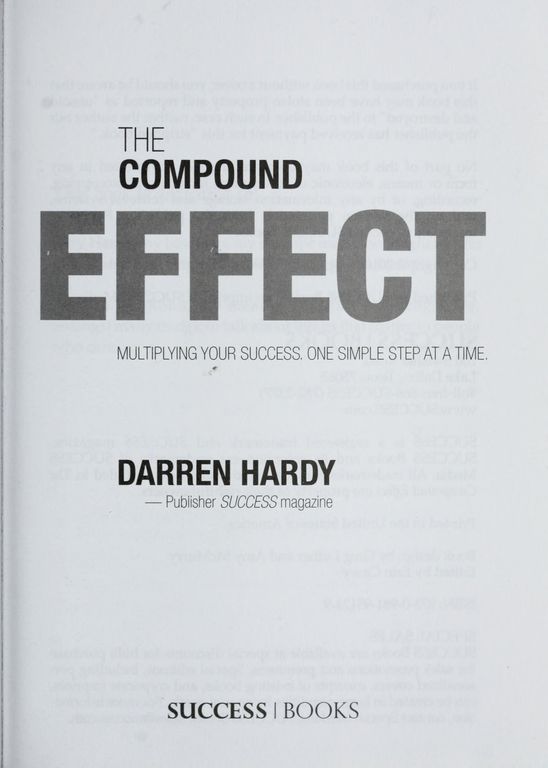
The Compound Effect: Small, Consistent Actions, Massive Results
Golden Hook & Introduction
SECTION
Nova: Atlas, quick question for you. What's one thing that you know, intellectually, is true, but your instincts often try to argue against?
Atlas: Oh, that's a good one, Nova. Immediately, I think of something like... the fact that a single drop of water can eventually carve a canyon. My brain gets it, but my gut is like, "Come on,? Really?" It feels too small to be meaningful.
Nova: Exactly! That gut feeling, that skepticism about the power of the small, is precisely what we're tackling today. We're diving into a pair of books that fundamentally challenge that instinct: Darren Hardy's and Jeff Olson's. Both are absolute cornerstones of personal development, published within a few years of each other, and they basically lay out the blueprint for how those tiny, almost invisible actions, when stacked daily, can create truly monumental shifts.
Atlas: That's a perfect way to put it. It’s funny, you hear 'compound effect' and you immediately think finance, right? Like interest on your money. But these authors took that concept and blew it wide open. Hardy, for instance, had this amazing career, rising through entrepreneurship, and he started noticing these patterns in successful people – it wasn't about grand gestures, but these mundane, repetitive things. He wrote almost as a distillation of those observations, a practical guide for anyone who felt stuck or wanted to accelerate progress. It was a huge hit precisely because it made that abstract financial concept deeply personal.
Nova: Absolutely. And Olson's reinforces that, almost as a philosophical companion. He points out that the difference between success and failure often isn't a massive gap, but a 'slight edge' – those seemingly insignificant choices that are easy to do, but also easy to do. Both books have been incredibly influential, widely acclaimed for their accessible wisdom, even if some critics initially dismissed them as 'common sense.' But as we know, common sense isn't always common practice.
Atlas: That's the truth! And for anyone who's a 'doer,' a 'builder,' someone who values tangible impact and mastering their craft, this isn't just theory. This is the operating manual.
The Unseen Force of Incremental Progress: The Compound Effect vs. The Slight Edge
SECTION
Nova: So let's really dig into this unseen force, this almost stealthy power of incremental progress. Hardy and Olson both argue that our culture is obsessed with the 'big bang' – the overnight success, the lottery win, the dramatic transformation. But the reality is far more subtle, and frankly, a lot more powerful.
Atlas: Yeah, I think that's why my gut pushes back. We're wired for immediate gratification, right? We want to see the results. If I do one small positive thing today, like read one page of a book, my life isn't suddenly transformed. It's easy to dismiss that single page as meaningless.
Nova: Precisely. And that's where the magic, or the danger, lies. Hardy gives this brilliant example of three friends. All start at the same place, earning the same amount, with similar habits. Friend A makes no changes. Friend B makes a few small, negative choices – eats 125 extra calories a day, watches an hour more TV. Friend C makes a few small, positive choices – reads 10 pages of a good book, listens to 30 minutes of educational audio, walks a little more.
Atlas: Okay, I'm already seeing where this is going. In the first few weeks, maybe even months, you probably wouldn't notice any difference between them. They'd all look pretty much the same.
Nova: Exactly! For the first 18 months, their lives are virtually identical. No one's getting rich, no one's getting fat. It's imperceptible. But then, around month 25, the tiny differences start to show. By month 31, Friend B is noticeably overweight and unhappy, while Friend C is fit, got a promotion, and is thriving in relationships. The gap becomes enormous. The small choices didn't create a difference; they into one.
Atlas: Wow, that's such a clear illustration. It highlights how deceptive the early stages are. It's like trying to watch grass grow. You know it's happening, but you can't see the individual blades getting longer. And that's why it's so easy to fall off track, isn't it? Because you don't see the immediate reward.
Nova: It is. Olson calls it the 'slight edge.' These positive actions are easy to do, but they're also easy to do. Skipping that one page, eating that one extra cookie – it feels harmless in the moment. The consequences are so delayed, so diluted, that our brains don't connect the action to the outcome. It's the cumulative effect of those small, seemingly insignificant decisions that creates momentum, either positive or negative.
Atlas: I can definitely relate to that. For anyone who's ever tried to learn a new skill or build something from scratch, that initial period is brutal because the progress is so slow. It's hard to stay motivated when you're not seeing immediate returns. But then, suddenly, you realize you're fluent in another language or you've completed a complex project, and you can't pinpoint the exact moment it clicked. It was just the small daily practice, wasn't it?
Nova: That's the power. And it's not just about what you, but also what you. Eliminating one small negative habit, like mindless scrolling for 15 minutes a day, and replacing it with something productive, like planning your next day, can have a profound impact over a year. That's hours reclaimed, stress reduced, and clarity gained. It's the silent force that either works for you or against you.
Architecting Your Future: Intentional Application of the Compound Effect
SECTION
Atlas: So, if the compound effect is this unseen force, how do we, as people who like to build and fix and create, intentionally harness it? It sounds like it requires a massive shift from our 'big bang' mentality.
Nova: It absolutely does. And this is where the practical genius of these books comes in. It's about architecting your future, not just passively hoping for it. It starts with identifying one tiny, positive action related to a 'next destination' you have. For someone like you, who's driven by connection and mastering crafts, let's think about your 'Next Destination' of effective communication.
Atlas: Okay, effective communication. That's huge. It's not just about what I say, but how I listen, how I build rapport. It impacts everything from my professional projects to my most important relationships.
Nova: Exactly. So, an example of a tiny step could be: every day for a week, you commit to listening actively to one person for just five uninterrupted minutes, without formulating your response. Or, sending one thoughtful, personalized message to a connection instead of a generic 'like' on social media. It sounds small, almost negligible.
Atlas: That's the catch, isn't it? It's so easy to do, but also so easy to dismiss. But if I did that consistently, let's say I chose the active listening one. Over time, I'd probably notice my relationships deepening, I'd understand people better, and my own communication would become more precise because I'd be more attuned. I'd be building emotional intelligence, another one of those 'next destinations.'
Nova: Precisely! You're connecting the dots. It's about recognizing that every small, consistent effort you put into your craft, your relationships, and your self-growth is an investment with exponential returns. Think about time management strategies, another one of your goals. Instead of trying to overhaul your entire schedule, what if you just dedicated 15 minutes daily to quiet contemplation, observing your thoughts, as a way to build focus and reduce stress?
Atlas: Huh. That's actually really interesting. I'm always 'doing,' always moving. Dedicating 15 minutes to doing anything, just observing, feels almost counter-intuitive for someone who's always building. But I can see how that small, consistent mental 'pause' could compound into greater clarity, better decision-making, and ultimately, more effective use of my time. It's like sharpening the saw, but for my mind.
Nova: Exactly! It's not about grand gestures or superhuman effort. It's about the relentless consistency of small, smart choices. The compound effect works in silence, in the background, until suddenly, you look up and realize you've built something incredible, or you've become someone new, simply by stacking those tiny, positive decisions day after day after day.
Atlas: That makes me reflect on areas where I've seen it play out negatively, too. Like, one skipped workout, one unhealthy meal, one procrastinated task. Individually, they're nothing. But string them together, and suddenly you're out of shape, feeling sluggish, and buried under a mountain of work. It really is a double-edged sword.
Synthesis & Takeaways
SECTION
Nova: And that's the profound insight here, Atlas. The compound effect isn't some mystical force; it's a fundamental law of the universe. It's always operating, either for us or against us. The key is to become aware of it and then intentionally direct it. It's the difference between drifting and designing your life.
Atlas: So, it's not about finding the one big hack or the magic bullet. It's about embracing the mundane, the consistent, the almost boring daily actions, and trusting that they will add up to something extraordinary. It's about respecting the process, even when the immediate results aren't visible.
Nova: Absolutely. And for our listeners, especially those who are constantly building, fixing, and connecting, the power lies in recognizing that your consistent effort, even in the smallest forms, is never wasted. It's an investment, and the dividends are guaranteed, as long as you stay the course. It’s about understanding that success isn't an event, it's a process, a daily rhythm of tiny, positive choices.
Atlas: That's actually really inspiring. It takes the pressure off needing to be perfect and puts the focus on simply showing up, consistently. It gives me a clear path forward for those 'next destinations' – effective communication, emotional intelligence, time management. It's not about a huge leap, but a series of tiny, deliberate steps.
Nova: And that's why these books have resonated with so many people. They offer a simple, powerful truth that cuts through all the noise of quick fixes. Start small, stay consistent, and let time do the heavy lifting.
Atlas: This is Aibrary. Congratulations on your growth!