

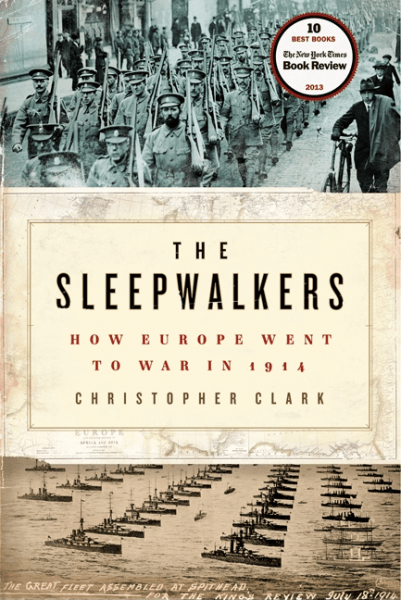
The Sleepwalkers
Introduction
Nova: Imagine this. It's 2 a. m. on June 11, 1903, in Belgrade. Twenty-eight Serbian army officers storm the royal palace, hunt down their king and queen who are hiding in a tiny closet behind the queen's ironing board, and butcher them — bullets, bayonets, an axe — before tossing their mutilated bodies off the royal balcony. Eleven years later, the same conspiratorial network that organized that regicide would orchestrate the assassination of Archduduke Franz Ferdinand in Sarajevo, setting in motion a chain of events that would kill 20 million people. That's the opening scene of Christopher Clark's masterwork, The Sleepwalkers: How Europe Went to War in 1914.
Nova: : That's a hell of an opening. But wait — the title is The Sleepwalkers. That suggests these leaders didn't know what they were doing. Is that really the argument? That the men who started the Great War were just... stumbling around in the dark?
Nova: That's exactly the provocative question at the heart of this book. Clark's central metaphor is that the protagonists of 1914 were "sleepwalkers — watchful but unseeing, haunted by dreams, yet blind to the reality of the horror they were about to bring into the world." They weren't innocent. They weren't passive. But they fundamentally failed to grasp the catastrophic consequences of their own decisions.
Nova: : So this is a 700-page book that essentially says: nobody meant to start World War I, but everybody's choices made it happen anyway. That sounds almost more terrifying than the idea of a single villain.
Nova: It is. And that's why this book became an international sensation — selling over 350,000 copies in Germany alone — and why it's still one of the most debated history books of the 21st century. Today we're diving into The Sleepwalkers: what Clark argues, why it's so controversial, and what it tells us about how great powers stumble into catastrophe.
How a Remote Corner of Europe Became the Epicenter
The Balkans as the Fuse
Nova: Most histories of World War I start in Berlin or Vienna or London. Clark does something radically different — he starts in Belgrade. The book's first section, called "Roads to Sarajevo," argues that if you want to understand how the war started, you have to understand the Balkans.
Nova: : So Clark is basically saying: the real origin story isn't about German militarism or the alliance system. It's about what was happening in Serbia.
Nova: Exactly. And he begins with that gruesome 1903 regicide I mentioned. The king and queen of Serbia — Alexander and Draga — were brutally murdered by a group of army officers. The ringleader was a man named Dragutin Dimitrijević, code-named Apis, which means "the Bull" — a reference to his physical build. Apis would go on to become the head of Serbian military intelligence and the founder of the Black Hand, the secret terrorist network that trained and armed the assassins who killed Franz Ferdinand.
Nova: : So there's a direct line from the regicide in 1903 to Sarajevo in 1914. That's almost like a crime thriller — the same guy, Apis, is at the center of both. But why does Clark think this matters so much for understanding the war?
Nova: Because it reframes the entire moral and political landscape. The standard narrative for decades was that Austria-Hungary was a bullying empire and Serbia was a plucky little victim. Clark shows that Serbia was, in many ways, a rogue state — a violently expansionist, irredentist power whose intelligence services ran terrorist operations across the border. Serbia dreamed of a "Greater Serbia" that would unite all South Slavs, and that meant tearing apart Austria-Hungary.
Nova: : That's a pretty uncomfortable picture, especially given how we tend to think about small nations versus empires. Was Clark criticized for this portrayal?
Nova: Absolutely. Some critics, particularly from the Balkans, argued that Clark's framing was too sympathetic to Austria-Hungary. But Clark's point isn't to exonerate Vienna. It's to show that the Balkans weren't just a passive powder keg waiting for a spark — they were actively generating the sparks. And the great powers, by tying themselves to these volatile local actors, created a system where a regional crisis could become a continental war.
The Alliance System and the Crisis of Masculinity
One Continent Divided
Nova: The second part of the book zooms out to the whole European chessboard. Clark examines the domestic politics, foreign policies, and alliance structures of every major power — and he finds something that should make us deeply uncomfortable: the system wasn't just fragile. It was actively being destabilized by the very people who were supposed to be managing it.
Nova: : What do you mean by that? Weren't these alliances supposed to create stability through balance of power?
Nova: In theory, yes. In practice, the alliances created what Clark calls a "bipolar" Europe where every local conflict immediately became a test of great-power credibility. But here's the really unsettling part Clark highlights: many of these decision-makers weren't just calculating national interests. They were operating from something much more primal. Clark suggests the European elites were suffering from a "crisis of masculinity."
Nova: : Wait — a crisis of masculinity? Tell me you're not saying World War I happened because a bunch of generals felt insecure about their manhood.
Nova: I'm not saying it — Clark is suggesting it as a real factor. He points to how statesmen and generals across Europe were obsessed with proving their "virility" in battle. They saw war as a test of national and personal character. The rise of previously marginalized groups — working-class men, non-white populations in the colonies — made these aristocratic elites feel threatened. War became a way to reassert dominance.
Nova: : That's wild. So you have these guys in frock coats and medals, and underneath all the diplomatic language, they're basically thinking: "If I back down, I look weak — and looking weak is worse than war."
Nova: That's exactly the dynamic. Clark quotes one particularly revealing moment: Kaiser Wilhelm II, when an official urged calm after Sarajevo, snapped back, "Stop this nonsense! It was high time a clean sweep was made of the Serbs." That's not a calculated strategic assessment. That's a man who feels personally disrespected and wants to prove something. And across Europe, you see this same pattern — leaders who had taken risks before without catastrophic consequences, now convinced they could do it again.
Thirty-Seven Days That Remade the World
The July Crisis
Nova: The final third of the book is a day-by-day, sometimes hour-by-hour, reconstruction of the July Crisis — the 37 days between the assassination on June 28 and the outbreak of general war on August 4. And this is where Clark's argument really crystallizes.
Nova: : Let me set the stage. Archduke Franz Ferdinand is killed in Sarajevo. Austria-Hungary is furious and wants to punish Serbia. But why does that local conflict become a world war?
Nova: Clark's answer is: because every single power made a choice that, in isolation, seemed defensible, but in combination created an unstoppable cascade. Austria-Hungary decided it had to crush Serbia to survive as an empire. On July 5, Germany gave Austria what became known as the "blank check" — unconditional support, even if it meant war with Russia.
Nova: : That blank check sounds like a pretty big deal. If Germany hadn't given it, would Austria have acted?
Nova: Probably not with the same confidence. But here's where Clark complicates the story. He argues that Russia was the first great power to actually order general mobilization. The Russians started moving troops and equipment to the German front a full week before Germany declared war on them. The first Russo-German clash happened on German soil, not Russian — because Russia had already invaded East Prussia.
Nova: : So Clark is saying the traditional timeline — Germany declares war, therefore Germany started it — is misleading. The Russians were already mobilizing, which in 1914 was essentially an act of war.
Nova: Exactly. Mobilization wasn't a warning shot. In the early 20th century, mobilization meant you were launching an invasion. The railroads, the timetables, the logistics — once you started, you couldn't stop. And Clark shows that Russia's decision to mobilize was not a defensive reaction to German aggression. It was a deliberate choice to support Serbia, come what may, even knowing it risked a general European war.
Nova: : What about France and Britain? Where do they fit in Clark's picture?
Nova: France, Clark argues, did not restrain Russia. In fact, French leaders positively encouraged Russia to face down the Germans. They wanted a strong ally against Germany and were willing to risk war to keep that alliance. As for Britain, Foreign Secretary Sir Edward Grey tried to mediate — he proposed a four-power conference — but Clark portrays these efforts as somewhat "half-hearted" and too late. By the time serious diplomacy got going, the military machines were already in motion.
Nova: : So the picture is: Austria wants a local war to punish Serbia. Germany backs Austria, knowing it risks war with Russia. Russia mobilizes to support Serbia, knowing it risks war with Germany. France encourages Russia, knowing it risks a general war. And Britain tries to mediate but can't stop the momentum. Nobody wanted the big war, but everybody kept taking steps that made it more likely.
Nova: That's Clark's argument in a nutshell. And he emphasizes that none of this was inevitable. At multiple points, different decisions could have been made. The tragedy is that the system — the alliances, the military plans, the culture of honor and prestige — made it almost impossible for anyone to step back.
Why This Book Became a Political Event
The Fischer Thesis and the German Firestorm
Nova: Now we need to talk about why The Sleepwalkers wasn't just a bestseller — it was a political event, especially in Germany. To understand that, you have to know about the Fischer thesis.
Nova: : I've heard that name. Fritz Fischer — he was the German historian who argued in the 1960s that Germany was primarily responsible for World War I, right?
Nova: Exactly. Fischer's 1961 book, Germany's Aims in the First World War, argued that Germany had deliberately sought war to achieve European hegemony. It was explosive. It shattered the post-war German consensus that "we all slithered over the brink" and forced Germans to confront the idea that their country bore primary guilt. Fischer was practically vilified in Germany — his own colleagues attacked him, the government tried to block his lecture tours.
Nova: : So for fifty years, the dominant narrative was: Germany started it. And then along comes Christopher Clark, an Australian historian teaching at Cambridge, who writes a 700-page book saying: actually, nobody started it — everyone sleepwalked into it.
Nova: And you can see why that would be, let's say, warmly received in Germany. The book sold 350,000 copies there. It became a cultural phenomenon. German foreign minister Frank-Walter Steinmeier invited Clark to be the keynote speaker at a major event. The book seemed to offer Germans something they had been denied for generations: a way to think about 1914 without the crushing burden of singular guilt.
Nova: : But not everyone was celebrating, right? I read that some German historians were pretty critical.
Nova: Fiercely critical. Hans-Ulrich Wehler, one of Germany's most eminent historians, accused Clark of "eliminating with bewildering one-sidedness" evidence of German responsibility. He said the book's success in Germany reflected a "deep-seated need" among Germans to free themselves from the burdens of war guilt. Another historian, Annika Mombauer, directly challenged the "sleepwalker" metaphor — she argued that the decision-makers in Berlin and Vienna were not blind or unaware. They made conscious, deliberate choices to pursue war rather than diplomacy.
Nova: : So the debate is: were they sleepwalkers, or were they wide awake and just didn't care about the consequences?
Nova: That's the core of the controversy. And there's an even deeper layer. Some critics, like the political scientist Vernon Bogdanor, point out that Clark downplays the multiple mediation offers that were rejected — not just by Germany and Austria, but specifically rejected. Grey proposed a four-power conference. Russia accepted it. Austria and Germany said no. Russia even proposed taking the dispute to the international court of arbitration in The Hague. Again, Germany and Austria said no. If you're looking for who closed off the diplomatic off-ramps, the answer keeps pointing toward Berlin and Vienna.
Nova: : So Clark's critics say he's not wrong about the complexity, but he's too eager to spread the blame evenly when some actors clearly pushed harder for war than others.
Nova: That's a fair summary. And Clark himself has pushed back, saying he's not trying to exonerate anyone — he's trying to show that the question "who started it?" is the wrong question. The right question is: how did a system of great powers, all of whom thought they were acting rationally, produce such an irrational outcome?
Conclusion
Nova: So where does The Sleepwalkers leave us? Clark's book is, at its heart, a warning. A warning about how great powers, even when they're not seeking catastrophe, can stumble into it through a combination of rigid alliances, military plans that take on a life of their own, and leaders who are more afraid of looking weak than of the actual consequences of war.
Nova: : And that's what makes this book feel so relevant right now. When Clark was asked in 2022 whether people should compare the Ukraine invasion to World War I, he actually pushed back hard. He said: don't use my book as a template for 2022. The situations are fundamentally different. But the underlying dynamic — great powers taking risks, misreading each other, letting local conflicts escalate — that feels uncomfortably familiar.
Nova: It does. And one of the most fascinating and troubling aspects of the book's reception is how it was instrumentalized. Some German commentators used Clark's argument to say: see, Germany wasn't uniquely guilty in 1914, so why should Germany be constrained within the European Union today? Clark himself was horrified by this. He said he never intended his book to be used as a political weapon.
Nova: : Which is a lesson in itself, isn't it? Once you put a 700-page history book into the world, you don't control how people read it or what they do with it.
Nova: Exactly. And that's why The Sleepwalkers is more than just a book about 1914. It's a book about how we think about responsibility, about how we tell stories about the past, and about how those stories shape the present. Clark's central insight — that the leaders of 1914 were "watchful but unseeing" — is not just a description of them. It's a question for us. What are we watching? And what are we failing to see?
Nova: : That's the real challenge of this book. It doesn't let you off the hook with a simple answer. It forces you to sit with the complexity and the contingency and the sheer human failure of it all. And then it asks: are we any different?
Nova: This is Aibrary. Congratulations on your growth!