

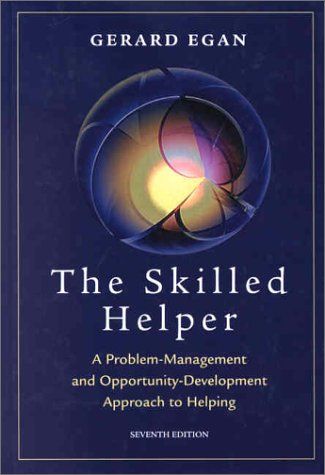
The skilled helper
A Problem-Management and Opportunity-Development Approach to Helping
Introduction
Nova: Imagine walking into a therapist's office for the first time. You have a problem, maybe several, but you can barely articulate what's really wrong. Now imagine the person across from you doesn't just nod and say "tell me how that makes you feel," but actually has a clear, structured roadmap to help you find your way. That's the revolution Gerard Egan started in 1975 with a book called The Skilled Helper.
Nova: : And here's a wild fact that caught my attention in preparing for this: Egan's book has gone through eleven editions and is considered the single most widely used counseling textbook on the planet. We're talking about a book that has shaped how tens of thousands of counselors, social workers, and helping professionals approach their work across four decades.
Nova: Exactly. And what's remarkable is that Egan wasn't trying to create a new school of therapy. He was a clinical psychology professor at Loyola University of Chicago who noticed something practical: his students needed a framework. They were drowning in theory but starving for actionable skills. So he built a model that was integrative, skills-based, and relentlessly practical.
Nova: : And today we're diving deep into that model. The three stages, the nine steps, the famous SOLER framework, and yes, even what Egan called "the shadow side of helping" — all the ways that helpers, despite their best intentions, can actually do harm.
Nova: So whether you're a therapist, a coach, a manager, or just someone who wants to be better at helping the people in your life, this one's for you. Let's get into The Skilled Helper.
Nova: : Let's go.
Origins of The Skilled Helper
The Man Behind the Model
Nova: So let's start with Gerard Egan himself. He was born in Chicago in 1930 and spent his career at Loyola University, where he became Professor Emeritus of Organization Development and Psychology. And here's the interesting part: he wasn't just a clinical psychologist. He was also deeply involved in organizational development, which means he was thinking about human problems not just inside a therapy room but inside companies, institutions, entire systems.
Nova: : That's a really important detail, because it explains something I noticed right away about his model. It feels almost like a business framework applied to personal problems. There's something very structured, very almost project-management-like about it.
Nova: That's perceptive, and it's actually central to how Egan thought. He was teaching clinical psychology when, as researcher Pete Sanders describes it, the germs of his approach started to grow. Egan began to believe that the problems people experienced were more to do with external factors — their family, work, and culture — rather than purely internal psychological dynamics.
Nova: : So he was pushing back against the idea that all problems live inside a person's head?
Nova: Yes. And that was a significant departure. The dominant model at the time was Carl Rogers' person-centered therapy, which Egan deeply admired. He incorporated Rogers' core conditions — empathy, congruence, and unconditional positive regard — into his own work. But he felt they weren't sufficient on their own. He wanted to add structure, skills, and a problem-management framework.
Nova: : And this created some tension in the therapeutic community, right? I was reading that purist person-centered therapists have actually excluded Egan's model from their canon altogether.
Nova: They have. Pete Sanders, a well-known figure in person-centered circles, explicitly excluded Egan's approach from his mapping of person-centered therapies, arguing that it violates practically all the principles and shares none of the underlying theory of personality or change. It's a fascinating divide. But Egan wasn't trying to be a card-carrying Rogerian. He called his approach a "developmental or systematic eclecticism." He was borrowing from Rogers, from Robert Carkhuff's work on empathy scales, from cognitive behavioral traditions, and frankly from common sense.
Nova: : So he was a pragmatist. And that pragmatism produced the three-stage model that is now taught in counseling programs around the world.
Nova: And here's a stat that underscores the reach: the 11th edition came out in 2018, co-authored with Robert J. Reese, and it's the culmination of more than forty years of refinement. That's staying power most psychology books can only dream of.
A Roadmap for Change
The Three-Stage Framework
Nova: Let's unpack the heart of the book: Egan's three-stage model. It's elegantly simple in concept but remarkably detailed in execution. Egan structured it around three fundamental questions that any person in distress needs to answer.
Nova: : I love that framing. What are the questions?
Nova: Stage One asks: What is going on? Stage Two asks: What do I want instead? And Stage Three asks: How might I get to what I want? Three questions. Three stages. But each stage has three substeps, so you're looking at a nine-step helping process.
Nova: : That nine-step structure is where things get interesting. Walk me through Stage One.
Nova: Stage One is about exploration. Step I-A is helping clients tell their stories. This is where the Rogerian core conditions really shine — empathy, active listening, creating a safe space. Then Step I-B is crucial and often overlooked: helping clients break through blind spots. These are the things clients cannot see about themselves or their situations, the self-deceptions, the overlooked patterns. Finally, Step I-C is about leverage — helping clients choose the right problems to work on, not just the most obvious ones.
Nova: : The concept of leverage really stands out here. Egan seems to be saying: don't just address whatever the client brings up first. Be strategic.
Nova: Exactly. Feltham and Dryden, in their Dictionary of Counselling, define leverage as a position from which it's possible to effect change. Egan believed the search for leverage was a crucial aspect of the counseling process. He framed it through positive psychology — the idea that you challenge a client's strengths, not just their weaknesses. Pointing out to clients the assets and resources they have but fail to use.
Nova: : So Stage One is about deep exploration and focusing. Stage Two then shifts to goal-setting?
Nova: Yes. Stage Two is about building what Egan called "the preferred picture." Step II-A: help clients use their imaginations to spell out possibilities for a better future. Step II-B: help them choose realistic and challenging goals. And Step II-C: help them find the incentives that will make them commit to change.
Nova: : I'm noticing something here. Egan uses the word "help" in every single step. "Help clients tell their stories." "Help clients set goals." It's baked into the language of the model. This isn't about the therapist doing things to the client.
Nova: That's a brilliant observation and it's absolutely intentional. The helper is a facilitator, not an expert who imposes solutions. Egan was adamant about this. The client retains ownership. The helper provides structure, skills, and support — but the client does the work.
Nova: : And then Stage Three is action.
Nova: Stage Three is where the rubber meets the road. Step III-A: help clients brainstorm possible actions — there are always multiple ways to achieve a goal. Step III-B: help them choose best-fit strategies by evaluating pros and cons. Step III-C: help them craft a concrete plan. Egan also emphasized what he called "the action arrow" — a reminder that all nine steps revolve around planning for change, but eventually you need results-producing action.
Nova: : One thing I want to highlight is the SMART goals framework embedded in Stage Two. Egan explicitly encourages goals that are specific, measurable, achievable, realistic, and time-bound. That's language you hear in corporate boardrooms, not therapy couches. And yet it makes so much sense.
Nova: It does. And it reveals Egan's organizational development background. He saw problem management as a transferable skill set. Whether you're dealing with anxiety, career confusion, or a failing marriage, the process of clarifying the problem, setting goals, and taking action is fundamentally the same.
The Non-Verbal Foundation
SOLER and the Power of Presence
Nova: There's a concept from The Skilled Helper that has taken on a life of its own far beyond the book. It's called SOLER. And it's about something incredibly simple but profoundly important: how the helper physically shows up in the room.
Nova: : I've actually encountered SOLER in completely different contexts — coaching, management training, even customer service workshops. It's become one of those ideas that escaped its original container.
Nova: It really has. SOLER is an acronym Egan developed to describe the non-verbal micro-skills of attending. S stands for facing the client Squarely. Not head-on in a confrontational way, but oriented toward them. O is for adopting an Open posture — no crossed arms, no barriers. L is for remembering that it's possible at times to Lean toward the other person, which conveys engagement.
Nova: : E is eye contact, I assume?
Nova: Yes — maintaining good eye contact. And R is for trying to be relatively Relaxed or natural in these behaviors. Egan believed deeply that first impressions are lasting impressions and that establishing a sound therapeutic relationship from the start was vital to success. He argued that you could master all the verbal techniques in the world, but if your body language communicated disinterest or judgment, none of it would matter.
Nova: : It sounds almost too basic. Face someone, don't cross your arms, make eye contact, lean in, relax. But when you think about it, how many conversations have you had where the other person is looking at their phone, or their arms are crossed, or they're physically turned away?
Nova: Exactly. And Egan's point was that these aren't just nice-to-have social graces. They are core therapeutic skills. They communicate empathy before you've said a single word. They establish safety. And they're especially important in cross-cultural contexts, where verbal communication styles may differ significantly.
Nova: : Interestingly, the SOLER model has also evolved over time. Some critics have noted that direct eye contact, for instance, can be culturally inappropriate in certain contexts — some Asian and Indigenous cultures may perceive it as aggressive or disrespectful.
Nova: That's a valid critique and one that later editions of the book have grappled with. The broader principle, though, is about intentional presence. Showing up in a way that communicates: I am here with you, I am listening, and this matters.
When Helpers Do Harm
The Shadow Side of Helping
Nova: One of the most sobering and, I think, most valuable contributions Egan made was his concept of the shadow side of helping. He dedicated significant attention across multiple editions to the idea that helping professions have a dark underbelly.
Nova: : This is the part of the book that really grabbed me. Most counseling textbooks focus on what to do right. Egan looked squarely at what can go wrong.
Nova: And he broke the shadow side into two categories. First, the downside — helpers who are simply not competent. They lack the skills, they rely on outdated methods, they don't continue learning. And second, something more troubling: helpers who use the helping relationship to meet their own needs rather than the client's. This can range from subtle — needing to feel important or powerful — to the outright unethical and abusive.
Nova: : Egan also warned about something he called the shadow side of helping models themselves — the idea that any framework, including his own, can become a rigid box rather than a flexible guide. When helpers apply a model mechanically rather than thoughtfully, they can do real damage.
Nova: Yes. He was remarkably self-aware about this. He didn't present The Skilled Helper as a universal solution. He explicitly acknowledged its limitations. For example, the model has been criticized for being overly rational. Critics argue it assumes clients can think clearly about their problems, set goals, and make plans — which is a tall order when someone is in the grip of severe depression, trauma, or psychosis.
Nova: : And there's a cultural critique that's worth exploring. Researchers Ashencaen Crabtree and Baba have argued that Western counseling modalities, including Egan's, focus heavily on the individual — on personal goals, personal agency, personal change. But in many cultures, people see themselves primarily as members of a wider community and prioritize collective needs over individual ones.
Nova: Egan himself acknowledged this tension. He wrote: "Inevitably, the helper's personal culture interacts with the client's, for better or for worse." He knew the model came with cultural assumptions baked in. The question is whether it can be adapted, and I think many practitioners would argue it can be — but only if you're aware of those assumptions in the first place.
Nova: : Another criticism is the linear, sequential nature of the model. Real life isn't this tidy. People loop back, they have setbacks, they uncover new layers of a problem. The three-stage model can feel like it oversimplifies the messy reality of human change.
Nova: It can. And yet, Egan's defenders would say that the model isn't meant to be followed rigidly. It's an orienting framework. Good helpers know when to move back to Stage One even when they're deep into Stage Three. The stages are more like a spiral than a straight line.
Nova: : That distinction between a rigid prescription and a flexible guide feels essential. And to his credit, Egan insisted throughout his career that wisdom matters more than technique. Moving from smart to wise — that was one of his recurring themes.
Beyond the Therapy Room
Legacy and Real-World Reach
Nova: One of the most remarkable things about The Skilled Helper is how far it has traveled beyond its original audience of counselors and therapists. The model has been adopted in social work training, nursing education, pastoral care, life coaching, and organizational management.
Nova: : I was reading about social work students in the UK who used Egan's model during their placements. The researchers found something fascinating: students commonly believed their role was to tell service users what to do. The Egan framework helped them shift from a directive expert stance to a collaborative facilitator stance.
Nova: That shift is everything. Egan's model trains helpers to resist the impulse to solve problems for people. Instead, you help them develop their own problem-solving abilities. It's the difference between giving someone a fish and teaching them to fish — but applied to emotional and psychological challenges.
Nova: : And the book has evolved alongside the field. The 11th edition, co-authored with Robert J. Reese, emphasizes what they call "the power of basics." In an era of increasingly complex therapeutic modalities, Egan and Reese argue that mastering fundamental skills — active listening, empathy, goal-setting, action planning — is what actually drives successful outcomes.
Nova: That aligns with a broader finding in psychotherapy research: common factors like the therapeutic alliance matter more than specific techniques. Egan was ahead of the curve on this. Decades before the evidence base solidified, he was building a model around the shared foundations of effective helping.
Nova: : There's also a philosophical dimension to the book that I think gets overlooked. Egan conceived of helping not just as problem management but as opportunity development. He was influenced by the positive psychology movement before it had that name. He wanted helpers to challenge clients' strengths, to help them identify unused potential and missed opportunities.
Nova: And he was clear-eyed about the limits. He wrote that the helping professions face challenges on multiple fronts: philosophical, scientific, economic, political. He questioned whether helping always helps. He engaged with the uncomfortable possibility that some problems might not be solvable through talk at all. That intellectual honesty, combined with the practical toolkit, is what makes the book endure.
Nova: : So after eleven editions and more than forty years, what would you say is the core message?
Nova: I think it's this: helping is a craft, not a mystery. It can be learned, practiced, and refined. You don't need to be a genius therapist or a natural-born empath. You need a framework, a set of skills, and the wisdom to know when to use them and when to step back. And perhaps most importantly, you need the humility to recognize your own shadow side — the ways your ego, your impatience, or your need to be the expert can get in the way of actually being helpful.
Nova: : That's a message that resonates far beyond the therapy room. Anybody who manages people, raises children, supports friends through difficult times — there's something in this book for them.
Conclusion
Nova: So let's pull this together. Gerard Egan's The Skilled Helper, first published in 1975 and now in its 11th edition, is the most widely used counseling textbook in the world — and for good reason. It offers a structured, practical, three-stage model grounded in three simple questions: What's going on? What do I want instead? How do I get there?
Nova: : Each stage has three substeps, making nine total, and the whole process is wrapped in core principles borrowed from Carl Rogers — empathy, congruence, unconditional positive regard — combined with the non-verbal attending skills captured in the SOLER acronym.
Nova: The model has been criticized for being too linear, too rational, and too Western in its emphasis on individual agency. But it has also proven remarkably adaptable, finding its way into social work, coaching, nursing, pastoral care, and management. Its strength lies in its clarity and its insistence that helping is a learnable skill, not an inborn gift.
Nova: : Perhaps Egan's greatest contribution, though, is his concept of the shadow side of helping: the uncomfortable truth that helpers can do harm, that models can become rigid cages, and that wisdom — not just technique — is the ultimate goal.
Nova: If you take one thing from The Skilled Helper, let it be this: the best helpers don't fix people. They walk alongside them with clarity, compassion, and a map — while remembering that the map is never the territory.
Nova: : This is Aibrary. Congratulations on your growth!