The Unseen Architects: How History's Blueprint Still Shapes Us
10 minGolden Hook & Introduction
SECTION
Nova: What if I told you that the most brilliant inventors, the most powerful leaders, and the most innovative cultures throughout history weren't necessarily superior, but just… luckier?
Atlas: Hold on, luckier? That’s a pretty bold claim, Nova. It flies in the face of so much of what we’re taught about human achievement and sheer will. Are you saying all our striving is just… a cosmic roll of the dice?
Nova: Not entirely a roll of the dice, Atlas. What I’m suggesting is that we often have a blind spot when it comes to history. We see current events as isolated, forgetting they are echoes of deep, sometimes ancient, historical forces. Overlooking these long-term patterns means missing the underlying structure of our world.
Atlas: That makes sense. It’s like looking at a magnificent skyscraper and only seeing the shiny facade, completely ignoring the bedrock it’s built upon or the complex engineering beneath.
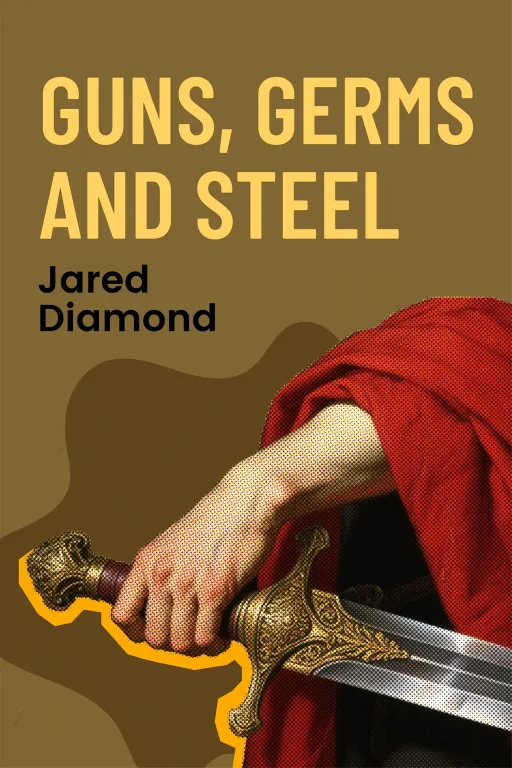
Nova: Exactly! And that’s what we're diving into today with the central theme of "The Unseen Architects." We're exploring how history's blueprint still shapes us. Our first major guide on this journey is a book that really shook up how we think about civilization: by Jared Diamond.
Atlas: Oh, I know that one by reputation. It’s a classic, widely acclaimed. But how did a physiologist, someone who studies the human body, end up writing such a groundbreaking book on world history? That’s a fascinating jump.
Nova: It’s incredibly interesting, Atlas. Diamond, with his background in biology and ecology, brought a totally fresh, scientific lens to historical inquiry. He wasn't looking at kings and battles, but at plants, animals, and geography. He was asking some civilizations developed advanced technology, writing, and complex societies, while others didn't, leading to vast inequalities we still see today. His approach was truly revolutionary, earning him a Pulitzer Prize, though it also sparked considerable debate about its implications.
The Environmental Blueprint: How Geography Shaped Destiny
SECTION
Atlas: A physiologist looking at history through the lens of biology and ecology… that sounds like the ultimate 'Scientist' approach to understanding human systems. So, what did he discover? What was this "environmental blueprint" he uncovered?
Nova: He proposed that the primary drivers weren't differences in human ingenuity or intelligence, but rather massive environmental factors. Think about the raw materials of civilization: domesticable plants and animals. Eurasia, for instance, had a massive head start. It was home to a disproportionate number of species suitable for domestication – wheat, barley, sheep, goats, cattle, pigs.
Atlas: Wow. So, the very foundation of agriculture and settled life, the things that allow societies to grow beyond hunter-gatherer bands, were simply more abundant in certain regions?
Nova: Precisely. Consider the Fertile Crescent, a cradle of civilization. It had wild ancestors of wheat and barley that were high-yield and easy to cultivate. It also had wild sheep and goats that could be domesticated for meat, milk, and wool. This gave early Eurasian societies a massive agricultural surplus.
Atlas: And a surplus means you can feed more people, specialize labor, develop writing, build cities… I see the cascading effect.
Nova: Absolutely. Now, contrast that with the Americas. They had maize, which was incredibly productive but took far longer to domesticate and spread effectively. And their large mammals? Very few were suitable for domestication. The llama was useful, but it couldn't pull a plow or carry a rider like a horse or ox.
Atlas: So, even with incredible human effort and ingenuity, the starting conditions were dramatically different. It’s like some teams started with a fully stocked workshop and others with just a few basic hand tools.
Nova: A perfect analogy, Atlas. And it wasn't just about what was available, but easily it could spread. Eurasia has a largely east-west axis. This means that crops and domesticated animals could travel vast distances along similar latitudes, experiencing similar climates and growing seasons. Wheat cultivated in the Middle East could easily spread to Europe or China.
Atlas: Ah, so the innovations could diffuse much faster. It's like a superhighway for agricultural ideas and technologies.
Nova: Exactly. Whereas the Americas have a dominant north-south axis. Moving a crop like maize from Mexico to the Andes meant crossing vastly different climate zones – deserts, mountains, tropical forests. This made the spread of agriculture and technologies incredibly slow and challenging.
Atlas: That’s a powerful point. It means innovations, even if they emerged, were often isolated. It really challenges the idea of inherent cultural superiority. For those of us who think about building resilient systems, it’s a stark reminder that the environment can be the ultimate system architect. But wait, Nova, doesn't this environmental determinism diminish human agency? It can sound like we're just puppets of geography.
Nova: That’s a common and important critique, Atlas. Diamond was very careful to emphasize that he wasn't claiming inherent racial or cultural superiority. He was showing how created advantages that allowed certain societies to develop technologies and immunities at a faster pace. Human ingenuity was still vital, but it operated within these environmental constraints. The argument is about the, not the inherent capability of the runners.
Atlas: I see. It's about understanding the deep, systemic biases embedded in the world from the very beginning. For anyone trying to build equitable systems today, ignoring that foundational blueprint would be a huge mistake.
The Interconnected Web: Trade, Culture, and the Global Flow
SECTION
Nova: And that naturally leads us to the second key idea we need to talk about, which often acts as a complementary layer to Diamond’s work. While geography set the stage, civilizations then interacted across those geographies is another critical, often overlooked, dimension. This is where by Peter Frankopan comes in.
Atlas: The Silk Roads. I picture caravans laden with spices and silks, ancient empires clashing. But Frankopan’s take is more than just a historical travelogue, isn't it?
Nova: Far more. Frankopan fundamentally shifts our historical gaze. He argues that for millennia, the true center of the world wasn't Europe, but the vibrant, interconnected heartland of Asia, stretching from the Mediterranean to China. The Silk Roads weren't just trade routes; they were arteries of cultural exchange, religious diffusion, and indeed, disease.
Atlas: That’s a radical re-centering for many of us, who grew up with a more Eurocentric view of history. It feels like flipping a map upside down and suddenly seeing an entirely different perspective.
Nova: It absolutely is. He shows how goods like silk and spices, but also ideas like Buddhism and Christianity, scientific knowledge, and even devastating plagues, traveled these routes, binding distant peoples together in a vast, invisible web.
Atlas: I'm curious, can you give an example of how these ancient routes had a profound, lasting impact? Something that vividly illustrates this "interconnected web"?
Nova: Certainly. One of the most stark and devastating examples is the Black Death. This horrific pandemic, which swept across Eurasia in the 14th century, didn't just appear out of nowhere in Europe. Its origins are traced back to Central Asia, likely carried by fleas on rats that hitched rides on merchant caravans and ships traveling the Silk Roads.
Atlas: So, the very same routes that brought prosperity and cultural exchange also became superhighways for death. That’s a sobering thought about interconnectedness.
Nova: It truly is. Imagine the bustling markets, the camel trains, the port cities along the routes. Each point of contact, each exchange of goods, also became a vector. The plague spread rapidly, decimating populations from China to the Middle East to Europe. It reshaped societies, economies, and even religious beliefs on a global scale. It wasn't just a European event; it was a global catastrophe facilitated by these ancient arteries of commerce.
Atlas: That’s a powerful illustration of how these historical flows are not just about positive connections. They also create vulnerabilities in our systems. For someone focused on human systems, it highlights the often-unforeseen consequences of vast networks. It makes me wonder, how does this "continuous flow" of history, as Frankopan puts it, still impact us today? What modern challenge can we trace back to these ancient interconnections?
Nova: Frankopan would argue that the very geopolitics of today – the energy routes, the strategic importance of Central Asia, the ongoing cultural dialogues and conflicts between East and West – are direct descendants of these ancient Silk Roads. The patterns of trade, influence, and even historical grievances were forged along these pathways centuries ago. What we see as new conflicts or alliances often have roots in these deep, continuous flows.
Atlas: That’s a great example. It's like the ghost of the Silk Roads still whispers in the halls of global power. It makes you realize that understanding the flow of history isn’t just an academic exercise; it’s essential for anyone trying to navigate or build in the modern world.
Synthesis & Takeaways
SECTION
Nova: Precisely, Atlas. When you combine Diamond's "environmental blueprint" with Frankopan's "interconnected web," you get a much richer, more profound understanding of history. You start to see how the initial geographic luck laid certain foundations, and then how the subsequent interactions, the flow of goods, ideas, and even pathogens, built upon and reshaped those foundations over millennia.
Atlas: It’s empowering, in a way. It helps us move beyond simplistic explanations for global disparities or current events. It helps us see the system, not just the individual players. For anyone driven by impact, understanding these deep structures is critical for building anything meaningful and sustainable. You can’t fix a system if you don’t understand its historical architecture.
Nova: Absolutely. It’s about cultivating a deeper, more holistic perspective. You can’t truly understand a current global challenge – be it economic inequality, geopolitical tension, or even public health disparities – without tracing its roots back through centuries of these unseen architectural forces. These books teach us that our present is not just a snapshot, but a living, breathing echo of a very long past.
Atlas: Wow, that’s actually really inspiring. It means we have the power to understand the forces at play, and with that understanding, to potentially design better futures. It’s about moving from a blind spot to profound insight.
Nova: That’s the goal. And it makes you wonder about your own perspective, doesn't it? What current global challenge have been viewing as new, that might actually be an echo from centuries past?
Atlas: That’s a fantastic question for our listeners to ponder.
Nova: This is Aibrary. Congratulations on your growth!