

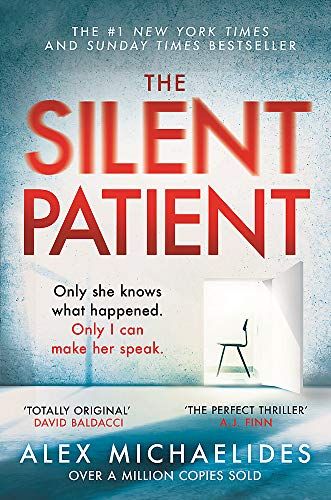
The Silent Patient
Introduction
Nova: "Alicia Berenson was thirty-three years old when she killed her husband." That is one of the most arresting opening lines in modern thriller fiction. And today, we are diving into the phenomenon behind those words: The Silent Patient by Alex Michaelides. I'm Nova.
Nova: And here's the thing — you've probably seen this book everywhere. Airport bookstores, bestseller tables, every BookTok recommendation list for the past several years. It debuted at number one on the New York Times bestseller list, which had never happened for a debut UK author before. It has sold over six and a half million copies worldwide. And there's a reason: this book gets its hooks into people.
Nova: So let's start from the top. Alicia Berenson is a celebrated painter in London, married to Gabriel, a successful fashion photographer. Their life looks picture-perfect. Then one night, Gabriel comes home, and Alicia shoots him five times in the face. She never speaks another word. Not at the trial. Not to the police. Not to anyone. For six years, she is the silent patient.
Nova: Enter Theo Faber, a forensic psychotherapist who becomes absolutely obsessed with her case. He gets himself hired at the Grove, the secure psychiatric facility where Alicia is being held, determined to be the one who finally gets her to talk. And what unfolds from there is one of the most talked-about psychological thrillers of the last decade. We're going to unpack the plot, the twist, the themes, the author's fascinating background, and why this book became such a global sensation.
A Murder, A Silence, and A Therapist Obsessed
The Setup and the Mystery
Nova: So let's really get into the architecture of this story. The novel is structured around two intertwined narratives. You have Theo's present-day account of treating Alicia at the Grove, and then you have Alicia's diary entries from the weeks leading up to the murder. And it's through this dual lens that the reader slowly pieces together what actually happened.
Nova: It's a smart structure because Alicia's diary gives us interior access to her — her fears, her suspicions, the sense that someone is watching her — while Theo's narration gives us what we think is the objective outside perspective. But here's the thing about Theo: he's got his own baggage. He grew up with an abusive father, he survived a suicidal depression thanks to therapy, and he's currently married to an American actress named Kathy, whom he's desperately in love with — and also deeply suspicious of. He's started following her, convinced she's having an affair.
Nova: Exactly. Theo is not a blank slate. He's bringing all of his own trauma into that therapy room. And Michaelides really draws on his own background here — he actually worked in a secure psychiatric unit for teenagers while studying psychotherapy. He told interviewers that he encountered people in the field who were supposedly eminent but lacked anything he recognized as empathy. So there's this fascinating ambivalence about the mental health profession baked into the novel.
Nova: And that ambivalence shows up in how the Grove is portrayed. You've got the wise, grandfatherly Diomedes who runs the unit, the nurturing therapist Indira, the stern manager Stephanie — but also Christian, the arrogant psychiatrist who was treating Alicia unofficially before the murder, which is a huge red flag. The place is full of people with their own agendas, their own blind spots. It's not a safe haven so much as another arena where power dynamics play out.
Nova: Right. And Theo's approach to Alicia is unconventional to say the least. He reduces her medications so she's less sedated. He brings her art supplies. He interviews her cousin, her brother-in-law, her former neighbor, her gallery owner. He's essentially playing detective, which is way outside the bounds of proper therapeutic practice. And the deeper he digs, the more he uncovers about Alicia's past — her mother's suicide, which happened with young Alicia in the car, and then her father's devastating words after the accident: that he wished Alicia had died instead of her mother.
Nova: That line is a bomb that goes off in the reader's mind. A father essentially killing his daughter psychologically. And Theo, when he discovers this, has a genuine therapeutic breakthrough. He brings it up with Alicia, and after six years of silence, she finally speaks. She says just one word at first: "Okay." Then later, she tells him her version of what happened the night Gabriel died — that a masked intruder tied them up and shot Gabriel. But here's where things get interesting. Theo doesn't believe her story. And neither does anyone else at the Grove.
Nova: And this is where the novel pivots from being a straightforward psychological mystery into something much more devious, because the reader at this point also doesn't quite know what to believe. We're trusting Theo because he's our narrator, our guide. But should we be?
Alcestis and the Power of Myth
The Greek Tragedy Connection
Nova: Before we get to the twist — and we will get there, I promise — I want to spend some time on something that sets this thriller apart from so many others: the Greek mythology thread running through the entire book. It's not just decoration. It's the skeleton.
Nova: So after Alicia kills Gabriel, before she goes to trial, she paints one last self-portrait. She titles it Alcestis. Now, Alcestis is a play by Euripides, one of the great Athenian tragedians. The story goes like this: King Admetus is told he's going to die, but Apollo gives him a loophole — if he can find someone willing to die in his place, he can live. Nobody volunteers. Not his elderly parents. Not his friends. The only person who steps up is his wife, Alcestis. She dies for him. He lets her. Eventually, Heracles shows up, wrestles Death, and brings Alcestis back from the underworld. She returns — but she never speaks again.
Nova: A wife sacrificed by her husband's cowardice, who comes back from death and remains silent. Sound familiar? Michaelides grew up in Cyprus, surrounded by Greek mythology. He's talked about how the Alcestis captivated him since childhood. And he's used it as a kind of interpretive key to the whole novel. Alicia is painting her own story before we even know what it is.
Nova: And here's what's really clever: throughout the book, different characters interpret Alcestis differently, and their interpretations reveal more about them than about Alicia. Diomedes sees it one way. Jean-Felix, the gallery owner, sees it another. And Theo — Theo sees in Alcestis what he wants to see. The novel literally does to the reader what the painting does to its viewers: it becomes a Rorschach test.
Nova: Michaelides has also cited Agatha Christie as a massive influence on the novel's structure, particularly her use of shifting perspectives where you reach the end and realize you've been looking at the whole thing the wrong way up. He mentioned Five Little Pigs and Death on the Nile specifically. And you can feel that Christie DNA — the carefully planted clues, the misdirection, the final reveal that forces you to reconsider everything.
Nova: But Michaelides is also doing something more literary than a standard whodunit. He's using the Greek tragedy framework to ask bigger questions about sacrifice, about silence as a form of power or protest, about what happens when the person who's supposed to love you most chooses themselves over you. That's the core wound of both Alcestis and Alicia.
Unreliable Narration and the Collapsing Timeline
The Twist That Changed Everything
Nova: All right. This is the chapter where we talk about the twist. If you haven't read the book and want to experience it fresh, pause this now. Because what Michaelides pulls off is genuinely audacious.
Nova: So here it is. Throughout the novel, Theo has been telling us about his dissolving marriage to Kathy, about following her, about watching her meet a dark-haired man in a park, about trailing that man to his house and seeing his wife through the window. We've been reading this alongside Theo's work with Alicia at the Grove. We assume these are parallel stories happening in the same timeframe. But they're not. Theo has been manipulating the timeline. The Kathy storyline — all of it — happened six years earlier, before Gabriel's murder. And the dark-haired man Kathy was having an affair with? That's Gabriel Berenson. Alicia's husband.
Nova: The wife Theo sees through the window? That's Alicia. Theo is the masked intruder. Theo is the one who tied Alicia and Gabriel up. Theo is the one who gave Gabriel that horrific choice: your life or hers. And Gabriel chose himself.
Nova: It's a staggering reversal. Everything you thought you knew about Theo — the caring therapist, the wounded healer trying to save Alicia — collapses. He wasn't at the Grove to help her. Not really. He was there because he felt guilty about triggering the chain of events that led her to kill her husband. And when Alicia finally speaks and tells him a slightly altered version of the murder night, he realizes she recognizes him. That's why he injects her with morphine, putting her in a coma. It's not Christian who tried to kill her — it's Theo. And he frames Christian for it.
Nova: And here's what makes it so effective structurally: the clues were there the whole time. Theo's occasional contradictions. His obsessive focus on Alicia. The way he interprets her silence as approval of his actions. His boundary-crossing behavior. On a second read, all of it snaps into place. Michaelides revised this manuscript about fifty times before publication, and you can feel that obsessive attention to the architecture.
Nova: But the most devastating detail is this: Alicia didn't just shoot Gabriel because he was cheating. She shot him because when he chose his own life over hers, it unlocked the deepest wound of her childhood — her father wishing she had died instead of her mother. Theo had no idea about that history. He just wanted to expose Gabriel as a coward. He had no idea his little morality play would end with someone dead.
Nova: The book ends with Alicia's hidden diary entry reaching the police, and Chief Inspector Allen showing up at Theo's door, reading Alicia's words back to him. And the final image — Theo catching a snowflake on his tongue as his world crumbles — is this haunting, ambiguous moment. Is it childlike wonder? Is it dissociation? Is it the cold finally catching up with him? Michaelides leaves it open.
Nova: It's an ending that has generated enormous debate among readers. Some find it brilliant — that "oh man, I should have guessed this" feeling. Others felt manipulated, arguing that an unreliable narrator who omits entire timelines is cheating rather than playing fair. But either way, people can't stop talking about it, and that's exactly what a thriller of this magnitude is supposed to do.
What the Novel Really Wants Us to Think About
Themes: Silence, Trauma, and the Therapist-Patient Relationship
Nova: Beyond the plot mechanics, The Silent Patient is genuinely interested in some heavy psychological terrain. And because Michaelides studied psychotherapy and worked in the field, he brings a certain insider credibility to it.
Nova: Let's start with silence itself. Alicia's silence isn't a passive absence of speech — it's an active choice. She's not mute; she's refusing. And that refusal is her power. Everyone around her — the media, the doctors, the other patients, Theo — they all project their own theories, their own fantasies, their own diagnoses onto her silence. She becomes whatever they need her to be: the dangerous femme fatale, the battered wife who snapped, the mysterious sphinx, the perfect patient, the impossible case. Theo literally describes her as a mirror in which people see only their own reflection.
Nova: And Michaelides is very deliberate about this. He said he wanted to explore how we impose meaning on silence, how uncomfortable we are with it, how desperate we are to fill it with our own interpretations. In a sense, the reader is implicated too. We also want Alicia to speak. We also want to solve her. And we trust Theo to help us do that — which makes the betrayal, when it comes, feel personal.
Nova: Then there's the theme of childhood trauma. Both Theo and Alicia are shaped by devastating early experiences. Alicia's mother's suicide, her father's rejection. Theo's abusive father, his own suicide attempt. The novel suggests that these wounds don't heal — they go underground and wait for the right trigger. For Alicia, that trigger was Gabriel choosing himself. For Theo, it's the terror of abandonment by Kathy that drives him to stalk, to invade, to try to control the narrative.
Nova: And neither character escapes. That's the tragic irony at the heart of the book. Theo has done years of therapy. He is a therapist. He knows all the theory. He can analyze his own patterns. And he still repeats them. He still can't stop himself from destroying everything. The novel is deeply skeptical about whether insight alone can save anyone.
Nova: Countertransference is another big concept woven throughout. That's the therapist's emotional reaction to the patient — when the therapist's own unresolved issues get tangled up with the patient's. Theo is constantly projecting onto Alicia, interpreting her silence as agreement with his decisions, seeing in her a version of himself. The professional boundaries dissolve entirely. And Michaelides, who left the field partly because of his disillusionment with certain practitioners, seems to be asking: is therapy a genuine path to healing, or just another arena where damaged people act out their pathologies on each other?
Nova: There's also a pointed critique here about how women's pain is handled — by the media, by institutions, by the men who want to save them or control them. Alicia is the object of everyone's gaze but rarely the subject of her own story. Until her diary. Until the final pages. And when her truth finally surfaces, it's too late — she's in a coma. The voice comes, but the person is gone.
Sales, Reception, and the Long Road to Hollywood
From Debut to Global Phenomenon
Nova: Let's talk about the sheer scale of what this book achieved. Alex Michaelides was a screenwriter before he wrote The Silent Patient. He'd worked on films, he'd felt frustrated watching his scripts get mangled in production. So he sat down to write the kind of book he'd want to read — and ended up creating a publishing juggernaut.
Nova: The numbers are staggering. The Silent Patient debuted at number one on the New York Times bestseller list — the first time a debut UK author had ever done that. It spent more than a year on that list. It has now sold over six and a half million copies worldwide and been translated into a record-breaking forty-nine countries. It won the Goodreads Choice Award for Mystery and Thriller in 2019. The audiobook, narrated by Louise Brealey and Jack Hawkins, has been a massive success in its own right.
Nova: Michaelides himself has a fascinating background. He's British-Cypriot, grew up on Cyprus surrounded by Greek mythology — which is where the Alcestis thread comes from. He studied English literature at Cambridge, then did postgraduate work in psychotherapy, then studied screenwriting at the American Film Institute. It's almost like he spent his life collecting the exact pieces he'd need to write this one novel.
Nova: The critical reception has been split in interesting ways. The Independent called the writing "scalpel-sharp and uncluttered." The Guardian praised the "skillful building of tension until the novel's shocking denouement." But the Washington Post, while calling the plot "fresh," critiqued what it called "hacky horror tropes" and "comically shifty red herring characters." Kirkus Reviews was harsher, calling it "clumsy, contrived, and silly" with a twist "savvy readers will see coming from a mile away." And on Reddit, the book has inspired passionate debates, with some readers finding the portrayal of female characters problematic and overly reliant on stereotypes.
Nova: But here's the thing about thrillers: critical nitpicking rarely matters if the reading experience is gripping. And Michaelides, drawing on his screenwriting background, knows how to pace. He cited Billy Wilder's advice — "any scene that doesn't have a plot point in it is a bad scene" — and applied it ruthlessly. The book moves. It's 323 pages that feel like 200. And for millions of readers, that propulsive quality overrides the flaws.
Nova: Then there's the movie adaptation saga. Back in March 2019, Annapurna Pictures and Brad Pitt's Plan B Entertainment optioned the film rights. These are the producers behind Moonlight and 12 Years a Slave — serious prestige players. But for seven years, nothing happened. Fans had basically given up. Then, in July of 2026, came the announcement: Sony Pictures joined the project alongside Annapurna and Plan B, and the adaptation is reportedly being fast-tracked. A director is expected to be attached soon. Michaelides posted about it on Instagram, calling it "a long wait."
Nova: It's actually kind of poetic that a book about silence and waiting — about a woman who refuses to speak for six years — itself had to wait in silence for its film adaptation. And given Michaelides's screenwriting background, the movie version could be something special. He understands both mediums.
Conclusion
Nova: So what makes The Silent Patient endure, years after its release, with millions of copies still moving and a film finally on the way? I think it's this: the book taps into something deeply unsettling about the people we trust. Our therapists. Our spouses. Our own narrating selves. It makes you question whose version of events you're accepting, and why.
Nova: The novel's central insight — that silence is not emptiness but a space we fill with our own projections — applies to the reading experience itself. We read thrillers hungry for answers, trusting the narrator to guide us. And when that trust is broken, it's not just a plot twist. It's a small betrayal. A reminder that stories are always told by someone, and that someone always has a stake in what you believe.
Nova: Alex Michaelides has gone on to write The Maidens and The Fury, building out a sort of shared universe of psychological suspense. But The Silent Patient remains his defining work — the book where his skills as screenwriter, psychology student, and Greek myth enthusiast all converged at exactly the right moment.
Nova: If you haven't read it, it's a quick, twisty ride that rewards close attention. If you have read it, it might be worth a second pass — now that you know what to look for. The clues are there, hiding in plain sight, just like Theo himself. This is Aibrary. Congratulations on your growth!