From Data Overload to Strategic Edge: Unlocking Sales Trends
Golden Hook & Introduction
SECTION
Nova: Did you know that despite drowning in more sales data than ever before, most businesses are actually confident in their strategic decisions? We're talking about a paradox where abundance creates scarcity.
Atlas: Whoa, that's a bit of a gut punch, but I can definitely see it. For leaders trying to carve out niche market domination, that feeling of being overwhelmed by numbers, yet still feeling blind? It's a real problem. What's going on here, Nova?
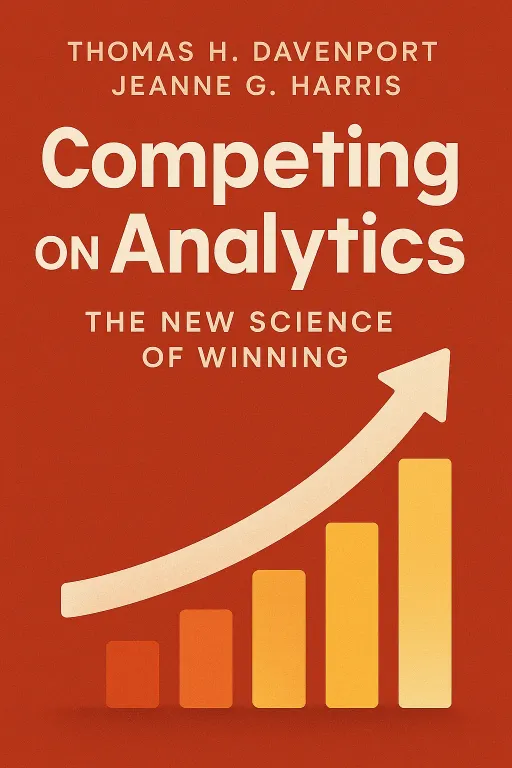
Nova: It is, Atlas. And it's precisely what we're tackling today. We're looking at how to transform that data overload into a definitive strategic edge. Our guide for part of this journey is the seminal work, "Competing on Analytics" by Thomas H. Davenport and Jeanne G. Harris. Davenport, for those unfamiliar, is a true pioneer. He's often credited with coining the very term "analytics" in a business context, making his work foundational for understanding how data, when wielded correctly, becomes a strategic weapon.
Atlas: That's a powerful legacy. So, this isn't just about collecting more data, it's about what you with it to actually compete?
Nova: Exactly. It's about moving beyond basic reporting and into a realm where data isn't just information, but a direct pathway to market leadership.
Leveraging Analytics for Strategic Competitive Edge
SECTION
Nova: Many companies are simply swimming in dashboards and spreadsheets, producing reports that only tell them what. But true analytic competitors, as Davenport and Harris illustrate, embed sophisticated analytical models into every strategic decision. They don't just ask 'what happened?' They ask 'what happen?' and 'what's the best way to make it happen?'
Atlas: Okay, so this sounds like a shift from being reactive to being profoundly proactive. But how does a company actually that? What does it look like on the ground for someone aiming for market leadership?
Nova: Let's paint a picture. Imagine a mid-sized B2B software company, we'll call them 'InnovateTech,' struggling in a crowded niche. Their sales team is hitting targets, but growth has plateaued. They're tracking leads, conversion rates, average deal size—all the usual suspects. But their competitors keep popping up with new features, seemingly anticipating market shifts. InnovateTech decides to become an analytic competitor.
Atlas: That's a relatable scenario. What's their first move? Just hire a bunch of data scientists?
Nova: Not just that. They start by deeply integrating their sales data—CRM, marketing automation, even customer service interactions—into a single, unified platform. Then, instead of merely reporting past quarter's sales, they start building predictive models. They analyze customer behavior patterns, identifying micro-segments most likely to churn it happens, and conversely, those most likely to upgrade.
Atlas: So they're not just looking at the rear-view mirror; they’re building a highly sophisticated GPS.
Nova: Precisely. Their sales team, instead of cold-calling based on broad demographics, now receives daily lists of high-propensity leads, based on predictive scores. Their marketing department can tailor campaigns to specific customer lifecycle stages, rather than blanket emails. They even start using sentiment analysis from support tickets to flag potential product issues before they escalate, feeding that back into product development.
Atlas: That's incredible. It sounds like they're not just selling; they're orchestrating an entire customer journey with data as the conductor. What was the outcome for InnovateTech?
Nova: Within 18 months, InnovateTech saw a 20% increase in customer retention, a 15% uplift in cross-sell revenue, and they were able to launch two highly successful new features, directly informed by their predictive analytics on emerging customer needs. They weren't just competing; they were setting the pace in their niche. They transformed from a company reacting to the market to one shaping it.
Atlas: That's a powerful transformation. For a strategic builder, the idea of turning data into that kind of sustained competitive advantage is gold. It’s not about having data, it's about having insights.
Nova: And that's the key. It's about embedding that analytical mindset into the very DNA of the organization, making data-driven decision-making a cultural standard, not an exception.
Distinguishing Signal from Noise in Sales Data
SECTION
Atlas: That makes perfect sense, Nova. But even with all that sophisticated analytics, data can still be incredibly misleading, right? I imagine a strategic leader could still drown in all that predictive power if they can't tell what's actually important.
Nova: You've hit on a crucial point, Atlas. That's where our second key insight comes in, from Nate Silver's brilliant book, "The Signal and the Noise." Silver, famous for accurately predicting everything from election outcomes to baseball statistics, dives deep into the art and science of prediction in a data-rich world. He teaches us how to distinguish meaningful signals from random noise.
Atlas: Oh, I like that. So, it's about cutting through the fog. How does a strategic builder apply that to, say, their sales pipeline or market trends?
Nova: Think of it like this: If you're trying to predict the weather, you have a massive amount of data—temperature, humidity, wind speed, pressure. But not all of it is equally important, and some variations are just random. A true signal is a pattern that reliably predicts an outcome; noise is everything else, the irrelevant fluctuations, the red herrings. In sales, this means understanding which trends are truly indicative of future growth or decline, and which are just temporary blips.
Atlas: Can you give an example? I imagine it's easy to get fooled by what like a trend.
Nova: Absolutely. Let's consider a company, 'GlobalGrow,' which had a sudden, unexpected spike in sales for a specific product line in a seemingly random region. Initial reports showed a 300% increase in a single month. The sales team was ecstatic, ready to reallocate resources, launch new marketing campaigns, and even consider opening a new regional office.
Atlas: That's the kind of news that gets everyone excited. The immediate instinct is to double down.
Nova: Exactly. But GlobalGrow's lead data analyst, applying Silver's principles, dug deeper. They looked at the of the sales, the of customer, and compared it to historical patterns. What they found was a single, very large, one-time government contract that skewed the entire month's data for that region. It was a massive sale, but it was in terms of predicting a sustainable, ongoing trend. It was an anomaly, not a signal of burgeoning organic demand.
Atlas: So, if they had reacted purely to the aggregate number, they would've poured resources into a false signal, chasing something that wasn't actually there for the long term. That’s a costly mistake.
Nova: Precisely. By correctly identifying that one-off contract as noise, GlobalGrow avoided misallocating millions in marketing and operational expansion. Instead, they celebrated the win, but then refocused their predictive models on the underlying, less dramatic but more sustainable growth trends. They understood that sometimes the most exciting data point is also the most misleading.
Atlas: That really highlights the need for a sharp analytical mind, as our user profile suggests. It's about trusting your instincts, but refining them with data, not letting data overwhelm them. What if a leader’s gut says one thing, but the data, even after filtering for noise, suggests another?
Nova: That's where Silver's approach also shines. He emphasizes embracing uncertainty and thinking probabilistically. It's rarely about absolute certainty. It's about understanding the of different outcomes. A leader's instinct becomes a valuable hypothesis to test against the data, rather than a definitive answer. It's about continually refining your mental models alongside your data models.
Synthesis & Takeaways
SECTION
Nova: So, what we're really talking about today, Atlas, is a two-pronged approach to turning data overload into a strategic advantage: first, actively leveraging analytics to build a competitive edge, as Davenport and Harris teach us, and second, having the wisdom and skill to distinguish true signals from all the noise, as Nate Silver so brilliantly articulates.
Atlas: It sounds like the ultimate recipe for niche market domination and building a resilient business culture. It’s about building, but building smart. For a leader who's all about strategic thinking and impact, what's a tiny, tangible step they can take this week to start applying these profound insights?
Nova: A fantastic question. Our tiny step for this week is incredibly simple, yet profoundly powerful: select just one sales metric you track daily. For the entire week, try to hypothesize it fluctuates you look at the underlying data.
Atlas: Oh, I love that! That forces you to engage your strategic mind, to think about cause and effect, to form your own predictions. It's like training your brain to look for signals, not just react to numbers.
Nova: Exactly. It builds that analytical muscle. It trains you to connect the dots, to consider external factors, internal processes, and customer behavior, before the data confirms or challenges your hypothesis. It's how you refine your instincts and become a true master of signal detection. True leadership in a data-rich world isn't about having data; it's about having insights and the courage to act on them for lasting impact.
Atlas: That's a perfect call to action for anyone looking to transform their data into a strategic superpower. Nova, this has been incredibly insightful.
Nova: Always a pleasure, Atlas.
Nova: This is Aibrary. Congratulations on your growth!