

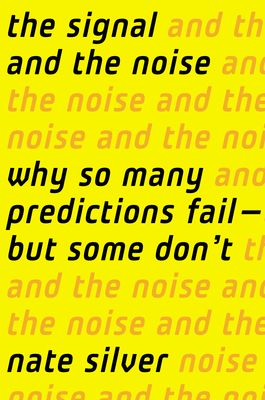
The Signal and the Noise
Introduction: The Prediction Epidemic
Introduction: The Prediction Epidemic
Nova: Welcome to Aibrary, the show where we distill the world's most complex ideas into actionable insight. Today, we are diving into a book that fundamentally changed how we look at the future: Nate Silver's 2012 masterpiece, The Signal and the Noise.
Nova: : That title alone is provocative, Nova. It suggests that everything we consume—every news report, every stock tip, every weather forecast—is mostly garbage. Is that the premise?
Nova: Exactly. Silver posits that we live in an age of data abundance, but this abundance is a double-edged sword. He argues that the vast majority of what we see is 'noise'—random fluctuations, irrelevant details, or outright error. The 'signal' is the underlying truth, the predictable pattern. And the central problem is that we are terrible at telling the difference.
Nova: : So, this isn't just about political polling, which is what Silver is famous for, right? He’s talking about everything from baseball to earthquakes.
Nova: Absolutely. He covers a staggering range: baseball’s Moneyball revolution, the 2008 financial collapse, poker strategy, climate modeling, and even terrorist attacks. The book asks a profound question: Why do some predictions succeed spectacularly while others, often from experts, fail miserably? And more importantly, how can we become better at forecasting our own lives?
Nova: : I’m already hooked. If we can learn to filter out the noise, we can make better decisions everywhere. Let's start with the basics. What exactly is this 'noise' that’s drowning out the truth?
Key Insight 1: More Data Does Not Equal More Certainty
The Data Deluge: Defining Signal vs. Noise
Nova: Silver’s foundational concept is beautifully simple: The signal is the truth, and the noise is everything else. But here’s the kicker he emphasizes: as the amount of data increases, the amount of noise often increases than the signal.
Nova: : That feels counterintuitive. I always thought more data meant more certainty. If I have a thousand data points instead of ten, I should be closer to the truth, shouldn't I?
Nova: In theory, yes. But in practice, especially in complex systems, those extra 990 data points might just be random variations or measurement errors. Think about trying to predict a single coin flip. You can flip it a million times, but the next flip is still 50/50. The historical data, while technically 'signal,' doesn't help you predict the instance if the system is inherently random or chaotic.
Nova: : That makes sense when you think about something like stock market day trading. Everyone is looking at minute-by-minute fluctuations, which are almost pure noise, hoping to spot a trend that isn't there.
Nova: Precisely. Silver points out that in many domains, like weather forecasting, the signal-to-noise ratio is actually improving because our models get better. But in domains like economics or predicting human behavior, the noise floor is incredibly high. He cites an example where a massive influx of data about a phenomenon might just reveal more ways the phenomenon behave predictably.
Nova: : So, the first step to better prediction is recognizing that the data you have might be misleading you into false confidence. It's about skepticism toward volume.
Nova: It is. And this leads directly to the second major theme: how do we process this messy data? Silver argues that the best forecasters don't just collect data; they use a specific mathematical framework to update their beliefs. They are, fundamentally, Bayesians.
Nova: : Ah, the famous Bayes' Theorem. I remember hearing about that in college, and it felt like abstract math. How does Silver make this relevant to, say, predicting the outcome of a baseball game?
Nova: He translates it from abstract math into a practical mindset. Bayes' Theorem is essentially a formal way of saying: Start with what you already believe—your 'prior' probability—and then rationally adjust that belief based on the new evidence you receive. It’s about structured learning.
Nova: : So, if I think a pitcher has a 60% chance of winning based on his season stats, that’s my prior. If he then gives up three runs in the first inning, Bayes’ Theorem tells me I should lower that 60% estimate, rather than just throwing out the whole prediction and guessing wildly.
Nova: That’s the essence of it! It forces you to quantify your uncertainty. A bad forecaster might say, 'He’s going to lose,' when the evidence comes in. A good forecaster, using a Bayesian approach, says, 'My confidence in his win has dropped from 60% to 35%, but I still assign a 35% probability to that outcome.' They never go to 0% or 100% certainty unless the evidence is absolute.
Nova: : That’s a huge difference. It means good predictions are always expressed as ranges, not single points. It’s about probability distributions, not definitive statements. It sounds like Silver is advocating for a permanent state of intellectual humility.
Nova: You’ve hit on the critical link. Bayesian thinking is the, but intellectual humility is the required to use the tool correctly. If you are overconfident in your prior belief, you won't adjust it enough when new evidence arrives. You’ll dismiss the signal as noise, or worse, you’ll see the noise as a signal confirming your bias.
Nova: : Let’s explore that mindset. Because I think that’s where most people—and most experts—fall down. They get attached to their initial model or their initial opinion. What does Silver say about the psychology of overconfidence?
Key Insight 2: Overconfidence is the Greatest Predictor of Failure
The Prediction Paradox: Humility as a Superpower
Nova: Silver dedicates significant space to the human tendency toward hubris. He found that the best predictors—the ones who consistently beat the odds in elections or sports—were often the ones who expressed the confidence in their own forecasts.
Nova: : That’s the prediction paradox you mentioned earlier, right? The more humble you are, the better you perform. Why is that?
Nova: Because overconfidence blinds you to the noise. If you are 95% sure of your prediction, you are likely ignoring legitimate counter-evidence that would push you down to 80% or 70%. You are treating the noise as irrelevant, when in fact, that noise might be the first sign that your initial model is flawed.
Nova: : It’s like driving in fog. If you think visibility is perfect, you drive fast. If you acknowledge the fog—the uncertainty—you slow down and pay closer attention to the faint outlines you can barely make out. Those faint outlines are the true signal.
Nova: That’s a fantastic analogy. Silver contrasts the professional forecasters—the ones who track their historical accuracy, who use Bayesian methods, and who are comfortable saying, 'I’m 65% sure'—with the amateurs or the pundits who always claim 90% certainty. The professionals are calibrating their confidence to reality.
Nova: : I wonder if this applies to fields where the stakes are highest, like the 2008 financial crisis, which he covers. Were the people predicting the collapse humble, or were they the most overconfident?
Nova: They were largely overconfident, or perhaps worse, they were operating with models that fundamentally excluded the possibility of a systemic collapse. Their models were based on historical data that didn't account for the specific, unprecedented level of interconnected risk. They saw the warning signs—the noise in the subprime market—but their models told them it was an outlier, not a signal of impending doom.
Nova: : So, the model itself became the source of noise, because it was too rigid to adapt to new, extreme conditions. It couldn't update its priors effectively.
Nova: Exactly. And this is where Silver draws a line between different types of prediction problems. He categorizes them based on how dynamic and 'out-of-sample' they are. A problem is hard to predict if it involves a dynamic system where the rules change, or if it’s an event that has never happened before in the historical record.
Nova: : Give me an example of a hard one versus an easy one, according to Silver.
Nova: An easier one, relatively speaking, is predicting the outcome of a known system, like the trajectory of a baseball pitch, or even the outcome of a major election where the underlying political landscape is relatively stable. We have decades of trackable data. A harder one is predicting a major earthquake or the next technological breakthrough. These are 'out-of-sample' events—we have no historical data to base a prior on, so we rely more on theory, which is often weak.
Nova: : That distinction is crucial. It means we shouldn't expect the same level of accuracy from a climate scientist predicting sea-level rise in 2100 as we do from a meteorologist predicting rain tomorrow.
Nova: Precisely. And the best forecasters know this boundary. They know when to stop predicting and start managing risk. They understand that when the system is highly complex, like the global economy, the best prediction might just be a very wide confidence interval, acknowledging the massive amount of noise we cannot filter out.
Nova: : It sounds like Silver is giving us permission to be less certain, which is strangely liberating. If we accept that we can only be 70% sure, we stop wasting energy trying to achieve 100% certainty and start focusing on what to do if we are wrong.
Key Insight 3: Applying Bayesian Thinking Across Diverse Fields
The Laboratories of Prediction: From Baseball to Black Swans
Nova: Let's look at the case studies that really bring this theory to life. Silver starts with baseball, which is the poster child for data-driven analysis, thanks to the Moneyball movement.
Nova: : Right, where they realized traditional scouting metrics were noise, and things like on-base percentage were the true signal for run production. It’s a perfect, contained system for learning Bayesian principles.
Nova: It is. But Silver shows how the principles extend far beyond batting averages. Take weather forecasting. He notes that weather prediction has improved dramatically, moving from 24-hour forecasts being decent to 7-day forecasts being quite reliable. This is because the physics of the atmosphere, while complex, are relatively consistent.
Nova: : So, weather is a domain where the signal is strong and getting stronger due to better models and more sensor data. What about the opposite end of the spectrum?
Nova: The opposite end is where the human element dominates, like poker or political polling. In poker, Silver notes that while the rules are fixed, the opponent's psychology introduces massive, unpredictable noise. A great poker player isn't just calculating odds; they are constantly updating their Bayesian prior on what their opponent they know.
Nova: : And political polling, his bread and butter. He famously nailed the 2012 election. What was his secret sauce there, beyond just having a good model?
Nova: It was his rigorous application of Bayesian weighting. He didn't just take the average of all polls. He weighted polls based on their historical accuracy, their methodology, and how often they had been wrong in the past. If a polling firm consistently over-predicted one party, Silver's model automatically lowered that firm's weight in the final calculation. He was treating the pollsters themselves as data points to be filtered.
Nova: : That’s brilliant. He wasn't just analyzing the electorate; he was analyzing the of the electorate. That’s filtering the noise at the meta-level.
Nova: Exactly. But he also showed where prediction breaks down, particularly in areas like predicting the timing of major financial crises or, more tragically, terrorist attacks. In these cases, the events are so rare—the signal is almost non-existent in the historical record—that any prediction is essentially a guess based on weak theory.
Nova: : He’s essentially saying that for truly rare, high-impact events, we should focus less on predicting they will happen, and more on building resilient systems that can withstand them they do happen. That shifts the focus from prediction to preparation.
Nova: That’s the ultimate takeaway from the case studies. When the system is too complex or the data too sparse, the best use of our predictive energy is to build robustness. It’s a shift from 'What will happen?' to 'What should we do regardless of what happens?'
Nova: : It’s a very mature way to approach uncertainty. It moves beyond the ego of being right and focuses on the utility of being prepared. This whole framework seems to demand a complete overhaul of how we consume information daily.
Key Insight 4: Actionable Steps for Filtering Your World
The Path Forward: Becoming a Better Forecaster
Nova: So, we’ve established the theory: Signal over noise, Bayesian updating, and humility. For our listeners who want to stop being victims of the noise, what are the three most actionable takeaways from Silver’s work?
Nova: : I think the first one has to be about feedback loops. If you’re not tracking your past predictions, you can’t calibrate your future confidence. How do we build that feedback mechanism into our daily decision-making?
Nova: You have to keep score. If you make a prediction—whether it’s about a work project deadline, a market movement, or even a personal goal—write down your prediction your confidence level. Then, when the outcome is known, go back and score yourself. Did you say 70% likely, and it happened 7 out of 10 times? If so, you’re calibrated. If you said 90% likely and it only happened 50% of the time, you need to dial back the hubris.
Nova: : That’s powerful. It turns every decision into a mini-experiment. What’s the second step? I suspect it involves questioning the source.
Nova: It does. Always ask: What is the source’s track record? Silver is ruthless about this. If a pundit or analyst has a history of being wrong, their current prediction should be given very little weight, regardless of how confidently they state it. You must discount the noise generated by biased or inaccurate sources.
Nova: : So, we need to be our own personal fact-checkers, but also our own personal prediction auditors. What about the third step? I feel like it has to circle back to that core concept of noise.
Nova: The third step is to actively seek out the counter-argument. If you are leaning toward a conclusion, actively search for the best evidence your conclusion. This forces you to test your prior belief against the strongest possible noise. It’s the intellectual equivalent of stress-testing a bridge before you drive over it.
Nova: : That’s the Bayesian process in action—forcing yourself to confront the evidence that would make you change your mind. It prevents you from building a comfortable echo chamber of confirmation bias.
Nova: Exactly. And Silver shows that the best predictors are those who are constantly trying to their own models. They are not trying to prove themselves right; they are trying to find the flaw before the real world does.
Nova: : It’s a paradigm shift. We move from trying to the future to trying to about the future. It makes the world feel less deterministic and more manageable, even if it’s still messy.
Nova: That’s the beauty of it. The book doesn't promise perfect foresight. It promises a better framework for navigating uncertainty. It teaches us that the goal isn't to eliminate the noise—that’s impossible—but to develop the discipline to hear the signal loud and clear when it finally breaks through.
Conclusion: Living in the Probabilistic World
Conclusion: Living in the Probabilistic World
Nova: We’ve covered a lot of ground today, moving from the abstract definition of signal and noise to the practical application of Bayes' Theorem in everything from sports to finance.
Nova: : The key takeaway for me is the necessity of intellectual humility. Silver proves that the most successful people in prediction are the ones who are most comfortable saying, 'I don't know for sure, but here is the probability.' It’s a powerful antidote to the certainty we see everywhere in modern media.
Nova: Absolutely. Remember the core lessons: First, be skeptical of data volume; more data often means more noise. Second, think probabilistically using Bayesian logic—always update your beliefs when new evidence arrives. Third, track your own performance to calibrate your confidence. And finally, actively seek out the arguments that contradict your current view.
Nova: : It’s a toolkit for critical thinking in an age of information overload. It empowers us to be less reactive and more reflective in our decision-making, whether we're choosing an investment or just deciding whether to trust a headline.
Nova: The world is inherently noisy, full of chaos and randomness. But by adopting the mindset of a disciplined forecaster, we can stop being overwhelmed by that chaos and start making small, rational steps toward a better future. It’s about making the best possible bet with the information you have, knowing you might be wrong, but being ready to adjust when the next piece of signal arrives.
Nova: : A fantastic deep dive into a truly essential book. Thank you for guiding us through the signal and the noise today.
Nova: My pleasure. This is Aibrary. Congratulations on your growth!